
The trucking industry is the lifeblood of the American economy, responsible for moving roughly 70% of the nation’s freight by weight.
Yet behind the romanticized image of the open road and the freedom of the highway lies a profession that exacts a heavy toll on those who choose it.
For anyone considering this career, the question “how hard is it to be a truck driver?” deserves an honest, unvarnished answer.
The reality is that truck driving is one of the most physically, mentally, and emotionally demanding occupations in the country, with challenges that drive nearly 90% of new drivers away within their first year.
The Physical Toll: More Than Just Sitting
On the surface, truck driving might appear to be a sedentary job that requires little more than staying awake and steering.
In reality, the physical demands are severe and well-documented.
According to the CDC, truck drivers have significantly higher rates of heart disease, diabetes, hypertension, and obesity compared to the general U.S. working population.
This is not coincidental it’s a direct consequence of the job’s structure.
Long-haul drivers are legally permitted to drive up to 11 hours within a 14-hour on-duty window, followed by a mandatory 10-hour break.
Yet many work even longer hours; one study found that 61.5% of truck drivers work over 10 hours a day.
The combination of prolonged sitting, limited opportunities for exercise, and poor access to nutritious food creates a perfect storm for chronic health problems.
Truck stops, the primary food source on the road, rarely offer healthy options, and exercise facilities are virtually nonexistent.
Musculoskeletal disorders are rampant. A 2024 study published in the Brazilian Journal of Occupational Therapy found that 72.9% of truck drivers had experienced musculoskeletal symptoms in the past year, with lower back, neck, and shoulder injuries being most common.
The constant vibration of the truck, combined with hours of sitting in the same position, takes a cumulative toll that few other professions can match.
When considering how hard is it to be a truck driver from a purely physical standpoint, the evidence is clear: the job accelerates wear and tear on the body in ways that shorten careers and, in many cases, shorten lives.
The Mental Health Crisis on the Road
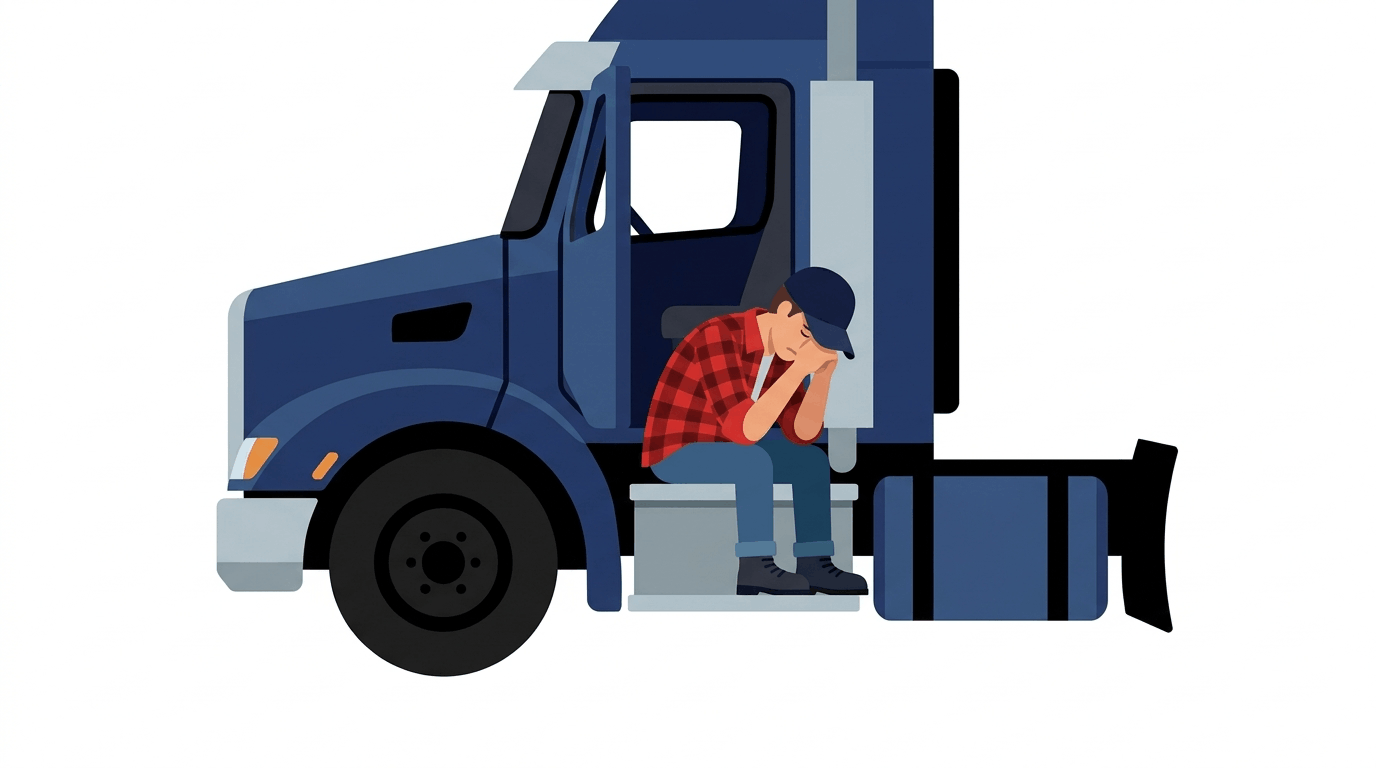
If the physical challenges are daunting, the mental health burden is perhaps even more alarming. Truck driving is one of the most isolating professions in existence.
Drivers spend days or even weeks alone in the cab of a truck, with limited human interaction beyond brief exchanges at loading docks and truck stops.
The statistics paint a grim picture. Surveys have found that nearly 28% of truckers report suffering from loneliness, 27% report depression, 21% experience chronic sleep disturbances, and 14.5% struggle with anxiety.
Some studies suggest that as many as 44% of professional drivers suffer from depression. Perhaps most sobering, truck drivers have a suicide rate that is 20% higher than the national average.
The causes are deeply intertwined with the nature of the work.
Irregular schedules disrupt natural sleep patterns, isolation from family and friends erodes social support networks, and the constant pressure of tight delivery windows creates unrelenting stress.
As one industry expert put it, drivers “miss birthdays, holidays, all the small things that connect you to your family, even to your community”.
The psychological toll of missing life’s milestones while staring at endless miles of highway is difficult to overstate.
This is perhaps the most profound answer to the question how hard is it to be a truck driver: it’s a job that can slowly erode your mental health, leaving you isolated, exhausted, and disconnected from the people and places you love.
The Lifestyle: Freedom or Prison?
Many people are drawn to truck driving by the promise of freedom and the chance to see the country.
And indeed, there is a certain appeal to the independence of life on the road. But that freedom comes with a steep price.
Long-haul drivers typically spend weeks away from home at a time.
They sleep in their trucks, eat at truck stops, and shower at facilities that range from adequate to appalling.
The average long-haul driver logs 120,000 to 130,000 miles per year that’s roughly five times around the Earth.
And for all that time on the road, the compensation can be disappointing.
While average annual earnings for over-the-road drivers are around $72,000, with top earners making upwards of $83,000, wages have not kept pace with inflation.
Driver compensation increased just 2.4% while inflation ran higher, meaning drivers’ real purchasing power has declined.
The pay structure itself creates additional stress. Most long-haul drivers are paid by the mile or by the load, meaning they are not compensated for the countless hours spent waiting at loading docks, stuck in traffic, or performing non-driving duties. A study commissioned by FinditParts found that 81% of drivers cited unpredictable pay as a reason for seeking alternative employment.
When you add in the nationwide shortage of safe truck parking which forces drivers to hunt for spots late at night, often parking in unsafe or illegal locations it becomes clear that the romanticized “freedom of the road” is often more constraint than liberation.
Why Drivers Leave: The Turnover Problem
Perhaps the most telling indicator of how hard is it to be a truck driver is the industry’s staggering turnover rate. Large carriers regularly experience driver turnover of 90% or higher.
As one industry leader put it, “When you have a 90% turnover rate, you don’t have a shortage” the problem isn’t finding drivers, it’s keeping them.
The reasons drivers leave are numerous and interconnected: low pay that doesn’t reflect the hours worked, time away from family, poor working conditions, lack of restroom access at shipper facilities, and the cumulative physical and mental toll of the job.
The industry has been described as having “unchangeable structural and cultural truths that discourage truckers’ aspirations”.
Is It Worth It?
For all its challenges, truck driving does offer genuine advantages.
The barriers to entry are relatively low no four-year degree is required, and CDL training can be completed in weeks rather than years.
Job security is strong, with the Bureau of Labor Statistics projecting about 237,600 openings for heavy and tractor-trailer truck drivers each year through 2034.
And for those who can endure the lifestyle, there is a path to advancement, whether through specialized freight, owner-operator status, or transitioning to local routes that offer more home time.
But the honest answer to how hard is it to be a truck driver is this: it is one of the hardest blue-collar jobs in America.
It demands physical endurance, mental fortitude, and a willingness to sacrifice family time, health, and personal connections.
The drivers who succeed are those who find ways to manage these challenges—staying connected with loved ones, prioritizing exercise and nutrition when possible, and advocating for better conditions within the industry.
The trucking industry is at a crossroads. With an aging workforce and a generation of younger workers increasingly unwilling to accept the sacrifices the job demands, meaningful change is necessary. Improvements in pay structures, better access to healthcare and mental health support, expanded truck parking, and more reasonable schedules could make the profession sustainable for the long term.
Until then, the men and women who keep America’s supply chains moving deserve recognition not just for the essential work they do, but for the immense personal cost they bear to do it. The open road, it turns out, is not nearly as open as it appears.
Ready to stop dreaming and start driving?
Fill out the form and a Remms recruiter will reach out within one business day. No spam, no pressure — just real results.
Submit Driver Profile