
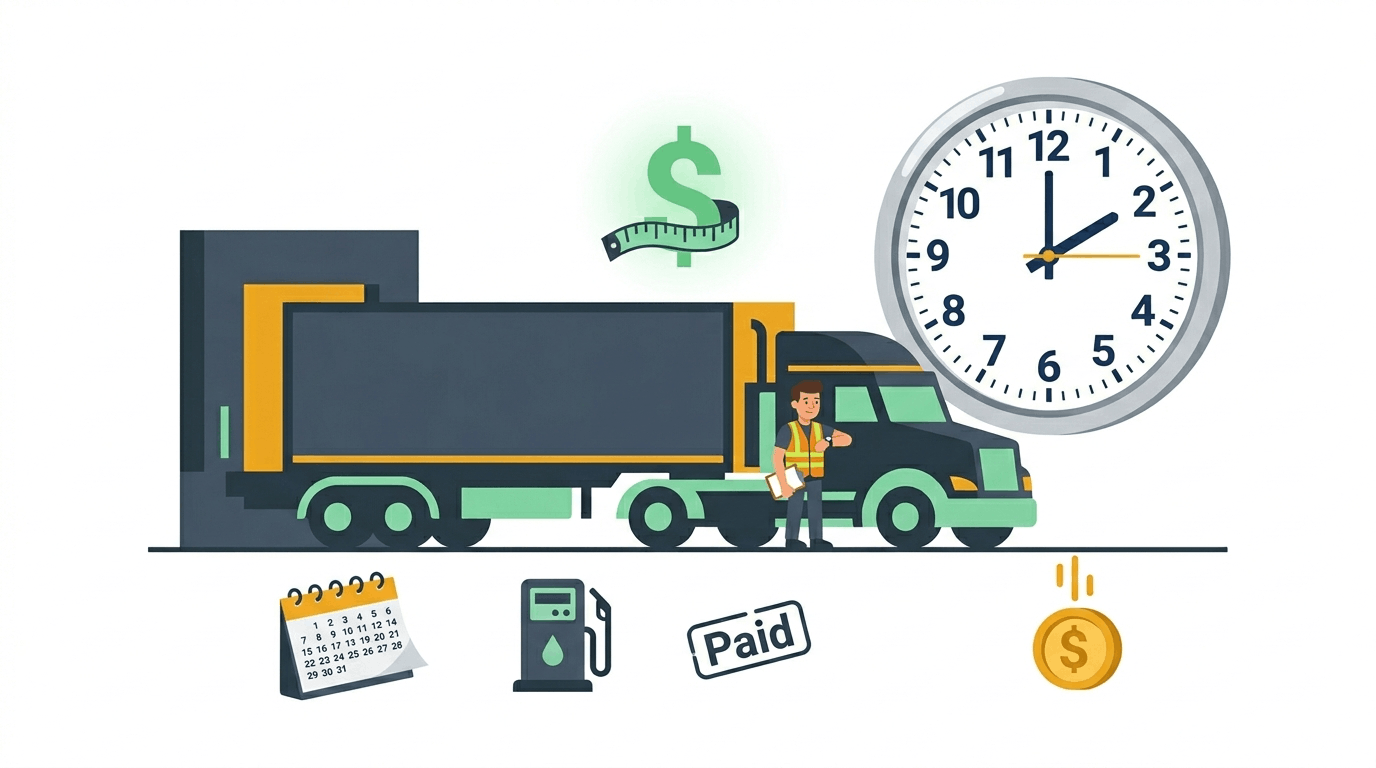
Detention pay is one of the most misunderstood and most important concepts in the trucking industry. For drivers who are paid by the mile, every hour spent waiting at a loading dock is an hour of lost income.
Detention pay exists to recover at least some of that lost revenue.
In short: detention pay is compensation truck drivers receive when they are forced to wait beyond an agreed-upon “free time” period at a shipper or receiver’s facility for loading or unloading.
To fully understand what is detention pay in trucking, you need to know how the clock starts, what qualifies as a delay, and most criticallyhow to actually collect what you are owed.
How Detention Pay Works
At its core, what is detention pay in trucking? It is compensation triggered when a driver arrives on time for a scheduled appointment but the shipper or receiver fails to load or unload the truck within the allotted window.
The Standard Grace Period
The trucking industry standard is a 2-hour grace period (also called “free time”) before detention pay kicks in. This means the first two hours of waiting are not compensated. Any time beyond that is billable detention.
Example: You arrive at 8:00 AM for a scheduled appointment. You aren’t loaded until 12:00 PM. That’s 4 hours total on-site. Subtract the 2-hour grace period, and you have 2 hours of billable detention.
When the Clock Starts
The detention clock typically starts at your appointment time (or your check-in time, whichever is later) not when you arrive early. If you show up an hour before your appointment, that early hour does not count toward detention.
What Qualifies as Detention
To qualify for detention pay, several conditions must be met:
- You arrived on time (or within the grace period) with a confirmed appointment
- The load is live (not drop-and-hook)
- The facility caused the delay beyond the free time
- You checked in properly and stayed available to move the truck when called
- The delay was not caused by you (late arrival, missing paperwork, overweight corrections, etc.)
Detention Pay Rates: What to Expect
When asking what is detention pay in trucking, the rate is often the next question. Detention pay rates vary widely depending on the carrier, broker, lane, and contract terms. Here are the typical ranges:
| Driver/Cargo Type | Low End | High End | Typical Rate |
|---|---|---|---|
| Company Driver | $25/hr | $50/hr | $35/hr |
| Owner-Operator | $50/hr | $100/hr | $75/hr |
| Reefer/Specialized | $75/hr | $125/hr | $100/hr |
Most industry sources report average detention rates between $50 and $75 per hour. Some brokers pay as low as $25/hour, while others may pay up to $100/hour depending on the lane and cargo.
Detention is typically billed in hourly increments, though some contracts specify 15-minute or 30-minute increments.
How to Calculate Detention Pay
Calculating what is detention pay in trucking in dollar terms is straightforward once you understand the formula:
Detention Pay = (Total Time on Site − Free Time) × Hourly Detention Rate
Example: You have a 9:00 AM appointment. You check in at 9:00 AM and depart at 2:30 PM that’s 5.5 hours on-site. With 2 hours of free time, you have 3.5 hours of billable detention. At a rate of $50/hour, you are owed $175 in detention pay.
The True Cost of Detention
Even if you collect detention pay, it rarely covers the full cost of the delay. At a typical operating cost of $60–$80 per hour (including truck payment, insurance, and lost revenue), a 4-hour detention event costs the driver $240–$320 in real terms whether or not they collect detention pay.
According to the American Transportation Research Institute (ATRI), the trucking industry loses $15.1 billion annually to detention $11.5 billion in lost productivity and $3.6 billion in direct expenses. Individual drivers lose an estimated $11,000 to $19,000 per year to uncompensated detention time.
Detention Pay vs. Layover Pay: What’s the Difference?
Detention pay and layover pay are often confused, but they cover entirely different situations. Understanding what is detention pay in trucking versus layover pay helps you invoice correctly:
| Feature | Detention Pay | Layover Pay |
|---|---|---|
| What It Covers | Short delays (hours) at a facility | Extended delays (full days) |
| Typical Trigger | After 2 hours of free time | After 24 hours from appointment |
| Rate Structure | $50–$100 per hour | $150–$350 per day |
| Where It Happens | At the dock waiting to be loaded/unloaded | Anywhere facility closed, rescheduled, etc. |
| Billed As | Hourly after free time expires | Daily flat rate |
The rule of thumb: Detention = hours at the dock. Layover = days away from the road.
If you’re waiting at a facility for the afternoon, that’s detention. If you’re parked overnight because they rescheduled to tomorrow, that’s layover.
Detention vs. Demurrage: Another Common Confusion
While sometimes used interchangeably, detention and demurrage are distinct concepts:
- Detention fees are charged when a driver is detained at a shipper or receiver beyond the agreed-upon appointment time.
- Demurrage fees are associated with ocean freight and long-distance shipping charged when import containers or ocean freight arrive at container yards and are not picked up within the free time.
FMCSA Regulations: Is Detention Pay Required by Law?
Currently, there are no federal regulations mandating detention pay. However, the FMCSA has been studying the issue for years, and reforms may be on the horizon.
What’s Happening in 2026
- The FMCSA is conducting a study on driver compensation, including detention pay, as mandated by a 2021 infrastructure law.
- The agency has proposed a two-pronged approach: setting a mandatory minimum detention time rate that brokers must pay.
- Several commenters have suggested the FMCSA should require $100 per hour for detention time after two hours of free time.
While no regulations exist yet, the pressure for reform continues to grow. In the meantime, detention pay is entirely a matter of contract negotiation.
How to Actually Get Paid for Detention
Knowing what is detention pay in trucking is useless if you cannot collect it. Getting detention pay isn’t automatic you have to document everything and follow the right process. Here’s how:
1. Get It in Writing Before You Roll
The time to negotiate detention is before you accept the load. Make sure your rate confirmation includes:
- The free-time allowance (typically 2 hours)
- Your detention rate
- How it accrues (hourly, 15-minute increments, etc.)
- The documentation required
2. Document Everything at the Facility
- Get in and out times stamped on the Bill of Lading (BOL) or Proof of Delivery (POD)
- Take time-stamped photos of the check-in screen or dock door
- Keep ELD/HOS logs showing geofenced on-site time
- Save dispatch notes and call logs with names, times, and what was said
3. Notify the Broker Before Detention Starts
Most brokers require notification 30 minutes before detention begins. Send a time-stamped message at the 90-minute mark:
“We’re approaching the 2-hour free time; please note we’ll start detention at [time] if not loaded.”
Then follow up at the 2-hour mark confirming detention has started.
4. Submit Your Claim Promptly
Submit your detention invoice with all supporting documentation within the broker’s billing window often 24 to 48 hours.
5. Follow Up
One email usually isn’t enough. Follow up daily if needed, politely reminding the broker of the situation.
Why Detention Pay Matters
Understanding what is detention pay in trucking is crucial for the financial sustainability of the entire industry not just for individual drivers.
For Drivers
Drivers are paid by the mile, not by the hour. Every hour spent waiting is an hour not earning miles. Detention also counts against your Hours of Service (HOS) clock a 5-hour wait means 5 fewer hours available to drive and earn revenue that day.
For Carriers
Prolonged detention lowers operational efficiency, disrupts schedules, and forces adjustments that ripple through supply chains. It also contributes to driver turnover, as unpaid waiting time is one of the biggest complaints in the industry.
For the Industry
ATRI research found that 39.3% of deliveries involve detention, and the FMCSA has reported that drivers lose between $1.1 and $1.3 billion in wages per year due to detention time. Perhaps most concerning: less than 50% of detention invoices are actually paid.
Final Thoughts
So, to recap, what is detention pay in trucking?
It is an accessorial charge that compensates truck drivers for time spent waiting beyond the standard 2-hour grace period at shipper or receiver facilities. Rates typically range from $25 to $100 per hour, with owner-operators commanding higher rates than company drivers.
While no federal law currently mandates detention pay, the FMCSA is actively studying the issue, and industry pressure for reform continues to build. In the meantime, your best protection is a clear, written contract and meticulous documentation.
Remember: If you don’t ask for detention pay, you won’t get it. If you don’t document it, you can’t prove it. And if you don’t follow up, you won’t collect it.
Ready to stop dreaming and start driving?
Fill out the form and a Remms recruiter will reach out within one business day. No spam, no pressure — just real results.
Submit Driver Profile