
Disclaimer: This article is for informational purposes only and does not constitute legal advice. Compensation practices vary by carrier, and drivers should always review their specific employment agreements and rate confirmations. For legal questions regarding unpaid wages, consult a qualified attorney.
If you’ve ever delivered to one location, only to be told you need to make two more stops before your day is done and wondered if you’re getting paid fairly for it you’re not alone.
Thousands of truckers search for what is stop pay in trucking every month, and for good reason.
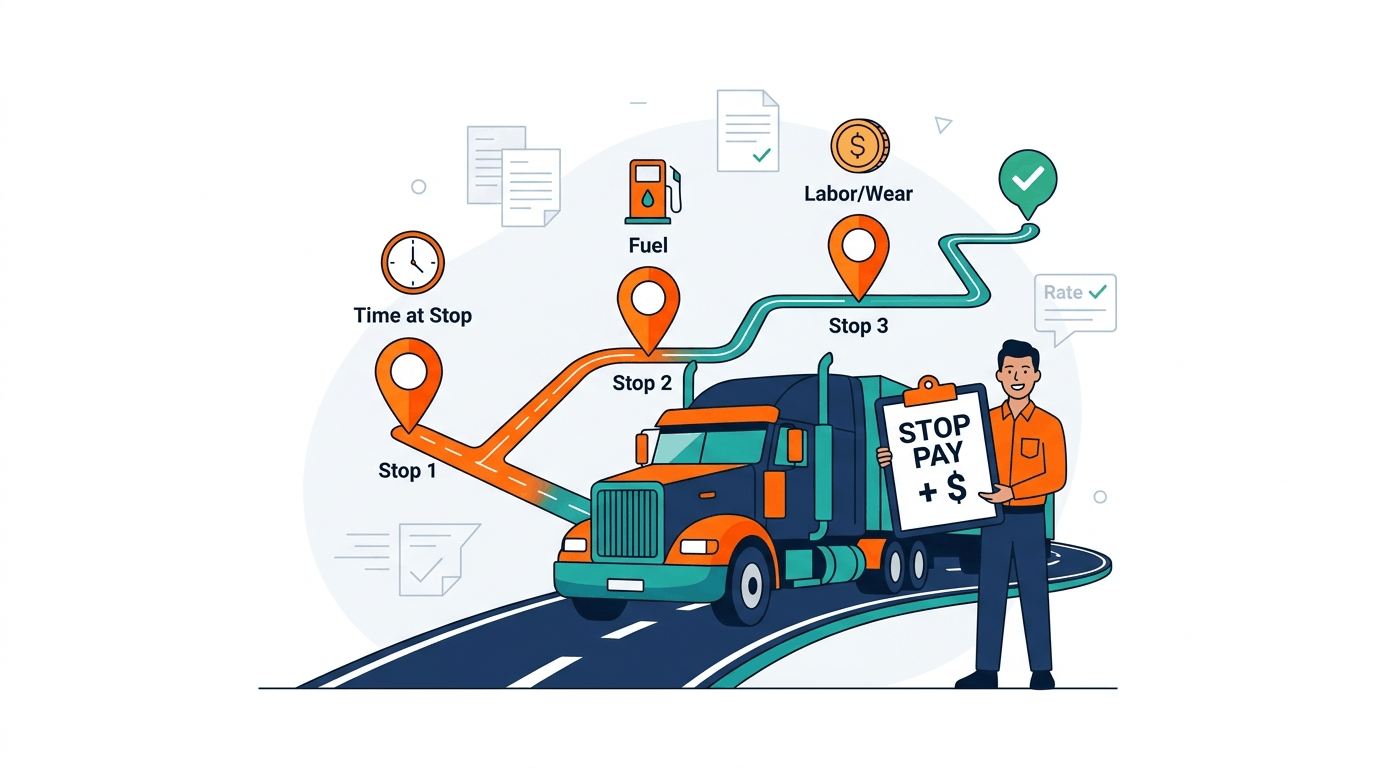
Truckers search for stop pay (also known as extra stop or stop-off pay) to ensure they are compensated for the time, fuel, and physical labor spent making multiple deliveries or pickups along a single route.
Without stop pay, every additional stop eats into your earnings, burns your fuel, and costs you hours you could have spent driving.
This comprehensive guide breaks down everything you need to know about stop pay in trucking from how it works and what it’s worth, to how to negotiate it and protect your paycheck.
What Is Stop Pay in Trucking? A Clear Definition
So, what is stop pay in trucking exactly? In the simplest terms, stop pay is compensation a truck driver receives for each extra stop made between the origin and final destination of a trip.
When you haul a load from Point A to Point B, your base pay (usually calculated by the mile, by the hour, or as a percentage of the load) covers that primary movement.
But when your route includes intermediate stops whether for partial deliveries, additional pickups, or any other reason those stops require extra time, effort, fuel, and wear on your equipment.
Stop pay exists to ensure you’re compensated for all of that.
Think of it this way: if you’re making three stops on a route instead of one, you have less drive time available and will log fewer miles per day.
Stop pay offsets that lost mileage income and ensures you’re appropriately compensated for your time.
Stop pay is classified as an accessorial pay an add-on charge tied to time, labor, or unexpected changes during a load.
Other common accessorials include detention pay (waiting at shippers), layover pay (delays between loads), and tarping pay.
Why Stop Pay Matters: The Real Cost of Extra Stops
Understanding what is stop pay in trucking is only half the battle. You also need to understand why it matters to your bottom line.
Every additional stop on your route costs you in several ways:
- Time: Each stop requires maneuvering into a dock or yard, paperwork, waiting for loading/unloading, and securing your trailer.
- Fuel: Stop-and-go driving burns more fuel than highway miles.
- Wear and tear: Frequent stopping puts additional strain on your brakes, transmission, and tires.
- Lost miles: Time spent at stops is time you’re not driving and if you’re paid by the mile, that’s lost income.
Without stop pay, you’re effectively working for free during those stops. That’s why the question what is stop pay in trucking isn’t just academic it’s about protecting your livelihood.
How Stop Pay Works: What Drivers Need to Know
What Counts as a Stop?
A “stop” is generally defined as any routed stop between the origin and destination of a trip.
Most carriers exclude the origin (first pickup) and final destination (last delivery) from stop pay calculations. Only intermediate stops qualify for additional compensation.
For example: If your route has a pickup in Chicago, deliveries in Indianapolis, Louisville, and Nashville, and a final drop in Atlanta you’d typically receive stop pay for the Indianapolis, Louisville, and Nashville stops, but not for Chicago or Atlanta.
How Is Stop Pay Calculated?
Stop pay is almost always a flat fee per stop. The rate varies widely by carrier, freight type, and region.
Based on current job listings and industry data, here’s what you can expect:
| Stop Type | Typical Rate Range |
|---|---|
| Live load/unload stop | $20 – $65 per stop |
| Drop and hook stop | $35 – $40 per stop |
| General stop pay | $14 – $55 per stop |
Some carriers differentiate between live stops (where you wait while the trailer is loaded or unloaded) and drop-and-hook stops (where you drop a loaded trailer and hook an empty one). Live stops typically pay more because they involve more of your time.
When Does Stop Pay NOT Apply?
It’s just as important to know when you won’t receive stop pay. Common exclusions include:
- The origin pickup point
- The final delivery destination
- Stops that are part of your normal, pre-planned route (if your contract doesn’t specify stop pay)
- Stops that aren’t pre-authorized by dispatch
Always clarify what counts as a compensable stop before you accept a load.
Stop Pay vs. Other Accessorials: Know the Difference
To fully understand what is stop pay in trucking, you need to distinguish it from other types of compensation you might encounter:
| Pay Type | What It Covers | When It Applies |
|---|---|---|
| Stop Pay | Extra pickups/deliveries along a route | Each intermediate stop on a trip |
| Detention Pay | Waiting time at shippers/receivers | After free time expires (typically 1-2 hours) |
| Layover Pay | Extended delays between loads | Usually after 24 hours of waiting |
| TONU | Truck Order Not Used | Load cancels after you’ve arrived |
These accessorials can stack. A second stop might also create detention at that facility, which is why stop-off pay exists. Knowing the difference helps you ensure you’re getting paid for everything you’re owed.
Stop Pay Rates: What Are Truckers Actually Getting?
The rates above give you a range, but let’s look at real-world examples from actual carriers:
- J.B. Hunt: Stop pay ranges from $20 to $65 per stop
- Landair: $20 per stop
- Nussbaum Transportation: $17 per stop
- Various regional carriers: $21 to $55 per stop
The wide variation means that what is stop pay in trucking worth to you depends heavily on who you drive for and what you negotiate.
Factors That Affect Your Stop Pay Rate
Several factors influence how much you’ll get per stop:
- Freight type: Specialized freight (hazmat, flatbed, oversized) often pays higher stop rates
- Region: Some regions have higher rates due to cost of living or demand
- Carrier policy: Every trucking company is different
- Your experience: More experienced drivers can often negotiate better rates
- Stop type: Live stops typically pay more than drop-and-hook
The Legal Reality: Is Stop Pay Required by Law?
Here’s a hard truth: there are no federal laws or FMCSA regulations requiring carriers to pay stop pay.
The FMCSA (Federal Motor Carrier Safety Administration) regulates safety, not compensation. While the agency has rules about broker financial responsibility and coercive practices, stop pay is not federally mandated.
This means stop pay is entirely contractual. Carriers are only required to pay you what’s on your original rate confirmation. If stop pay isn’t spelled out in your agreement, you’re not getting it.
That’s why understanding what is stop pay in trucking and making sure it’s in your contract is so critical.
Stop Pay Lawsuits: What Happens When Drivers Don’t Get Paid
The absence of federal mandates hasn’t stopped drivers from fighting for what they’re owed. Several lawsuits have been filed over unpaid stop pay and related compensation:
- BYG Byrd Express vs. Mountain Valley Express: A dispute over failure to pay for freight pickup and delivery services at a rate of $49.70 per compensable stop
- NFI settlement: A $5.75 million settlement over wage claims, with average payments of $31,500 to class members
- Multiple class actions: Drivers have filed suit over misclassification as independent contractors and failure to pay for all hours worked, including stop-related time
These cases show that while stop pay isn’t legally required, failing to pay what was promised can result in serious legal consequences.
How to Negotiate Stop Pay: A Driver’s Guide
Knowing what is stop pay in trucking is step one. Step two is getting paid what you’re worth. Here’s how:
1. Negotiate Before You Accept the Job
The best time to negotiate is before you accept an offer, not after you start. Carriers have the most flexibility during the hiring process.
2. Ask the Right Questions
Before you sign anything, ask:
- “Does your rate confirmation include stop pay for multiple deliveries or pickups?”
- “What’s the stop pay rate per stop?”
- “Are live stops and drop-and-hook stops paid differently?”
- “When does stop pay start and what’s excluded?”
3. Read the Rate Confirmation Carefully
The rate confirmation is a contract. If it doesn’t mention stop pay, assume you won’t get it. Don’t accept vague terms.
4. Document Everything
When you make a stop, document it:
- Time-stamped check-in
- Signed-in and out times on the Bill of Lading
- Gate tickets with times
- ELD time and location as backup
This documentation is your proof if you need to dispute unpaid stop pay.
5. Know Your Worth
Experienced drivers with clean records have leverage. Use data and market rates to justify your ask. Even a small increase per stop adds up over time.
Common Mistakes Drivers Make With Stop Pay
Avoid these pitfalls:
❌ Assuming Stop Pay Is Automatic: It’s not. If it’s not in your rate confirmation, you’re not getting it.
❌ Not Asking About Stop Pay Before Accepting a Load: Many drivers focus only on CPM (cents per mile) and ignore accessorials. A driver earning $0.60/mile with weak stop pay may take home less than a driver earning $0.55/mile with strong accessorial pay.
❌ Failing to Document Stops: If you can’t prove you made a stop, you can’t get paid for it.
❌ Treating Stop Pay as a “Favor”: You’re not begging. You’re billing for real costs.
Stop Pay Best Practices: Protecting Your Paycheck
Here’s how to make sure you’re getting every dollar you’re owed:
- Get it in writing: Every stop pay term should be on your rate confirmation
- Track every stop: Use your ELD, take photos, get time stamps
- Know your carrier’s policy: Different carriers pay differently
- Ask about stop pay in interviews: Make it part of your compensation discussion
- Follow up on unpaid stops: If you’re not paid, dispute it promptly
Conclusion: Stop Pay Is Your Right – Know It, Ask For It, Get It
So, what is stop pay in trucking? It’s the compensation you deserve for the time, fuel, and physical labor spent making multiple deliveries or pickups along a single route. It’s not a bonus or a favor it’s payment for work performed.
Yet too many drivers leave money on the table because they don’t understand what is stop pay in trucking, don’t ask for it, or don’t document their stops. Don’t be one of them.
The trucking industry runs on your time and effort. Every stop you make costs you something. Stop pay ensures you’re compensated for it. Know your rights, negotiate your terms, and never work for free.
Ready to stop dreaming and start driving?
Fill out the form and a Remms recruiter will reach out within one business day. No spam, no pressure — just real results.
Submit Driver Profile