
Quick Answer:
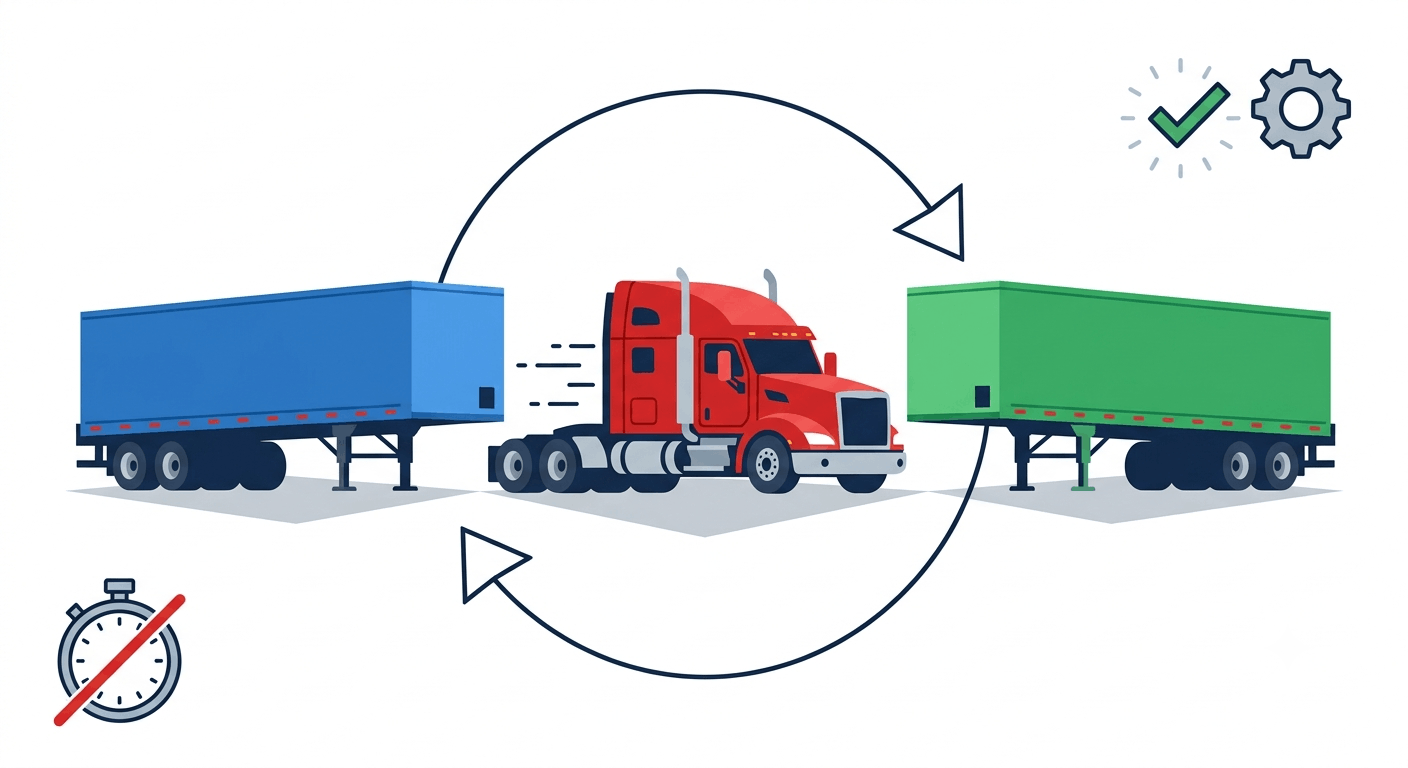
In trucking, drop and hook is a freight delivery method where you drop off a loaded trailer at a facility and then immediately hook your tractor to a different, pre-loaded trailer that’s ready to go.
This process allows you to avoid waiting for cargo to be loaded or unloaded, which is a major time-saver compared to a traditional “live load”.
How It Works
Here is a simple breakdown of the drop and hook process:
- Arrive: You drive your truck and trailer to the shipper or receiver’s facility.
- Drop: You disconnect your tractor from the trailer you are delivering. This trailer might be full of freight or empty.
- Hook: You then back your tractor up to a different trailer that is already pre-loaded (or empty) and hook it up.
- Leave: Once the trailer is securely attached, you are ready to hit the road immediately.
This entire process can often be completed in 15-30 minutes.
Key Benefits of Drop and Hook
This method offers several clear advantages for drivers:
- More Miles, More Money: Since you spend less time waiting, you can cover more miles and potentially haul more loads in a day.
- Less Hassle: You avoid the physical labor of loading or unloading, making it a true “no-touch” freight experience.
- No Unpaid Waiting: You are less likely to incur detention fees, as you’re not waiting on-site for loading or unloading.
- More Flexible Scheduling: Pre-loaded trailers make it easier to plan your day without being tied to rigid appointment windows.
Potential Drawbacks to Consider
Despite the benefits, there are a few potential downsides:
- Less Control: You’re using a trailer that you have no control over regarding its condition, cleanliness, or how it’s been loaded.
- Unpredictable Freight: You might find that the “pre-loaded” trailer is not ready when you arrive, which can lead to unexpected delays.
- Mismatched Trailers: You’ll be using whatever trailer is available, which could mean using a variety of equipment rather than keeping a familiar trailer.
Drop and hook is a highly efficient method that is widely used in the trucking industry, particularly in dedicated routes and with major carriers, because it keeps both drivers and equipment moving.
Let me know if you want more details on any of these points.
Introduction:
In the trucking industry, time is money. Truck drivers in the United States are legally permitted to drive for up to 11 hours a day, yet many end up driving for only six-and-a-half hours partially due to prolonged dwell times at warehouses.
According to FreightWaves data, truck drivers average 119 minutes of wait time per pickup or drop-off waiting to be loaded or unloaded.
This waiting comes at a staggering cost: a U.S. Department of Transportation report found that driver detention reduces earnings by $1.1 billion to $1.3 billion annually between $1,281 and $1,534 per driver per year for for-hire commercial motor vehicle drivers in the truckload sector.
Enter drop and hook the logistics practice that has become the gold standard for efficiency in modern freight shipping. But what exactly is it, how does it work, and why has it become so dominant that it now represents nearly 50% of the truckload market? This comprehensive guide answers all your questions.
What is Drop and Hook? The Definitive Answer
Drop and hook (also known as drop and pick) is a trucking method where a driver delivers a trailer to a facility for loading or unloading and then proceeds to hook their semi-truck to another trailer for a subsequent delivery all without waiting for cargo to be loaded or unloaded.
In simple terms: drop, hook, and go.
The driver arrives at a shipping facility, detaches their current trailer (which may be loaded or empty), and immediately attaches to a different trailer that has been pre-loaded or pre-staged. The entire process can take as little as 15 to 45 minutes a fraction of the hours required for traditional live loading.
The Two Phases: Drop and Hook
A proper drop and hook operation involves 16 distinct steps 7 to drop the current trailer and 9 to hook to the new one.
Phase 1: The Drop (7 Steps)
- Check in at the gate – Present paperwork, load number, and trailer number to receive your assigned drop location.
- Navigate to the assigned spot – Follow facility traffic patterns to your designated yard position.
- Back the trailer into the spot – Position it straight and centered for the next driver or yard jockey.
- Lower the landing gear – Crank until both legs firmly contact the ground and support the trailer’s weight.
- Disconnect air lines and electrical – Unhook the service air line (blue gladhand), emergency air line (red gladhand), and electrical pigtail.
- Release the fifth wheel and pull forward – Pull the release handle and ease the tractor forward.
- Verify the trailer is stable – Walk around to confirm the trailer is level and secure.
Phase 2: The Hook (9 Steps)
- Locate the assigned pickup trailer by verifying the trailer number.
- Back under the trailer, aligning the fifth wheel with the kingpin.
- Connect the air lines and electrical cable.
- Perform a tug test to ensure proper coupling.
- Raise the landing gear fully.
- Secure all connections and perform a walk-around inspection.
- Check the trailer seals against your paperwork.
- Complete any required facility paperwork or digital check-in.
- Depart for your next destination.
Drop and Hook vs. Live Load: The Critical Difference
The most frequent comparison drivers and shippers make is between drop and hook and live loading. Understanding this distinction is essential.
| Feature | Drop and Hook | Live Load |
|---|---|---|
| Process | Driver swaps trailers and leaves immediately | Driver waits while trailer is loaded/unloaded on-site |
| Average Wait Time | Less than 1 hour | 2–4+ hours |
| Driver Involvement | No-touch freight – driver never handles cargo | May assist with loading/unloading |
| Scheduling | Flexible; pre-loaded trailers ready when driver arrives | Must fit within tight appointment windows |
| Detention Fees | Generally avoided – driver isn’t present during unloading | Common; drivers often wait unpaid |
| Equipment | Driver uses whatever trailer is available | Driver keeps their own trailer |
Live loading requires more coordination to prevent disruptions that could lead to delays in procuring labor and equipment. In contrast, drop and hook offers greater flexibility to both parties since it doesn’t involve waiting for cargo to be loaded or offloaded.
The Massive Benefits of Drop and Hook
1. Dramatic Time Savings
Drop and hook cuts wait times from an average of 4 hours down to just 15 minutes. This efficiency translates directly to more miles driven, more loads completed, and higher revenue per driver.
2. Significant Cost Reduction
Shippers and carriers save 20-30% on labor and fuel costs through reduced idling and optimized trailer usage. One Midwest carrier that implemented drop and hook swapped 500 trailers weekly, cutting costs by $150,000 per quarter.
3. Increased Driver Productivity and Retention
Drivers covering drop and hook loads can complete more deliveries in a day. Truckers report 25% productivity gains in recent pilots. More time on the road means more mileage (within legal limits) and higher pay. Less waiting also means less fatigue and higher job satisfaction critical factors in an industry facing a persistent driver shortage.
4. Reduced Dwell Time and Detention Fees
Dwell time the period a truck remains stationary while waiting to load or unload is a massive efficiency killer. Prolonged dwell times lead to scheduling conflicts, increased fuel consumption from idling trucks, and higher overall operational costs. Drop and hook virtually eliminates these issues.
5. Warehouse Flexibility
Shippers can load or unload trailers on their own schedule during off-peak hours, overnight, or whenever labor and dock space are available. This decouples the delivery of new freight from the removal of the old.
6. Lower Emissions
Less idling means reduced fuel consumption and lower carbon emissions aligning with increasingly strict environmental regulations and corporate sustainability goals.
The Challenges and Drawbacks
Drop and hook isn’t without its challenges. Drivers and carriers should be aware of potential pitfalls:
Equipment Quality and Availability
When you swap trailers, you give up control over the equipment you’re using. The new trailer could be older, poorly maintained, or even in disrepair. Trailer shortages can also occur, requiring AI forecasting and better inventory management.
Yard Logistics and Accessibility
Sometimes the new trailer isn’t conveniently positioned it might be stored offsite, hidden behind other trailers, or in an inaccessible location. This can require waiting for yard workers to reposition it, though even with these delays, average wait times remain under an hour.
Unpredictable Turnarounds
Some drop and hook loads can unexpectedly turn into live loads due to issues with available trailers or incorrect information from the shipper.
Limited Schedule Flexibility
Drivers following the drop and hook model have less control over their schedules and must adhere strictly to appointments, leaving little room for unexpected delays.
Parking Challenges
Finding available parking spots at distribution centers can be difficult, particularly during peak times.
The Economics: How Drop and Hook Impacts Pay
The financial implications of drop and hook are significant for drivers. Real-world job postings illustrate the differences in compensation:
- Drop and hook pay: $23–$35 per stop
- Live load/unload pay: $47–$55 per stop
- Detention pay: $20–$27 per hour for wait times beyond free time
While live loads pay more per stop due to the additional time and effort required, drop and hook allows drivers to complete more stops in a day often resulting in higher overall weekly earnings.
What Does “50% Drop and Hook” Mean in Job Postings?
A common question from job seekers is: “What does 50% drop and hook mean?”
50% drop and hook means that half of the deliveries on that job or route use drop and hook trucking, while the other half require live loading. In practice:
- 100% drop and hook: The holy grail. No waiting, maximum driving time.
- 50% drop and hook: A mixed account. Some waiting periods, but still better than all live loads.
- 0% drop and hook: All live loads. Maximum time spent waiting at docks.
Always clarify the drop-and-hook percentage during a job interview it directly impacts your paycheck and daily routine.
Who Uses Drop and Hook? Major Players
Drop and hook is favored by large distribution centers with high-volume, continuous freight movement and a dedicated pool of trailers and yard space.
Amazon / Amazon Relay
Amazon operates one of the largest drop and hook networks in the world through its Amazon Relay program. Most Amazon fulfillment center loads are drop and hook drivers drop an empty or loaded trailer and pick up a pre-loaded one. The Amazon Relay app allows drivers to pre-register loads and get gate passes directly on their phones.
Walmart
Walmart’s dry van freight is primarily drop and hook, with many positions offering flat weekly pay of $1,800 or more for drivers hauling mostly drop-and-hook freight.
C.H. Robinson
C.H. Robinson’s Drop Trailer Plus program is one of the largest trailer pools in the country, with more than 800,000 annual shipments and more than 10,000 trailers in circulation daily.
Uber Freight Powerloop
Uber Freight’s Powerloop drop-and-hook program offers dedicated tours designed to help optimize miles, earnings, and efficiency while providing carriers with predictable, reliable freight.
Technology Transforming Drop and Hook in 2026
The drop and hook landscape is being revolutionized by technology:
- IoT Sensors and Real-Time Tracking: Trailers are now equipped with sensors that provide real-time location and status data.
- AI Scheduling and Forecasting: Artificial intelligence predicts trailer demand, reduces shortages, and optimizes routing.
- Digital Check-In and QR Codes: Drivers scan QR codes for instant digital handovers, reducing errors by up to 40%.
- Yard Management Systems (YMS): These systems track trailer locations in real time and maintain organized staging zones for easy swaps.
- Telematics and Geofencing: Advanced systems provide 24/7 real-time tracking, fraud mitigation, and automated notifications.
- Asset Management Systems: Companies like C.H. Robinson have replaced manual spreadsheets with unified portals that provide real-time awareness of inventory, dwell times, and facility commitments.
Best Practices for Implementing Drop and Hook
For carriers and shippers looking to implement or optimize drop and hook operations:
- Assess volume – Drop and hook is ideal for operations handling 20+ trailers per day.
- Partner with yards – Look for facilities with 50+ parking slots.
- Train teams – Ensure all staff are trained on digital check-in procedures.
- Integrate GPS – Use real-time ETA tracking for better coordination.
- Monitor KPIs – Track utilization rates, aiming for >90%.
- Use YMS technology – Implement yard management systems to eliminate “yard hunts” for hard-to-find trailers.
- Preload based on forecasts – Stage trailers according to demand predictions and shipment schedules.
The Future of Drop and Hook
Drop trailer programs today represent nearly 50% of the truckload market, and that number continues to grow. Looking ahead:
- Autonomous Trucks: Self-driving technology will redefine drop and hook operations, enabling completely unmanned trailer swaps.
- Blockchain Security: Blockchain seals are being deployed to enhance cargo security and reduce theft risks.
- AI Integration: Dynamic apps and AI-driven platforms will further reduce scheduling complexity.
- Sustainability: Lower emissions from reduced idling will align with tightening environmental mandates.
The platform can cut turnaround times by up to 80%, increasing monthly miles per truck from an average of 3,200 miles to 5,000 miles with limited additional costs improving shipping margins dramatically.
Conclusion
Understanding what is drop and hook is essential for anyone navigating the modern logistics landscape. Whether you’re a driver seeking higher-paying, more efficient routes, a shipper looking to reduce detention fees and streamline operations, or a fleet manager optimizing your network, drop and hook represents the future of freight transportation.
With nearly half of all truckload shipments now using drop trailer programs, and technology continuing to drive efficiency gains, this method is no longer a niche practice it’s the new standard. When evaluating job opportunities, always ask about the drop-and-hook percentage. If it’s 50% or higher, you’re looking at a role that respects the driver’s time, maximizes revenue, and keeps freight moving not waiting.
Frequently Asked Questions
What is drop and hook in trucking?
What is the difference between drop and hook and live load?
Is drop and hook the same as no-touch freight?
How long does a drop and hook take?
What are the benefits of drop and hook?
What are the drawbacks of drop and hook?
Does drop and hook pay more than live load?
Do I get paid for detention with drop and hook?
Can I choose between drop and hook and live load?
Which trucking companies offer drop and hook?
Is drop and hook better for new drivers?
What should I look for in a drop and hook job?
Ready to stop dreaming and start driving?
Fill out the form and a Remms recruiter will reach out within one business day. No spam, no pressure — just real results.
Submit Driver Profile