
If you’ve been behind the wheel as a company driver for any length of time, you’ve probably caught yourself doing the math. If I owned my own truck, how much more could I really be making? It’s one of the most common questions on the road and frankly, it’s a fair one.
The short answer? Owner operators have the potential to earn significantly more than company drivers. But here’s the catch how much an owner operator makes per mile is only half the story. The real question is: how much do you keep per mile?
In this comprehensive guide, we’ll break down exactly what owner operators earn per mile in 2026, what eats into those earnings, and most importantly how you can maximize what you take home. Let’s roll.
The Short Answer: What Do Owner Operators Make Per Mile?
Let’s cut straight to the numbers. In 2026, owner operator pay per mile varies widely based on freight type, equipment, and whether you’re running under your own authority or leased to a carrier.
Here’s the quick snapshot:
| Freight Type | Average Rate Per Mile (Gross) |
|---|---|
| Dry Van | $1.75 – $2.40 |
| Refrigerated (Reefer) | $2.00 – $2.90 |
| Flatbed | $2.25 – $3.00 |
| Tanker | $2.50 – $3.20 |
| Specialized / Oversized | $3.00 – $5.00+ |
But here’s what most articles won’t tell you: those are gross rates the amount before you pay for fuel, insurance, maintenance, truck payments, and everything else.
After all expenses are accounted for, the average net owner operator income per mile runs between $0.50 and $0.80 and that’s where the real story begins.
Gross vs. Net: The Number That Actually Matters
When someone says an owner operator makes “$200,000 a year,” they’re almost always talking about gross revenue the total amount billed before any expenses are paid.
Here’s the reality check:
Gross revenue: $180,000 – $300,000+ per year
Net income (after expenses): $50,000 – $120,000 per year
That gap the difference between what you earn and what you keep is where most owner operators get into trouble.
Two drivers can gross the exact same $200,000. One takes home $70,000. The other takes home $38,000. The difference isn’t the loads they run it’s the expenses they control.
So when you’re asking “how much does an owner operator make per mile,” you really need to be asking two questions:
- What’s my gross rate per mile? (what the broker pays)
- What’s my net profit per mile? (what I actually keep)
Owner Operator Pay Per Mile by Freight Type (2026)
Let’s dive deeper into each freight category. Remember these are gross rates. Your net will be lower after expenses.
Dry Van
The most common freight type, dry van hauling pays $1.75 to $2.40 per mile on average. Dry van operators typically gross $150,000 to $200,000 annually, with net take-home around $45,000 to $75,000.
Refrigerated (Reefer)
Reefer haulers deal with temperature-controlled freight and typically earn $2.00 to $2.90 per mile. The higher rate compensates for the additional equipment costs and maintenance associated with reefer trailers. Annual gross runs $175,000 to $240,000, with net income around $55,000 to $90,000.
Flatbed
Flatbed operators earn $2.25 to $3.00 per mile on average. The work is more labor-intensive you’re tarping, securing loads, and dealing with weather but the pay reflects that effort. Many flatbed owner operators see all-in rates between $2.50 and $4.00 per mile on loaded miles.
Tanker
Tanker haulers command $2.50 to $3.20 per mile, with annual gross revenues of $185,000 to $260,000 and net income estimated at $60,000 to $100,000. The specialized nature of the work and additional endorsements required contribute to the higher rates.
Specialized / Oversized
This is where the big money lives. Specialized freight think heavy equipment, oversized loads, or hazardous materials can pay $3.00 to $5.00+ per mile. Top earners in this category can clear $150,000+ in take-home pay.
The Cost Per Mile: What Really Determines Your Profit
Here’s the most important number in your trucking business: your cost per mile (CPM). This tells you exactly how much it costs to move your truck one mile down the road and without knowing this number, you’re essentially guessing whether each load is profitable.
What’s the Average Cost Per Mile?
For most owner operators in 2026, the true CPM runs between $1.45 and $1.85 per mile, depending on your truck payment, insurance class, fuel efficiency, and maintenance habits.
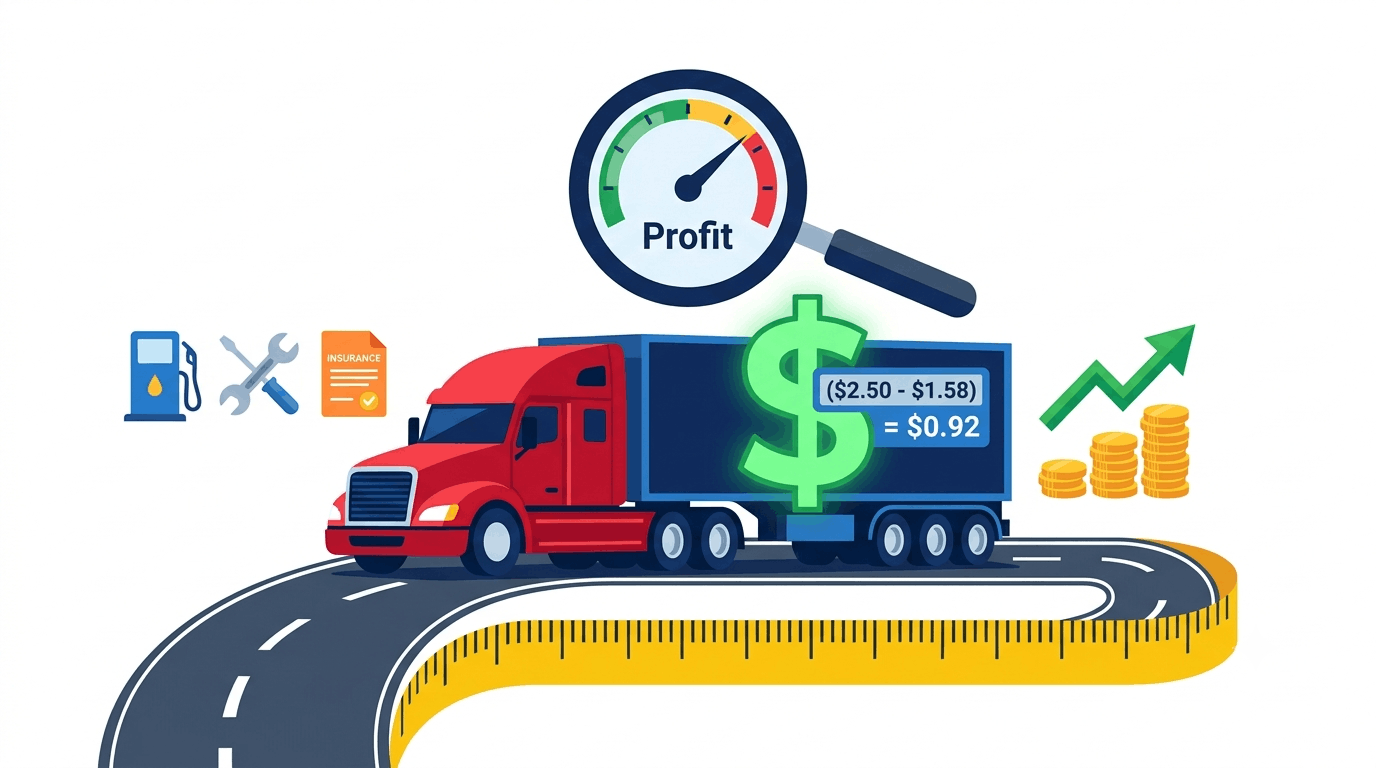
Here’s what that looks like in practice: if you run 8,500 miles per month and have $13,430 in total monthly expenses, your breakeven rate is $1.58 per mile meaning any load below $1.58/mile loses you money before you even consider profit.
Breaking Down Your Expenses
Understanding your costs is the key to knowing how much owner operators make per mile because your profit is simply your rate minus your cost.
Fixed Costs (You Pay These No Matter What)
Fixed costs hit you every month regardless of how many miles you drive:
| Expense | Monthly Cost |
|---|---|
| Truck payment | $1,200 – $2,500 |
| Trailer payment | $500 – $1,200 |
| Insurance | $1,200 – $3,000 |
| Permits & licensing | $50 – $150 |
| ELD & technology | $30 – $100 |
| Phone & internet | $100 – $200 |
| Accounting | $100 – $300 |
For a typical owner operator with a financed truck, total fixed costs land between $3,180 and $7,450 per month.
Pro tip: 34% of owner operators now own their trucks outright with no monthly payment. If you can get there, your fixed costs drop dramatically and your owner operator earnings per mile jump significantly.
Variable Costs (These Change Based on Miles Driven)
Variable costs go up and down with how much you drive:
| Expense | Cost Per Mile |
|---|---|
| Fuel | $0.50 – $0.75 |
| Maintenance & repairs | $0.10 – $0.20 |
| Tires | $0.03 – $0.06 |
| Tolls | $0.02 – $0.08 |
| Lumper fees | $0 – $0.02 |
| Factoring fees | $0.04 – $0.10 |
Total variable costs typically run $0.75 to $1.30 per mile.
The Math: What Owner Operators Actually Keep Per Mile
Let’s put it all together with a real example:
Scenario: A dry van owner operator running 9,000 miles per month at $2.00 per mile.
| Line Item | Amount |
|---|---|
| Gross revenue (9,000 × $2.00) | $18,000 |
| Monthly expenses (fuel, insurance, truck payment, etc.) | ~$13,430 |
| Net profit | ~$4,570 |
| Net profit per mile | ~$0.51 |
That’s the reality. A $2.00 per mile rate becomes about $0.51 per mile in your pocket after all expenses.
Owner Operator Pay Per Week and Per Year
Now that you understand the per-mile math, let’s look at the bigger picture.
Weekly Earnings
Your weekly income depends on how many miles you run and how efficiently you operate:
| Weekly Miles | Gross Revenue | Net Take-Home |
|---|---|---|
| 1,800 miles | ~$3,600 | $1,600 – $1,900 |
| 2,200 miles | ~$4,400 | $1,900 – $2,200 |
| 2,800 miles | ~$5,600 | $2,300 – $2,600 |
The more efficiently you run your truck good MPG, fewer empty miles, regular maintenance the more you keep in your pocket.
Annual Earnings
Annual earnings vary depending on the type of work you do:
| Operation Type | Gross Revenue | Net Income |
|---|---|---|
| Local / Regional | $150,000 – $200,000 | $60,000 – $90,000 |
| Over-the-Road (OTR) | $200,000 – $250,000+ | $90,000 – $120,000 |
| Lease-operator (under carrier) | $150,000 – $200,000 | $65,000 – $95,000 |
According to ATBS data, the average owner operator income in 2025 was approximately $71,800, with revenue per mile increasing about five cents per mile year over year.
Factors That Affect How Much Owner Operators Make Per Mile
Not all owner operators earn the same rate per mile and not all of them keep the same percentage. Here’s what separates the top earners from the rest:
1. Freight Type and Specialization
As we covered above, specialized freight pays significantly more than dry van. If you have the right equipment and endorsements, you can command $3.00 to $5.00+ per mile.
2. Operating Authority
Running under your own authority gives you the highest income ceiling: $2.00 to $3.50+ per mile when negotiated well. However, you manage all expenses, compliance, and cash flow and you’re waiting on broker payments.
Leasing to a carrier provides more predictable revenue and less administrative burden, but you typically earn a lower owner operator salary per mile.
3. Fuel Efficiency
Fuel is your single largest variable expense typically 25% to 35% of gross revenue. A truck that gets 6 MPG vs. 7 MPG can make a $0.10 to $0.15 per mile difference in your profit.
4. Deadhead Miles
Every empty mile is a money-loser. Successful owner operators minimize deadhead by finding backhauls and strategically positioning themselves for their next load.
5. Negotiation Skills
The most successful owner operators don’t just accept whatever a broker offers they negotiate. They know their cost per mile cold and have a clear “walk-away number” before they even pick up the phone.
6. Seasonality
Freight demand swings affect revenue per mile. Planning around peak seasons can raise your owner operator earnings per mile.
How to Increase Your Owner Operator Pay Per Mile
Want to earn more per mile? Here are proven strategies:
1. Know Your Numbers Cold
If you can’t recite your cost per mile within a few cents, you’re flying blind. Track every expense fuel, insurance, maintenance, tolls, factoring, and downtime. Review your profitability per lane, not just per load.
2. Set a Minimum Rate
Before you search for loads, know your minimum acceptable rate. A lane with 120 miles of deadhead and a slow receiver should pay more period.
3. Negotiate Fuel Surcharges Separately
Ask for a fuel surcharge separately from the linehaul rate, tied to a published fuel index. This protects you when fuel prices rise.
4. Focus on Net Profit, Not Gross Rate
A load paying $10 per mile may actually yield less profit than a longer haul at $3 per mile, once you factor in fuel, insurance, maintenance, downtime, and other expenses. Don’t chase the highest rate chase the highest net profit.
5. Run Efficiently
Good MPG, fewer empty miles, and regular maintenance all increase your net owner operator income per mile. An owner operator who runs 2,000 miles at $2.50 takes home more than one who runs 3,000 miles at $1.60.
6. Consider Specializing
If you can move into flatbed, tanker, or specialized freight, you’ll command higher rates per mile. The investment in equipment and training can pay off significantly.
Real Talk: Is Being an Owner Operator Worth It?
Let’s be honest. Being an owner operator isn’t for everyone. Yes, you have the potential to earn more than a company driver but you also have significantly more responsibility, risk, and expenses.
The upside:
- You control your earnings potential
- You choose which loads to run
- You’re building equity in your equipment
- Top earners clear $100,000+ net annually
The downside:
- You bear all the expenses
- You’re responsible for maintenance and repairs
- Cash flow can be unpredictable
- You’re running a business, not just driving a truck
According to Overdrive research, more than 40% of owner operators try to hit a profit margin target above 40% (when not considering their own pay on the expense side). Taking self-pay into account, 20% profit margin is a common ballpark target.
The ones who succeed are crafty and smart. They track their numbers obsessively, negotiate hard, and run efficiently.
Final Thoughts
So, how much does an owner operator make per mile?
The honest answer is: it depends.
It depends on what you haul, how you negotiate, how efficiently you run, and most importantly how well you control your costs.
The drivers who succeed aren’t necessarily the ones who earn the highest rate per mile. They’re the ones who keep the highest percentage of every dollar that comes in. They know their cost per mile cold and set minimum rates and stick to them. They negotiate with confidence. And they treat their trucking operation like the business it is.
If you’re considering the leap from company driver to owner operator, do your homework. Run the numbers. Build a realistic budget. And remember the goal isn’t to gross $200,000. The goal is to keep as much of it as possible.
Because at the end of the day, the only number that really matters is what you take home.
Ready to calculate your own numbers? Start by tracking every expense for a month. Know your cost per mile. Then you’ll know exactly what you need to make per mile and you’ll never take a losing load again.
Frequently Asked Questions
How much do owner operators make per mile after expenses?
What’s the average owner operator pay per mile in 2026?
How much does an owner operator make per mile with their own authority?
How much does an owner operator make per mile with their own authority?
What’s a good rate per mile for an owner operator?
How many miles do owner operators run per week?
Ready to stop dreaming and start driving?
Fill out the form and a Remms recruiter will reach out within one business day. No spam, no pressure — just real results.
Submit Driver Profile