
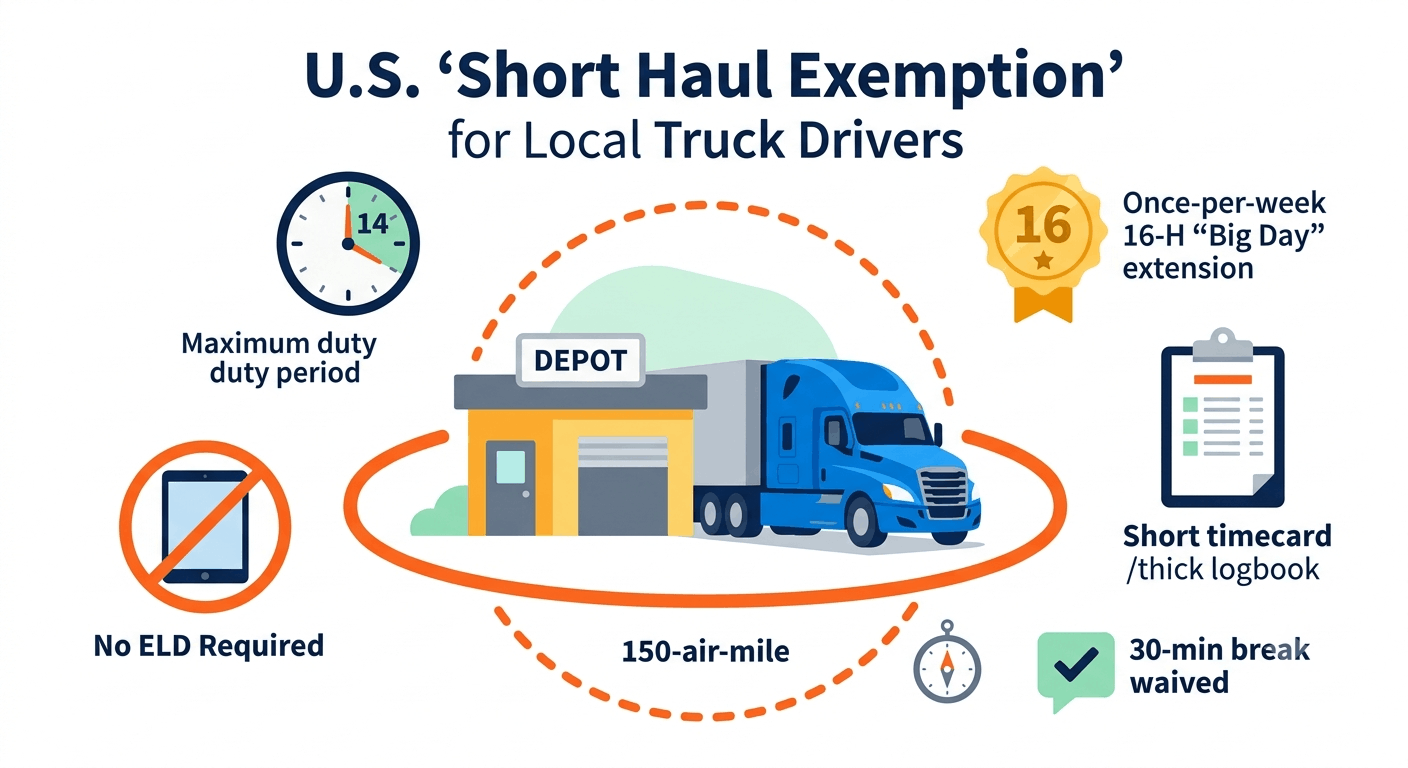
What is the Short-Haul Exemption?
This is a U.S. rule that gives local drivers a break from keeping complicated electronic driving logs. If you stay close to home, you usually don’t have to use an automatic time-tracker (ELD) or fill out daily paperwork as long as you follow a few simple distance and time rules.
The Basic Rules to Qualify:
To skip the logs, your day has to look like this:
- How far you can go: You must stay within a 150-mile straight-line radius from where you start your day. (Because roads aren’t straight, that usually works out to about 173 miles of actual driving).
- Where you start and end: You have to begin and finish your shift at the exact same location every day.
- Your total shift time: You must be finished and off-duty within 14 hours of clocking in.
- Your total driving time: You cannot drive more than 11 hours within that 14-hour window.
- Your weekly total: You still cannot drive more than 60 or 70 hours total in a week (depending on your company’s schedule).
The “One Free Pass” (16-Hour Rule)
Once every 7 days, you get a little extra flexibility. If you hit unexpected traffic or delays, you can stretch that 14-hour shift out to 16 hours but you can only do this once per week.
A Few Important Things to Keep in Mind:
- No electronic log, but still keep paper: Even though you don’t need the fancy gadget, your boss still has to write down what time you started, stopped, and how many hours you worked that day.
- You lose the pass for the day if: You go over that 150-mile radius or work longer than 14 hours. On that specific day, you’ll have to fill out a full paper log just like the long-haul drivers.
- Watch the 8-day rule: If you end up having to fill out those paper logs more than 8 days out of any 30-day period, the government will require you to switch back to using the electronic tracker.
- Good news on breaks: If you qualify for this exemption, you do not have to take the mandatory 30-minute break that other drivers are required to take.
The bottom line: This rule makes life easier for local drivers, but you have to strictly stick to that 150-mile and 14-hour limit to stay legal.
Are you asking about this for a regular pickup truck driver or a big-rig (CDL) driver? That changes a tiny detail, so let me know and I can narrow it down further!
If You’re Local Truck Driver
Who stays close to home, you’ve likely heard about the short haul exemption.
But what exactly is it, and more importantly, do you qualify?
This comprehensive guide breaks down everything you need to know about the FMCSA’s short haul exemption in plain, easy-to-understand language. Whether you’re a seasoned driver or new to the industry, understanding this rule can save you time, reduce paperwork, and keep you compliant with federal regulations.
What Is the Short Haul Exemption?
The short haul exemption is a provision created by the Federal Motor Carrier Safety Administration (FMCSA) that gives local drivers a break from some of the more burdensome paperwork requirements that long-haul truckers face.
In essence, it allows qualifying drivers to operate without using Electronic Logging Devices (ELDs) or maintaining detailed daily logbooks called Records of Duty Status (RODS).
Think of it this way: the government created Hours of Service (HOS) rules to prevent driver fatigue and keep our roads safe. However, they also recognized that not all trucking jobs are the same.
A driver who spends their day making local deliveries within a 150-mile radius doesn’t necessarily need the same level of tracking as someone driving cross-country. That’s precisely where the short haul exemption comes in it provides flexibility for drivers who operate close to their home base.
The short haul exemption simplifies compliance for local operations by eliminating the need for ELDs and reducing administrative burdens. However, it’s crucial to understand that this isn’t a free pass it comes with strict conditions that must be met every single day you claim it.
Who Qualifies for the Short Haul Exemption?
To qualify for the short haul exemption, you must meet several specific requirements. Let’s break them down one by one.
1. Operating Radius: The 150-Air-Mile Rule
The most well-known requirement is the distance limit. Under current FMCSA regulations (49 CFR 395.1(e)), drivers must operate within a 150-air-mile radius of their normal work reporting location.
Here’s an important distinction: an air mile is measured as a straight-line distance, not road miles. Because roads aren’t straight, 150 air miles typically work out to about 172.6 road miles. So if you’re driving roughly 170 miles or less from your starting point, you’re within the radius.
It’s worth noting that there’s a difference between CDL and non-CDL drivers in some interpretations. While the current standard is 150 air miles for both, some sources still reference the older 100-air-mile rule for CDL holders. The FMCSA officially expanded the short-haul exception from 100 to 150 air miles in recent years, so the 150-mile standard is the one to follow.
2. Start and End at the Same Location
You must begin and end your work shift at the same location each day. This location is typically your company’s depot, terminal, or your normal work reporting location. You can’t start at one place and finish at another and still claim the short haul exemption.
3. The 14-Hour Duty Period
You must be released from duty within 14 consecutive hours of coming on duty. This means your entire workday from the moment you clock in until you’re done for the day cannot exceed 14 hours.
4. The 11-Hour Driving Limit
Within that 14-hour window, you cannot drive more than 11 hours. This aligns with the standard HOS rule that applies to all property-carrying drivers.
5. Weekly Limits
Even with the short haul exemption, you must still comply with the 60-hour/7-day or 70-hour/8-day weekly on-duty limits. You can’t work unlimited hours just because you’re local.
Recordkeeping Requirements Under the Short Haul Exemption
One of the biggest benefits of the short haul exemption is that you don’t need to use an ELD or maintain a full Record of Duty Status (RODS). However, this doesn’t mean you’re completely off the hook for recordkeeping.
Your employer must maintain accurate time records that include:
- Your start time each day
- Your end time each day
- Total hours worked
- Your driver identification
These records must be kept for at least six months. Think of it as a detailed timecard rather than a full logbook. Additionally, if you do keep a logbook, it must be carried in the truck and available for inspection by enforcement officials within 15 minutes of their request.
The 16-Hour Short Haul Exemption (The “Big Day”)
Here’s where things get interesting. There’s a separate provision known as the 16-hour short haul exemption (FMCSA regulation). This rule allows qualifying drivers to extend their on-duty period from 14 hours to 16 hours but only once every seven consecutive days.
Think of it as your “big day” or your weekly mulligan. If you hit unexpected traffic, delays at loading docks, or other unforeseen circumstances, you can stretch your shift by two hours. However, you can only use this once per week unless you’ve taken a 34-hour restart.
Requirements for the 16-Hour Rule
To use the 16-hour short haul exemption:
- You must have returned to your normal work reporting location for the previous five duty tours
- Your carrier must release you from duty within 16 hours after coming on duty
- You must have had 10 consecutive hours off duty beforehand
- You cannot have used this exemption in the previous six consecutive days
It’s important to note that you cannot use the 16-hour exception if you’re claiming the non-CDL 150 air-mile exemption.
ELD Mandate and the Short Haul Exemption
The ELD mandate requires most commercial drivers to use electronic logging devices to track their hours of service. However, drivers who qualify for the short haul exemption are exempt from this requirement.
There’s also the “8-day rule” to keep in mind. If a driver is required to maintain Records of Duty Status for 8 days or fewer in any 30-day period, they are exempt from using an ELD. This is particularly relevant for drivers who typically qualify for the short haul exemption but occasionally go beyond the 150-air-mile radius.
Here’s the catch: if you exceed the short haul exemption more than eight times within 30 days, you’ll need an ELD for the rest of that cycle. The 30-day period is a rolling window of 30 consecutive days, not a specific calendar month.
The 30-Minute Break Exemption
Here’s some good news: drivers who qualify for the short haul exemption are also exempt from the mandatory 30-minute rest break requirement. Under normal HOS rules, drivers cannot drive if eight hours have passed since their last off-duty period of 30 consecutive minutes. But if you’re operating under the short haul exemption, you don’t need to worry about this break.
Common Mistakes and How to Avoid Them
Even experienced drivers can accidentally lose their short haul exemption for the day. Here are the most common pitfalls:
Exceeding the Radius
If you go beyond the 150-air-mile radius on any given day, you lose the exemption for that day. You’ll need to complete a full Record of Duty Status (RODS) log for that day. Fortunately, with ELDs, this switch can be relatively seamless.
Exceeding the 14-Hour Limit
Similarly, if you work more than 14 hours, you lose the exemption for that day. The 16-hour rule can help you avoid this, but remember you can only use it once per week.
Inadequate Recordkeeping
Even though you don’t need full logs, your employer must maintain accurate time records. Failure to do so can result in compliance violations.
Frequent Exceptions
If you lose the exemption more than eight times in a 30-day period, you become subject to the ELD mandate. This is designed to prevent drivers from routinely exceeding the limits while still claiming the exemption.
Who Benefits Most from the Short Haul Exemption?
The short haul exemption is particularly valuable for:
- Local trucking companies
- Construction fleets
- Utility service providers
- Delivery companies
- Municipal fleets
Basically, any operation where drivers start and end their day at the same location and stay within a local area can benefit from this exemption.
The Short Haul Exemption vs. Other HOS Exceptions
It’s worth understanding how the short haul exemption differs from other HOS exceptions:
| Exemption | Key Feature | Frequency |
|---|---|---|
| Short Haul (150-mile) | No ELD or RODS required | Daily, if conditions met |
| 16-Hour Short Haul | Extends duty day to 16 hours | Once every 7 days |
| Adverse Driving Conditions | Extends driving limit by 2 hours | As needed, if conditions unknown beforehand |
Final Thoughts
The short haul exemption is an incredibly valuable tool for local drivers and the companies that employ them. It simplifies compliance, reduces paperwork, and provides flexibility for day-to-day operations. However, it’s not automatic you must strictly adhere to the 150-air-mile radius, the 14-hour duty period, and all other requirements to remain compliant.
Remember these key takeaways:
- Stay within 150 air miles of your starting point
- Start and end at the same location
- Don’t exceed 14 hours on duty (unless using the 16-hour exception, once per week)
- Don’t drive more than 11 hours
- Keep accurate time records
- Watch the 8-day rule for ELD compliance
By understanding and properly applying the short haul exemption, you can keep your operation running smoothly while staying on the right side of FMCSA regulations. Whether you’re a driver looking to simplify your daily routine or a fleet manager aiming to reduce administrative burden, this exemption offers a practical solution for local operations.
Disclaimer: This article is for informational purposes only. Always verify your status directly through official FMCSA systems and consult with a qualified transportation safety professional for specific guidance applicable to your situation.
Frequently Asked Questions
Can I use personal conveyance with the short haul exemption?
What if I’m a Canadian or Mexican driver entering the US?
What happens if I lose the exemption mid-day?
Ready to stop dreaming and start driving?
Fill out the form and a Remms recruiter will reach out within one business day. No spam, no pressure — just real results.
Submit Driver Profile