
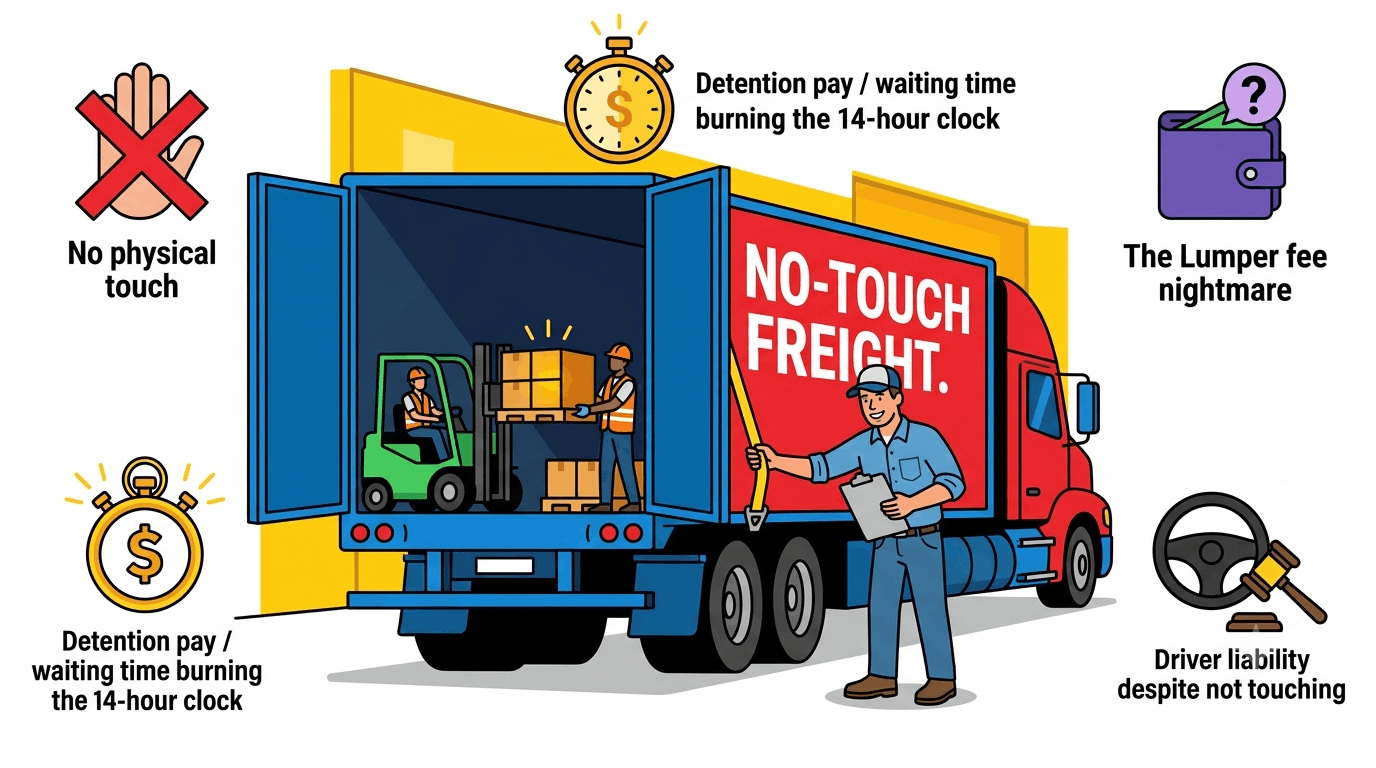
If you have spent any time browsing truck driving job listings, you have almost certainly come across the term “no-touch freight” splashed across recruitment ads. It sounds appealing less physical labor, less sweat, less strain. But what does it actually mean for your day-to-day life behind the wheel? More importantly, what are the hidden catches that recruiters do not always mention?
This guide breaks down everything you need to know about no-touch freight from the basic definition to the gritty realities of lumper fees, Hours of Service, and legal liability. Whether you are a seasoned veteran or a newly-minted CDL holder, understanding this concept inside and out can make or break your trucking career.
Quick Answer:
No-touch freight is a shipping arrangement where the truck driver is not responsible for loading or unloading the cargo. Instead, these tasks are handled by the shipper’s warehouse staff, the recipient’s employees, or third-party contractors.
The driver’s sole responsibility is to transport the load safely from point A to point B. This often involves waiting in the truck cab while dock workers use specialized equipment to handle the freight.
What Exactly Is No-Touch Freight?
At its core, no-touch freight is a shipping arrangement where the truck driver is not responsible for loading or unloading the cargo. Instead, these physical tasks are handled by the shipper’s warehouse staff, the receiver’s employees, or third-party contractors known as lumpers. The driver’s sole responsibility is to safely transport the load from point A to point B.
In practical terms, this means you back your trailer into the dock, wait in the cab while others do the heavy lifting, and then get back on the road. No pallet jacks, no hand trucks, no climbing in and out of trailers to rearrange boxes. Your job is to drive, not to be a warehouse worker.
However, it is important to note that no-touch freight does not always mean 100% touch-free. In some cases, drivers may still need to secure the load or make minor adjustments, such as reshuffling boxes before departure. The key distinction is that you are not expected to physically load or unload the entire shipment.
No-Touch Freight vs. Touch Freight: What Is the Difference?
To truly understand no-touch freight, it helps to compare it with its opposite: touch freight.
Touch freight is exactly what it sounds like the driver is physically involved in loading and unloading the cargo. This may involve operating equipment like pallet jacks, liftgates, load bars, straps, and dollies. Touch freight is common in sectors like food service, retail delivery, and beverage distribution.
Because touch freight involves additional physical labor, it often comes with higher pay to compensate for the extra work. However, it also carries greater liability and a higher risk of workplace injury.
No-touch freight, on the other hand, shifts the labor responsibility entirely to the shipper or receiver. This reduction in physical strain is the primary reason many drivers actively seek out no-touch freight jobs. The trade-off is that no-touch freight positions may offer slightly lower pay compared to touch freight roles.
The Two Faces of No-Touch Freight: Live Unload vs. Drop-and-Hook
Not all no-touch freight is created equal. There is a massive difference in convenience between a live unload and a drop-and-hook operation. Understanding this distinction is critical for managing your time and expectations.
Live Unload by Receiver
In a live unload scenario, you arrive at the facility, back into the dock, and wait while the receiving facility’s staff or a third-party lumper service unloads the entire trailer. You remain in the cab or an approved waiting area, observing the process but not participating in the manual handling.
The catch? You are stuck waiting. And waiting. And waiting. Depending on the facility’s efficiency, staffing levels, and workload, you could be there for hours. During this time, your 14-hour clock is still ticking if you are logging it as “on-duty not driving.”
Drop-and-Hook
Drop-and-hook is the gold standard of no-touch freight. In this scenario, you arrive at the facility, drop off your loaded trailer, and immediately hook up to another trailer that is already pre-loaded and waiting in the yard.
The beauty of drop-and-hook is that you never wait for loading or unloading at all. The average wait time for a drop-and-hook load is often an hour or less. You are in and out in minutes, which means more time driving and more miles under your belt.
Here is the key takeaway: All drop-and-hook freight is no-touch, but not all no-touch freight is drop-and-hook. When you see a job advertised as “no-touch,” do not assume it is drop-and-hook. Always clarify whether you will be doing live unloads or drop-and-hooks.
The Benefits of No-Touch Freight for Drivers
There is a reason why no-touch freight is such a popular selling point in job listings. The advantages are substantial, particularly for drivers who prioritize their long-term health and work-life balance.
Reduced Physical Strain and Injury Risk
This is the most obvious benefit. Regularly loading and unloading trailers takes a serious toll on the body over time. Repetitive lifting, pulling, and maneuvering heavy freight accelerates wear and tear on joints and the back. No-touch freight eliminates this physical strain, allowing drivers to conserve energy and stay focused on safe driving. For older drivers or those with physical limitations, no-touch freight jobs can extend their careers significantly.
Faster Turnaround Times
Compared to touch freight, no-touch freight is generally a faster process. You stay in the cab while workers handle the cargo, so you are ready to take off as soon as everything is loaded or unloaded. While waiting time for live unloads is still logged as “on-duty not driving,” the elimination of manual labor often results in faster facility turnaround times overall.
Reduced Liability
Since you never physically handle the cargo, you are not typically held responsible for damage that occurs during loading or unloading. This provides a layer of protection that touch freight drivers do not enjoy.
More Predictable Scheduling
When you are not responsible for loading or unloading, time at the dock becomes easier to estimate. This translates to better trip planning, more consistent delivery windows, and improved home-time expectations. The predictable scheduling that accompanies no-touch freight operations contributes to a better quality of life on the road.
The Hidden Drawbacks and Challenges
No-touch freight is not a perfect solution. There are several downsides that drivers need to be aware of before signing on the dotted line.
Potentially Lower Pay
The reduced physical demands of no-touch freight often mean lower pay compared to touch freight jobs. Touch freight roles frequently include a premium for the extra labor involved. If you are chasing the highest possible paycheck, you may need to weigh the convenience of no-touch freight against the lower compensation.
Less Control Over Loading Quality
When you do not load the trailer yourself, you have to trust that the warehouse workers are doing it correctly. Unfortunately, this is not always the case. Poorly stacked pallets, improper weight distribution, and inadequate securement can lead to serious problems on the road and you are the one who will face the consequences.
Detention and Waiting Time
Live unloads can be a nightmare for your 14-hour clock. If you are stuck at a dock for three hours while workers slowly unload your trailer, that time is logged as “on-duty not driving” unless you physically get into the sleeper berth. This burns through your available working hours and can ruin your entire day’s plan.
Many companies offer detention pay after a certain amount of free time typically after one or two hours but the rates vary widely. Some pay as little as $12.50 per hour after two hours, while others offer $25 to $30 per hour. Regardless, detention pay rarely compensates for the lost opportunity to drive more miles.
The Lumper Fee Nightmare: What Every Driver Must Know
This is where no-touch freight gets ugly. At many large grocery receivers and distribution centers think Walmart, Costco, and similar operations the store does not use its own staff to unload. Instead, they hire third-party crews called lumpers.
Here is the kicker: The driver is often required to pay the lumper service out of pocket sometimes $200 to $300 or more and then wait for reimbursement from the broker or carrier. This is not optional. In many cases, if you decline the lumper, your load simply does not get touched.
The Reimbursement Trap
The problems do not end with paying the fee. To get reimbursed, you typically need to submit a receipt within 24 hours. No receipt? Too bad you are out the money. Some lumpers are still paper-based, and drivers do not even get receipts at all. Meanwhile, brokers get paid instantly by the shipper, leaving the driver holding all the risk.
What Should Happen vs. What Actually Happens
The lumper is performing a service on behalf of the shipper, not the driver. Ideally, the shipper should authorize and pay the lumper directly. If a broker is involved, they should issue the payment code and handle all documentation. If the driver pays out of pocket, reimbursement should be instant.
Unfortunately, the reality is often far from ideal. Some brokers especially those who truly support drivers make this process smooth by pre-authorizing lumpers and paying directly. But there is a growing number who do not.
How to Protect Yourself
Before accepting any no-touch freight job, ask these critical questions:
- Who pays the lumper fees? If the answer is “you do, and we reimburse you,” ask about the reimbursement timeline and process.
- What happens if I do not get a receipt? This is a deal-breaker question.
- Does the company offer lumper advances? Some factoring companies provide advances to cover these costs upfront.
Some companies are transparent about this in their job postings, explicitly stating “Lumper fees paid by the company never coming out of your pocket”. These are the jobs you want.
The Liability Trap: You Do Not Touch It, But You Are Still Responsible
This is perhaps the most misunderstood aspect of no-touch freight. Even though you are not physically loading or unloading the cargo, DOT regulations place the ultimate responsibility for load securement on the driver.
If a warehouse worker poorly stacks pallets, puts too much weight on the front axle, or fails to secure the back row of freight, and the load shifts during a hard brake you get the ticket and the cargo claim, not the warehouse worker. The driver has the authority and the obligation to inspect the load before departure.
The Smart Driver’s Approach
Seasoned drivers know that “no-touch” does not mean “no-inspection.” Before sealing the trailer doors, always:
- Peek inside to check for bulging or unstable stacks
- Test the straps to ensure they are properly tensioned
- Verify the weight distribution to avoid axle overload violations
- Note any concerns on the bill of lading with the phrase “Shipper Load and Count – Driver Not Liable”
You may not touch the boxes, but you absolutely must touch the straps and visually inspect the load. This simple habit can save you from thousands of dollars in fines and cargo claims.
How No-Touch Freight Affects Your Hours of Service
Your 14-hour clock is your most precious resource as a truck driver. No-touch freight can either protect it or destroy it, depending on the type of operation.
Live Unload: The Clock Burner
If you are doing a live unload and you remain in the driver’s seat or the cab, you are logging that time as “On-Duty (Not Driving)”. This burns your 14-hour clock. If you are stuck for three hours, that is three hours you cannot use for driving later in the day.
The Sleeper Berth Loophole
If you know you are going to be waiting for an extended period, you can log that time as “Sleeper Berth” or “Off-Duty” but only if you physically get into the sleeper berth. This pauses your 14-hour clock and can preserve your driving hours.
Drop-and-Hook: The Clock Saver
Drop-and-hook is the ultimate clock-saver. Since you are not waiting for loading or unloading at all, every minute of your 14-hour clock can be dedicated to driving. This is why drop-and-hook no-touch freight is so highly sought after.
Is No-Touch Freight Right for You?
The answer depends entirely on your priorities as a driver.
Choose no-touch freight if:
- You want to minimize physical labor and reduce injury risk
- You prefer a more predictable daily routine
- You are willing to accept potentially lower pay for reduced physical demands
- You can handle the frustration of waiting during live unloads
Avoid no-touch freight if:
- You want to maximize your paycheck and are willing to do physical labor
- You prefer to control how your load is secured and stacked
- You cannot stand waiting at docks for hours
- You want to avoid the headache of lumper fees and reimbursements
Final Thoughts: The Pro-Tip for No-Touch Freight Success
After years in the industry, seasoned drivers have figured out the formula for stress-free no-touch freight. Here is their advice:
- Seek out drop-and-hook operations whenever possible. This is the true gold standard of no-touch freight.
- Clarify the lumper fee policy before accepting any job. If the company does not pay lumpers directly, move on.
- Always inspect the load before sealing the doors. You may not touch the freight, but you are still responsible for it.
- Write “Shipper Load and Count” on the paperwork to protect yourself from shortage claims.
- Know your detention pay rates and track your waiting time diligently.
No-touch freight can be a fantastic career choice for drivers who value their physical health and want a more predictable workday. However, it is not a free pass to ignore your responsibilities. The smartest drivers treat no-touch freight as an opportunity to focus on what they do best driving safely and efficiently while still taking ownership of the load through thorough inspection and documentation.
Choose wisely, ask the right questions, and you can build a long, healthy, and profitable career hauling no-touch freight across America’s highways.
Frequently Asked Questions:
What is no-touch freight in trucking?
What is the difference between no-touch freight and touch freight?
Is no-touch freight the same as drop-and-hook?
What are the benefits of no-touch freight?
What are the drawbacks of no-touch freight?
What types of freight are typically no-touch?
Does no-touch freight pay less than touch freight?
Is no-touch freight better for new drivers?
What is the difference between a live load and drop-and-hook?
Which trucking companies offer no-touch freight?
Is no-touch freight better for older drivers?
What should I look for in a no-touch freight job?
Ready to stop dreaming and start driving?
Fill out the form and a Remms recruiter will reach out within one business day. No spam, no pressure — just real results.
Submit Driver Profile