

You’re running the business.
You wear ten hats, sleep less, and growth feels slow.
What if you could buy back hours of your week and turn them into results?
That’s what virtual assistant services do. They free you to do the high-leverage work. This is the playbook I wish someone gave me when I started hiring help.
Why this matters?
Most small business owners think “hire later.” They wait until they’re burning out. That costs momentum. Every week you delay, you miss opportunities. A well-deployed VA converts time into traction. In plain terms: hire smarter, grow faster.
Today, you’ll learn:
- Advanced tactics most people don’t use.
- A no-fluff definition of services that work for small businesses.
- High-ROI tasks you can delegate right now.
- Mini-case studies you can copy.
- A comparison with ROI scoring.
- A 7-day sprint to get traction fast.
The Pain & the Real Cost of Doing It All
Let’s be blunt. You’re not short on ideas. You’re short on time. Time is the one thing you can’t debit or credit. You can always hire faster than you can invent more hours in a day.
Delegation does not only reduce stress it improves client experience, conversion speed, and consistency.
Translate that into action. If you spend your week on low-leverage tasks, you’re trading away growth. A VA changes that exchange.
What Exactly Are Virtual Assistant Services for Small Businesses?
A virtual assistant is remote help that does clearly defined work for you. Not vague “help” — specific tasks with measurable outputs. In small business settings the most valuable VAs are specialists: social media VAs, lead-gen VAs, client-onboarding VAs, and operations VAs.
Core idea: You want output. Hire for outcomes, not for “availability.” The clearer the task, the faster the ROI.
High-ROI Tasks You Should Delegate First
Start where you get the biggest win for the least risk. That list is the secret sauce for small businesses.
- Email + Calendar Triage — Clean inbox, prioritized replies, fewer context switches.
- Lead Qualification & CRM Updates — Move leads from “cold” to “actionable.”
- Social Media Execution — Content batching, captions, scheduling, and community replies.
- Customer Support — Fast answers, surveys, and ticket handling.
- Recurring Admin — Invoicing, expense tracking, research, data entry.
📘 Micro Case Studies: Under 60 Seconds Each
Quick snapshots showing how real small businesses transformed using virtual assistants.
Case Study #1 — Saved 22 Hours/Week
Sarah was handling customer messages and returns herself. She hired a customer-support VA for 20 hours/week. Within 3 weeks response time dropped from 48 hours to under 6 hours. Returns decreased and reviews improved. Sarah spent the reclaimed time on partnerships and found one retailer that doubled her monthly revenue.
Case Study #2 — 3X More Leads
Jason, spent nights chasing leads and scheduling. A calendar-and-lead VA cleaned his funnel. Qualified leads increased 30% because follow-ups were consistent. Jamal closed more deals and stopped working weekends.
Case Study #3 — $4,500 Saved Monthly
A small recruiting team used a VA for candidate sourcing and template messaging. Time to fill roles decreased by half. Recruiters spent more time interviewing and less on manual sourcing.
VA vs. In-House Employee
Use the table to decide: if a task is tactical, start with a VA. If it’s core strategy, consider in-house or hybrid models.
| Feature | Virtual Assistant | In-House Employee | ROI Score |
|---|---|---|---|
| Cost | Low pay for hours/tasks | High salary + office + benefits | High |
| Ramp Time | Fast days to 2 weeks | Slow weeks to months | Medium |
| Flexibility | Scale up/down quickly | Fixed hours and salary | High |
| Quality of Specialization | Easy to find specialists | May take time to hire specialist | Medium |
| Long-Term Control | Good for tactical tasks | Better for core strategic roles | Medium |
How to Hire the Right VA
Hiring the right VA is mostly about process. Follow this checklist.
- Define outcomes — What does “done” look like? Be specific.
- Start with a trial — 10–20 hours to test fit.
- Ask for work samples — Templates, past posts, messages, tickets.
- Test with real tasks — Not hypothetical ones.
- Measure weekly — KPIs and short feedback loops.
- Document SOPs — SOPs let you scale the VA to handle more.
- Pay fairly — Competitive pay buys consistency.
Advanced Playbook — What Small Businesses With VAs Do Differently
Most people hire a VA and give them a list. Better businesses build systems. Here’s what sets the winners apart.
Systems-first mindset: Create repeatable processes instead of one-off asks.
Asynchronous workflows: Use shared docs and voice notes; avoid constant Zooms.
Output-based KPIs: Track results, not hours.
Cross-training:Train VAs in two adjacent skills to increase flexibility.
Incremental delegation: Increase ownership over time
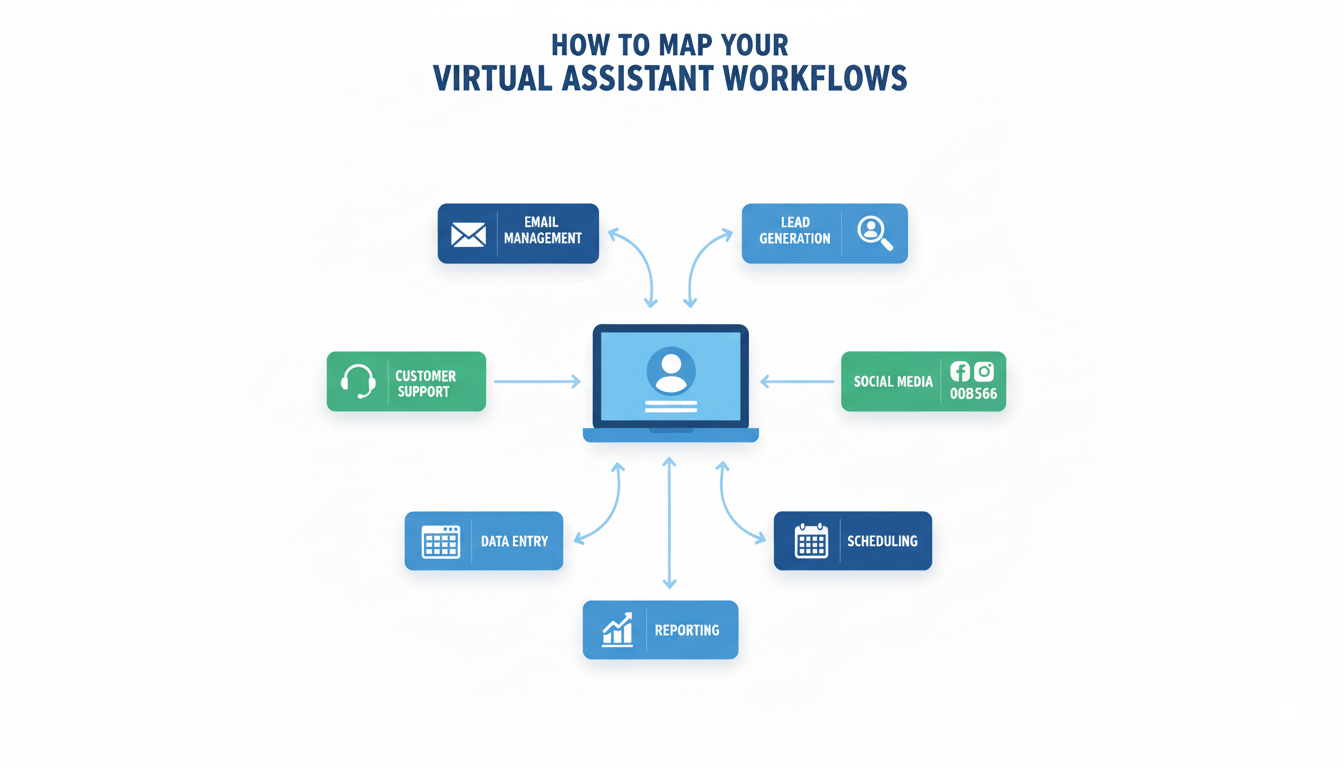
How to Map Your VA Workflows
📩 Plug-and-Play Templates That Get Replies
Use these proven scripts to get clients, close deals, and grow your small business — instantly.
Email Template — “Warm Lead Nurture”
Hello {{Name}},
Just wanted to drop something helpful your way…
...
DM Template — “Value First Approach”
Hey {{Name}}, I noticed you're working on…
...
Outreach Template — “The Fast Offer”
Hi {{Name}}, if you're currently spending too much time on…
...
🚀 The 7-Day Speed Execution Plan
A simple, fast, zero-overwhelm roadmap to implement VA support in one week.
List all low-value tasks draining your time.
Rank tasks by ROI + Stress level.
Create your first delegation pack (templates + SOPs).
Hire or shortlist your VA with a 15-minute test task.
Assign your first 3 recurring tasks.
Automate communication workflows.
Review → Optimize → Increase VA output by 30%.
Ready to Grow Your Small Business?
If you’re tired of doing everything yourself and you’re ready to scale your business without stress, it’s the perfect time to hire a VA.
Book a Free Consultation