
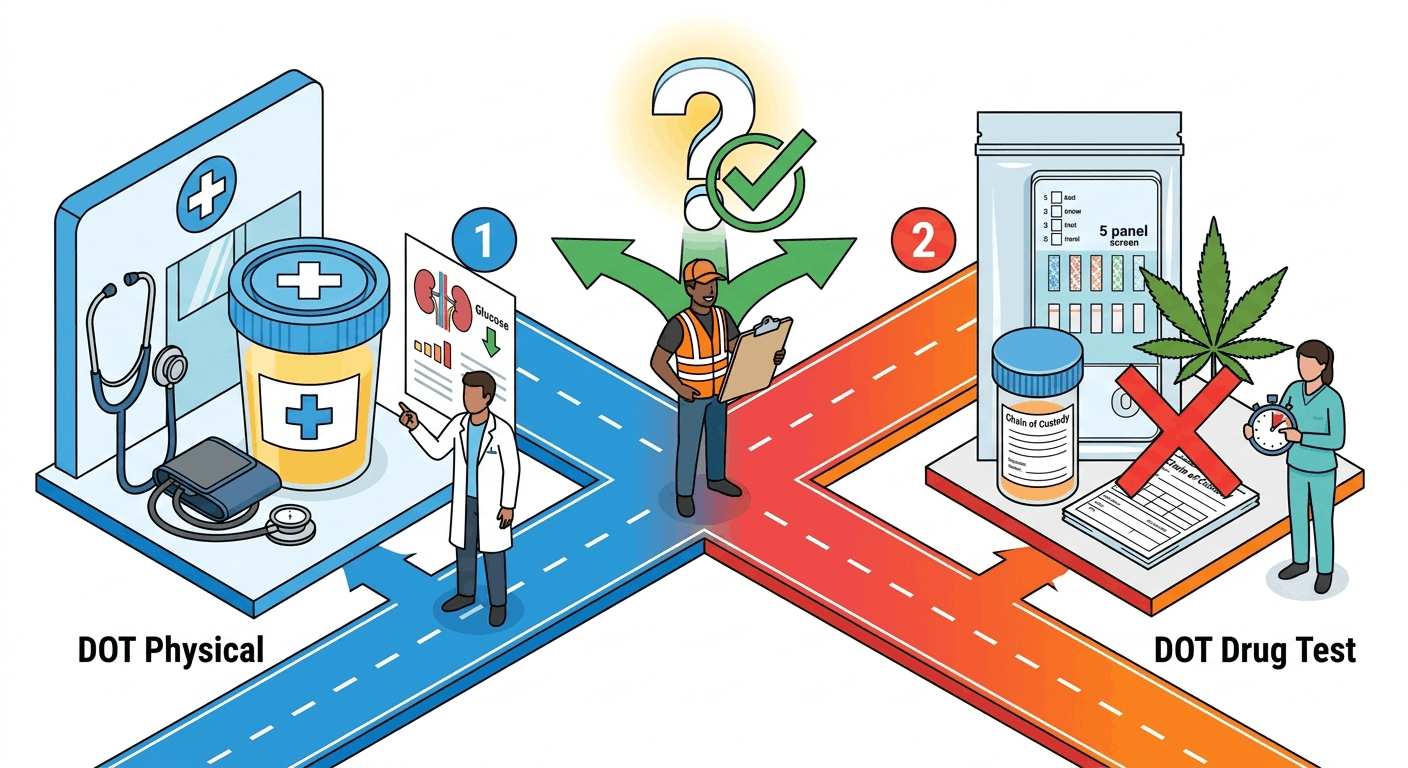
If you’re a commercial driver or an employer in the transportation industry, you’ve likely asked yourself: does a DOT physical require a drug test? It’s a common question with a surprisingly nuanced answer.
The short answer is no but the full picture is more complex. While the DOT physical itself doesn’t include a drug test, drug testing remains an absolute requirement for anyone in a safety-sensitive transportation role.
Understanding the distinction between these two processes is essential for compliance, career longevity, and public safety.
This comprehensive guide will walk you through everything you need to know about DOT physicals, drug testing requirements, and the latest 2026 regulatory updates.
Whether you’re a veteran truck driver, a fleet manager, or a newcomer to the industry, this article will clarify the confusion and help you stay compliant.
What Is a DOT Physical?
A Department of Transportation (DOT) physical, also known as a DOT medical exam, is a mandatory health evaluation for commercial motor vehicle (CMV) drivers.These exams are governed by the Federal Motor Carrier Safety Administration (FMCSA) and are designed to ensure that drivers are physically, mentally, and emotionally fit to safely operate large vehicles on public roads.
The DOT physical must be conducted by a certified medical examiner listed on the FMCSA National Registry. The examination evaluates:
- Vision and hearing
- Blood pressure and heart health
- Neurological function
- Musculoskeletal health
- Respiratory function
- Mental health and cognitive ability
- Urinalysis for medical screening
A valid DOT medical card is required to operate a commercial motor vehicle, and it must be renewed at least every two years or more frequently if the driver has certain medical conditions.
Does a DOT Physical Include a Drug Test? The Direct Answer
No, a DOT physical does not include a drug test. The urine sample you provide during a DOT physical is used for medical screening purposes, not for detecting drug use. However, and this is a critical distinction every commercial driver is required to undergo DOT drug testing at various points throughout their employment.
The question “does a DOT physical require a drug test?” often arises because the physical and the drug test are closely related in the minds of drivers and employers alike.
In reality, these are two separate requirements governed by different regulations:
| Requirement | Regulation | Purpose |
|---|---|---|
| DOT Physical | 49 CFR Part 391 | Medical fitness to operate a CMV |
| DOT Drug Test | 49 CFR Part 382 & Part 40 | Detection of prohibited substance use |
Drug testing requirements are separate from the DOT physical process and require testing at six distinct points throughout a driver’s employment.
Why the Confusion Exists: Urinalysis vs. Drug Test
The confusion surrounding whether a DOT physical requires a drug test stems from one simple fact: both processes involve providing a urine sample. During a DOT physical, you’ll be asked to provide a urine sample for a urinalysis. This is a medical test that screens for indicators of underlying health conditions not drugs.
Unless the examiner requests a second sample specifically for drug testing (sometimes done during pre-employment), the urine you provide for the physical isn’t used to detect drug use.
The urinalysis during a DOT physical screens for:
- Glucose – an indicator of possible diabetes
- Protein – which may signal kidney issues
- Blood – which could indicate infection or other medical problems
A DOT drug test, on the other hand, is a regulated test performed under the DOT drug and alcohol testing program, with its own strict chain-of-custody requirements and laboratory protocols.
What Does a DOT Physical Urinalysis Actually Screen For?
The urinalysis conducted during a DOT physical is a standard medical screening tool. It helps the medical examiner identify conditions that could impair a driver’s ability to operate a CMV safely.
The medical examiner reviews your urine for:
- Glucose – Elevated levels may indicate diabetes, which requires careful management and monitoring for commercial drivers.
- Protein – Protein in the urine can be a sign of kidney disease or damage.
- Blood – The presence of blood may indicate infection, kidney stones, or other urological issues.
This urinalysis does not test for marijuana, cocaine, opioids, amphetamines, or PCP. It is purely a medical screening tool.
DOT Drug Testing: What It Is and When It Happens
Now that we’ve established that a DOT physical does not require a drug test as part of the exam itself, let’s explore what DOT drug testing actually involves.
DOT drug testing falls under 49 CFR Part 382 (for FMCSA-regulated employers) and 49 CFR Part 40 (the overall DOT drug and alcohol testing procedures).
The testing is administered through a DOT-compliant program with strict protocols for collection, chain of custody, laboratory analysis, and medical review.
Currently, DOT drug testing uses urine specimens exclusively. While the DOT has authorized oral fluid testing as an alternative methodology, employers cannot yet utilize this method because there are currently no HHS-certified laboratories available to perform oral fluid testing.
The 5-Panel DOT Drug Test: What Substances Are Tested?
The DOT drug test is a 5-panel urine drug screen that tests for five specific classes of drugs:
| Substance Class | Examples |
|---|---|
| Marijuana | THC metabolites |
| Cocaine | Cocaine and its metabolites |
| Opiates | Codeine, morphine, heroin, hydrocodone, hydromorphone, oxycodone, oxymorphone |
| Amphetamines | Amphetamine, methamphetamine, MDMA (ecstasy) |
| Phencyclidine | PCP |
The test is conducted in two stages: an initial immunoassay screening, followed by a confirmation test using gas chromatography/mass spectrometry (GC/MS) if the initial screening returns a non-negative result.
It’s worth noting that the DOT has proposed adding fentanyl and norfentanyl to the testing panels. In January 2025, the U.S. Department of Health and Human Services announced a rule to add fentanyl to federal workplace drug testing panels.
While this change hasn’t yet been finalized for DOT testing, it represents a significant upcoming development.
The Six Testing Scenarios Under DOT Regulations
Now that we’ve answered “does a DOT physical require a drug test?” with a clear no, let’s look at when drug testing actually is required. DOT drug testing occurs in six specific scenarios:
1. Pre-Employment Testing
Before a driver can perform any safety-sensitive function for a new employer, they must pass a DOT drug test. This applies to all CDL drivers and other safety-sensitive transportation workers.
2. Random Testing
Employers must randomly test at least 50% of their safety-sensitive employees for drugs annually. The random testing rate for alcohol is 10%. These tests are unannounced and conducted throughout the year.
3. Post-Accident Testing
Drug testing is required after qualifying accidents:
- When a human fatality occurs
- When a driver is cited for a moving violation AND the accident results in injury or disabling vehicle damage
4. Reasonable Suspicion Testing
If a trained supervisor observes specific behavioral, speech, or appearance indicators of drug use, they can require the driver to undergo a drug test.
5. Return-to-Duty Testing
After a positive drug test or a refusal to test, a driver must complete the return-to-duty process including evaluation by a Substance Abuse Professional (SAP), compliance with recommended treatment, and a negative return-to-duty drug test before resuming safety-sensitive duties.
6. Follow-Up Testing
Following a return-to-duty, drivers are subject to unannounced follow-up drug testing. The DOT requires at least 6 tests in the 12 months following return-to-duty. This follow-up period typically lasts for five years.
2026 Updates: Oral Fluid Testing and New Regulations
The regulatory landscape for DOT drug testing is evolving. On May 11, 2026, the U.S. Department of Transportation published a final rule amending its drug and alcohol procedures under 49 CFR Part 40. The rule becomes effective June 10, 2026.
Key Updates:
1. Directly Observed Urine Collections
The DOT amended Part 40 to allow employers to use directly observed urine collections in situations where oral fluid testing would otherwise be required but only as long as oral fluid testing is not yet available. This is characterized as an interim measure.
2. Oral Fluid Testing Prerequisites
The Final Rule clarifies that oral fluid testing will be considered “available” only if:
- At least two HHS-certified oral fluid laboratories are available
- A qualified oral fluid collector is available
- A conforming oral fluid collection device is available at the collection site
3. 18-Month Grace Period
DOT adopted an 18-month grace period following HHS’s announcement of a second certified oral fluid drug testing laboratory. During this period, employers may continue to conduct directly observed urine collections until they’re set up for oral fluid testing.
4. Terminology Updates
The rule replaces “gender” with “sex” in certain provisions of Part 40 to align with Executive Order 14168.
What About Marijuana?
Despite ongoing discussions about marijuana rescheduling, DOT’s drug testing process and regulations have not changed. As of 2026, marijuana remains a Schedule I drug under federal law, and it is still unacceptable for people in safety-sensitive transportation positions to use marijuana.
The DOT is closely following the rescheduling process and will update the industry as changes occur.
What Happens If You Fail a DOT Drug Test?
A positive DOT drug test has serious consequences for commercial drivers:
Immediate Removal from Duty: The driver is immediately removed from performing any safety-sensitive functions.
Return-to-Duty Process: The driver must undergo a return-to-duty process, which includes:
- Evaluation by a Substance Abuse Professional (SAP)
- Compliance with recommended treatment or education
- A negative return-to-duty drug test
Follow-Up Testing: The driver is subject to unannounced follow-up drug testing for a specified period, typically five years.
Employer Notification: The employer is notified of the positive test result.
FMCSA Clearinghouse Reporting: Positive DOT drug test results and refusals to test are reported to the FMCSA Drug and Alcohol Clearinghouse. This means the violation follows the driver across employers.
Refusal to Test = Test Failure: Under DOT rules, refusing to take a drug test is treated as a test failure.
Prescription Medications and the DOT Physical
Although a DOT physical does not require a drug test, the medical examiner will review all current medications you’re taking including prescriptions for diabetes, heart disease, blood pressure, neurological conditions, mental health, and post-surgical recovery.
Some medications may:
- Temporarily disqualify you from driving
- Result in a medical certificate valid for only 6 or 12 months instead of the standard 2 years
- Require a letter from your prescribing physician describing your condition, the medications you take, and the impact on your ability to drive safely
If you’re taking a prescription medication that could cause a positive drug test result (such as prescription codeine or Adderall), the Medical Review Officer (MRO) will review this with you during the verification process.The MRO is a licensed physician responsible for interpreting and verifying drug test results.
State Marijuana Laws vs. Federal DOT Regulations
A common question drivers ask alongside “does a DOT physical require a drug test?” is about marijuana.
Even if you live in a state where marijuana is legal for medical or recreational use, DOT regulations still prohibit its use for anyone in a safety-sensitive transportation position.The FMCSA has made this clear: “Legalization of marijuana use by States and other jurisdictions also has not modified the application of U.S. Department of Transportation (DOT) drug testing regulations in 49 CFR parts 40 and 382”.
This means:
- A positive marijuana test is a violation regardless of state law
- Medical marijuana prescriptions do not exempt drivers from DOT testing requirements
- CBD products containing even trace amounts of THC can potentially cause a positive test
Final Thoughts
So, does a DOT physical require a drug test? The definitive answer is no the physical itself does not include drug testing. However, this distinction is just the beginning of understanding DOT compliance.
The DOT physical and DOT drug testing are two separate but equally essential requirements for commercial drivers. The physical ensures you’re medically fit to operate a CMV, while drug testing ensures you’re not using prohibited substances that could impair your ability to drive safely.
As we move through 2026, the regulatory landscape continues to evolve. Oral fluid testing is on the horizon, fentanyl may soon be added to the testing panel, and the ongoing discussion around marijuana rescheduling could eventually impact DOT regulations. Staying informed about these changes is essential for both drivers and employers.
For drivers, the key takeaways are:
- Your DOT physical urine sample is for medical screening, not drug testing
- You remain subject to drug testing at six distinct points throughout employment
- Marijuana use is prohibited regardless of state law
- Prescription medications must be disclosed and reviewed by the MRO
- A positive test has serious consequences but there is a path to return-to-duty
For employers, the key takeaways are:
- Maintain a DOT-compliant drug testing program
- Ensure all safety-sensitive employees are tested at the required intervals
- Report violations to the FMCSA Clearinghouse
- Stay updated on regulatory changes, including the 2026 final rule
Ultimately, the question “does a DOT physical require a drug test?” reflects a broader need for clarity in a complex regulatory environment. By understanding the distinction between these two requirements and the specific obligations they create drivers and employers can maintain compliance, ensure safety, and keep America’s transportation system running smoothly.
Frequently Asked Questions
Does a DOT physical require a drug test at the appointment?
Can an employer require a drug test during the DOT physical?
Does a DOT physical require a drug test for CDL renewal?
What happens if I test positive on a DOT drug test?
Is hair follicle testing allowed for DOT drug tests?
When will oral fluid testing be available?
Does a DOT physical require a drug test for owner-operators?
Can I use CBD products as a commercial driver?
Ready to stop dreaming and start driving?
Fill out the form and a Remms recruiter will reach out within one business day. No spam, no pressure — just real results.
Submit Driver Profile