
Disclaimer: CDL regulations vary by state and are subject to change. Always check with your state DMV and the FMCSA for the most current information. This article is for informational purposes only and does not constitute legal advice.
Introduction:
A CDL restriction is a code placed on your commercial driver’s license that legally limits the types of commercial motor vehicles you are allowed to operate. In simple terms, endorsements add driving privileges to your CDL, while restrictions take some away.
Common CDL Restriction Codes
Restriction codes are printed on the front of your CDL. Here are some of the most common ones you may encounter, along with what they mean and how they are typically triggered.
| Code | Restriction | How It’s Triggered | Career Impact |
|---|---|---|---|
| E | Automatic Transmission Only | You take your CDL skills test in a vehicle with an automatic transmission. | You are legally prohibited from driving a manual transmission truck. This can limit you from some specialized, higher-paying jobs or carriers with manual fleets. |
| L | No Air Brakes | You fail the air brakes knowledge test or take your skills test in a vehicle without air brakes. | You cannot operate any commercial vehicle with air brakes. This is a very limiting restriction, as almost all Class A trucks use air brakes. |
| Z | No Full Air Brakes | You take your test in a vehicle with an “air over hydraulic” brake system. | Similar to the “L” restriction, it limits you from operating vehicles with full air brake systems. |
| O | No Tractor-Trailer | You take your skills test with a pintle hook or utility trailer instead of a standard fifth-wheel connection. | You are restricted from driving standard semi-trucks and trailers, as you cannot operate a vehicle with a fifth-wheel. |
| M | No Class A Passenger Vehicle | You take your passenger endorsement exam in a Class B bus. | If you hold a Class A CDL, you are restricted from driving Class A passenger vehicles like large coaches. |
| K | Intrastate Only | You are under 21 years of age or do not have the required medical clearance for interstate driving. | You are legally restricted to driving only within the state that issued your CDL. |
| V | Medical Variance | You have an FMCSA-approved medical exemption or variance (e.g., for corrected vision or a hearing aid). | This code indicates you have a medical waiver on file and must carry it with you. |
| N | Restricted Passenger Vehicles | You take your passenger endorsement exam in a Class C vehicle. | You are restricted to operating only Class C passenger vehicles or school buses. |
It’s important to remember that while these are the standard federal codes, states can add their own specific restrictions. For example, New York uses codes like “A3” (excepted vehicle) and “S1” (school bus only). Always check with your local DMV for any state-specific codes.
How to Avoid or Remove Restrictions
The best way to avoid a restriction is to take your CDL skills test in the type of vehicle you want to be fully licensed to drive.
If you already have a restriction on your license, it is not permanent. In most cases, you can have it removed by:
- Obtaining a Commercial Learner’s Permit (CLP) for the specific vehicle or system you need to test on.
- Passing the required knowledge test(s) (e.g., the Air Brakes Knowledge Test to remove an “L” restriction).
- Passing the CDL skills test in a vehicle that is not subject to the restriction you want to remove (e.g., a truck with a manual transmission to remove the “E” restriction).
- Paying the applicable fees for a replacement license.
Introduction: Your CDL Is More Than Just a License It’s Your Career Passport
Let me ask you something, driver. Have you ever looked at your Commercial Driver’s License and noticed those little letters printed on the front maybe an “E,” an “L,” or a “K” and wondered what they really mean?
If you have, you’re not alone. Most truck drivers focus on getting their CDL and forget to pay attention to the fine print. But here’s the truth: those tiny letters can make the difference between a six-figure career and being turned away at the hiring gate.
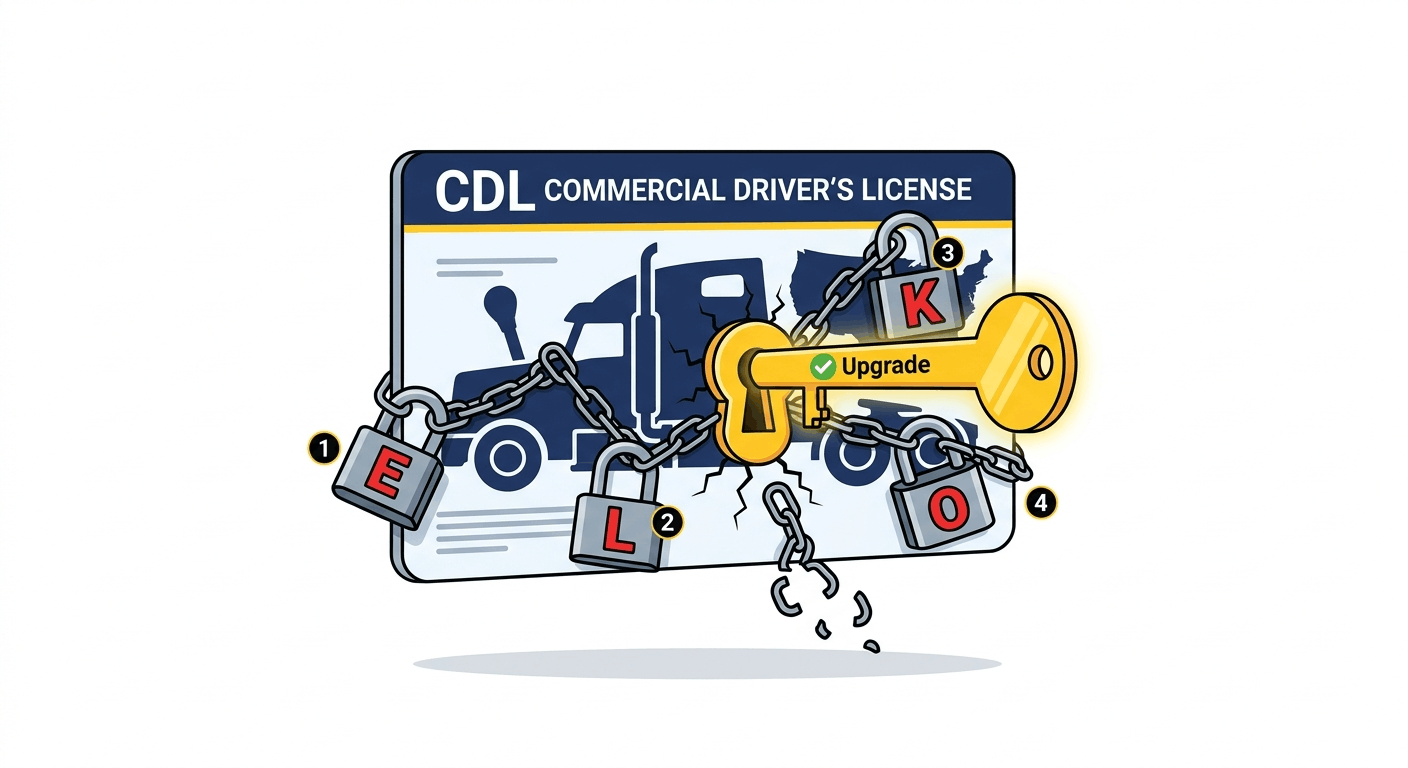
Think of your CDL like a set of keys. A full, unrestricted CDL is like having a master key that opens every door in the trucking industry. But CDL restrictions?
Those are like having keys that only open certain locks. They limit where you can go, what you can drive, and how much money you can make.
According to the Federal Motor Carrier Safety Administration (FMCSA), CDL restrictions are applied when a driver takes their skills test in a vehicle that lacks certain features required for specific types of commercial motor vehicles.
In plain English? If you test in an automatic truck, you get an “E” restriction. If you test in a truck without air brakes, you get an “L” restriction. It’s that simple and that consequential.
In this guide, we’re going to break down every major CDL restriction code, what it means for your career, and most importantly how to get rid of it. So grab a cup of coffee, pull up a chair, and let’s dive in.
What Exactly Are CDL Restrictions?
Before we get into the nitty-gritty of each code, let’s start with the basics.
A CDL restriction is a limitation placed on your commercial driver’s license that defines what types of vehicles you can operate and under what conditions.
While CDL endorsements expand your driving privileges (think HazMat, Tanker, or Passenger endorsements), restrictions do the opposite they put boundaries on your license.
On your physical CDL, these restriction codes appear on the front, typically located beneath the expiration date and endorsement fields, following the letter “R”. The full explanation of each restriction is printed on the back of your license.
Why do restrictions exist? The FMCSA and state DMVs use restrictions to ensure that drivers only operate vehicles they’ve been properly trained and tested on. It’s a safety mechanism plain and simple.
If you’ve never driven a manual transmission truck, you shouldn’t be behind the wheel of one on a busy interstate. That’s common sense, right?
However, here’s the kicker: having restrictions on your license is legal, but it can seriously limit your job opportunities and earning potential.
Many trucking companies require unrestricted CDLs for long-haul or specialized freight transport. Employers often prioritize drivers who can operate both manual and automatic trucks, and they’re willing to pay more for that flexibility.
The good news? Most CDL restrictions can be removed. You just need to know how.
The Complete List of CDL Restriction Codes
Now, let’s get into the meat of this article. Below is a comprehensive breakdown of every major CDL restriction code. I’ve organized them from most common to least common, so you can quickly find what you’re looking for.
E Restriction: No Manual Transmission CMV
What it means: You cannot operate any commercial motor vehicle with a manual transmission. You’re restricted to automatic or semi-automatic transmissions only.
How it happens: You took your CDL skills test in a vehicle with an automatic transmission.
Why it matters: This is one of the most common restrictions out there, and it’s also one of the most career-limiting. Many trucking companies especially in long-haul and OTR (Over-The-Road) operations still use manual transmissions.
They prefer manual transmission experience for cost efficiency and maintenance benefits. If you have an “E” restriction, you’re automatically eliminated from a significant portion of job opportunities.
How to remove it: You’ll need to retake the CDL skills test in a vehicle with a manual transmission. Some states require additional training or fees. The process typically involves:
- Holding a CLP without the restriction for 14 days (in many states)
- Passing the on-road portion of the skills test in a manual transmission CMV
The bottom line: If you want maximum flexibility in your trucking career, get rid of this restriction. It’s worth the effort.
L Restriction: No Full Air Brake System
What it means: You cannot operate any commercial motor vehicle equipped with a full air brake system. You’re limited to vehicles with hydraulic brakes or other non-air brake systems.
How it happens: You either failed the air brake knowledge test, couldn’t identify air brake system components, didn’t correctly perform an air brake system check, or took your skills test in a vehicle without a full air brake system.
Why it matters: This is a major restriction. Air brakes are standard equipment on virtually every heavy-duty commercial truck in America. If you have an “L” restriction, you’re essentially locking yourself out of 90% of trucking jobs.
As one industry expert put it, an “L” restriction may limit you to vehicles without air brakes, reducing the number of available positions significantly.
How to remove it: You’ll need to:
- Pass the air brake knowledge test (if you haven’t already)
- Hold a CLP without the restriction for 14 days (in many states)
- Pass the vehicle inspection and on-road portion of the skills test in a CMV with air brakes
The bottom line: If there’s one restriction you absolutely must remove, it’s this one. Air brakes aren’t going anywhere, and neither should this restriction.
Z Restriction: No Full Air Brake CMV (Air-Over-Hydraulic)
What it means: Similar to the “L” restriction, but specifically for drivers who tested in a vehicle with an air-over-hydraulic brake system rather than full air brakes. You’re not authorized to operate CMVs with full air brakes.
How it happens: You took your skills test in a vehicle equipped with air-over-hydraulic brakes a system that combines elements of both air and hydraulic braking.
Why it matters: While slightly less restrictive than the “L” (since you can still drive air-over-hydraulic vehicles), you’re still locked out of the vast majority of heavy-duty trucks that use full air brakes.
How to remove it: The process is essentially the same as removing an “L” restriction. You’ll need to pass the air brake knowledge and skills test in a fully air-brake-equipped CMV.
The bottom line: If you have a “Z,” treat it like an “L” get it removed as soon as possible.
K Restriction: Intrastate Only
What it means: You are limited to operating commercial motor vehicles only within the state where your CDL was issued. You cannot cross state lines for any commercial driving purpose.
How it happens: This restriction is most commonly applied to drivers between the ages of 18 and 20. Federal law prohibits interstate commercial driving under age 21, so states apply the “K” restriction to keep young drivers within state borders.
Why it matters: If you’re over 21 and still have this restriction, you’re severely limiting your career. The vast majority of trucking jobs especially the high-paying ones involve crossing state lines. Long-haul OTR, regional routes, and even many local jobs that deliver across state borders will be off-limits.
How to remove it: If you’re under 21, you simply need to wait until you turn 21 and visit your DMV to upgrade your license. If you’re over 21 and still have this restriction, you need to visit your DMV office and update your license to remove the restriction.
The bottom line: This is a temporary restriction for most drivers. If you’re over 21 and still have it, fix it immediately.
O Restriction: No Tractor-Trailer (Fifth-Wheel Connection)
What it means: You cannot operate any Class A vehicle with a fifth-wheel connection. You’re limited to Class A vehicles with pintle hooks, gooseneck connections, or other non-fifth-wheel attachments.
How it happens: You took your skills test in a Class A vehicle with a pintle hook or other non-fifth-wheel connection instead of a standard fifth-wheel.
Why it matters: If you have a Class A CDL with an “O” restriction, you’re essentially driving a Class A truck that can’t pull a standard semi-trailer.
That defeats the whole purpose of having a Class A license. Most Class A jobs involve fifth-wheel connections.
How to remove it: You’ll need to:
- Hold a CLP without the restriction for 14 days (in many states)
- Pass the complete skills test in a vehicle with a fifth-wheel connection
The bottom line: If you want to pull standard 53-foot trailers the backbone of the trucking industry you need to remove this restriction.
M Restriction: No Class A Passenger Vehicle
What it means: If you have a Class A CDL but took your passenger or school bus test in a Class B vehicle, you’re restricted to operating only Class B and C passenger vehicles.
How it happens: You took the skills test for your passenger (P) or school bus (S) endorsement in a Class B vehicle instead of a Class A vehicle.
Why it matters: If you’re planning to drive passenger vehicles or school buses, this restriction limits you to smaller buses. You won’t be able to operate the larger Class A passenger vehicles.
How to remove it: You’ll need to:
- Hold a CLP without the restriction for 14 days
- Pass the skills test in a Class A passenger vehicle
N Restriction: No Class A or B Passenger Vehicle
What it means: If you have a Class B CDL but took your passenger or school bus test in a Class C vehicle, you’re restricted to operating only Class C passenger vehicles.
How it happens: You took the skills test for your passenger (P) or school bus (S) endorsement in a Class C vehicle instead of a Class B vehicle.
Why it matters: Similar to the “M” restriction, this limits you to the smallest class of passenger vehicles.
How to remove it: You’ll need to:
- Hold a CLP without the restriction for 14 days
- Pass the skills test in a Class A or Class B passenger vehicle
- If you test in a Class B, the “N” will be replaced with an “M” restriction
P Restriction: No Passengers in CMV Bus
What it means: You cannot operate any CMV bus carrying passengers. This applies to CLP (Commercial Learner’s Permit) holders with a passenger or school bus endorsement.
How it happens: This restriction applies to CLP holders who haven’t yet completed all requirements for their passenger endorsement.
Why it matters: If you’re still on your CLP and have this restriction, you can’t transport passengers which is the whole point of having a passenger endorsement.
How to remove it: Complete all requirements for your passenger (P) or school bus (S) endorsement and pass the necessary tests.
V Restriction: Medical Variance
What it means: You have a medical condition that requires a waiver or variance approved by the FMCSA. This restriction lets employers and authorities know that you’re operating under a medical exemption.
How it happens: You have a medical condition (such as vision impairment, hearing loss, or sleep apnea) that doesn’t meet standard FMCSA medical requirements, but you’ve received a medical variance or exemption.
Why it matters: This restriction doesn’t necessarily limit what you can drive, but it does indicate that you have special medical considerations. Some employers may be hesitant to hire drivers with a “V” restriction, depending on the underlying condition.
How to remove it: If your medical condition improves or you no longer need the variance, you can have the restriction removed. You’ll need to visit your DMV with documentation showing you meet standard medical requirements.
The bottom line: The “V” restriction isn’t necessarily career-ending, but it does require ongoing medical monitoring and documentation. Stay on top of your medical certifications.
X Restriction: No Cargo in Tank Vehicle (CLP Only)
What it means: If you have a CLP with a tank (N) endorsement, you’re prohibited from operating a tank vehicle carrying any liquid or gaseous cargo.
How it happens: This applies to CLP holders with a tank endorsement who haven’t yet completed all requirements.
Why it matters: You can’t actually haul anything in a tanker with this restriction which is the whole point of having a tank endorsement.
How to remove it: Complete all requirements for your tank (N) endorsement.
CDL Restrictions vs. CDL Endorsements: What’s the Difference?
This is a common point of confusion, so let’s clear it up once and for all.
Endorsements are additions to your CDL that expand what you can do. They allow you to operate specialized vehicles or haul specific types of cargo. Common endorsements include:
- H – Hazardous Materials
- N – Tank Vehicle
- P – Passenger
- S – School Bus
- T – Double/Triple Trailers
- X – Combination Tank Vehicle and Hazardous Materials
Restrictions, on the other hand, are limitations on your CDL that reduce what you can do. They tell employers and the law what you’re not qualified to operate.
Think of it this way: Endorsements are like adding tools to your toolbox. Restrictions are like having locks on some of those tools. The more endorsements you have and the fewer restrictions, the more valuable you are to employers.
How CDL Restrictions Impact Your Career and Paycheck
Let’s be real for a minute. You didn’t get into trucking because you love sitting in traffic.
You got into it because it pays well and offers freedom and independence. But CDL restrictions can seriously cut into both your freedom and your paycheck.
1. Employment Limitations
Many trucking companies require unrestricted CDLs for long-haul or specialized freight transport. Employers often prioritize drivers who can operate both manual and automatic trucks.
If you have an “E” restriction (automatic only) or an “L” restriction (no air brakes), you’re automatically excluded from a significant portion of job opportunities.
2. Salary Differences
Drivers with fewer restrictions typically earn higher wages due to their ability to operate a wider range of vehicles. A driver restricted to automatic transmissions may earn less than one certified for both manual and automatic trucks.
The same logic applies to air brakes, fifth-wheel connections, and interstate travel.
3. Geographic Limitations
The “K” restriction (intrastate only) is perhaps the most geographically limiting.
If you can’t cross state lines, you’re limited to local and regional routes within your home state. That means fewer miles, lower pay, and less variety in your work.
4. Specialized Opportunities
Certain high-paying specialized jobs require endorsements and an unrestricted CDL. For example:
- HazMat hauling requires an “H” endorsement and typically requires an unrestricted CDL
- Tanker operations require an “N” endorsement
- Double/Triple trailers require a “T” endorsement
If you have restrictions, you might not qualify for these specialized and higher-paying opportunities.
How to Remove CDL Restrictions: A Step-by-Step Guide
Here’s the good news: most CDL restrictions can be removed. The process varies slightly by state, but the general approach is consistent.
Step 1: Identify Your Restrictions
Look at your CDL. Find the restriction codes listed on the front of your license (under the “R” field). Make a list of every restriction you have.
Step 2: Understand What’s Required
Each restriction has specific requirements for removal. For example:
- E restriction: Retake the skills test in a manual transmission vehicle
- L restriction: Pass the air brake knowledge test and retake the skills test in a vehicle with air brakes
- K restriction: Turn 21 (if under 21) or visit the DMV to update your license
- O restriction: Retake the skills test in a vehicle with a fifth-wheel connection
Step 3: Get a New CLP (If Required)
Many states require you to hold a CLP (Commercial Learner’s Permit) without the restriction for a specific period often 14 days before you can take the skills test to remove the restriction.
Step 4: Pass the Required Tests
This typically involves passing:
- The relevant knowledge test (if applicable)
- The vehicle inspection portion of the skills test
- The on-road portion of the skills test
Step 5: Pay the Fees
Most states charge fees for license upgrades and replacements. Check with your local DMV for specific costs.
Step 6: Get Your New License
Once you’ve passed all required tests and paid the fees, your DMV will issue a new CDL without the restriction.
Recent Regulatory Changes: What You Need to Know
The trucking industry is constantly evolving, and CDL regulations are no exception. Here are some recent changes you should be aware of:
Non-Domiciled CDL Restrictions
Effective March 16, 2026, the FMCSA implemented a final rule restricting the issuance of non-domiciled CDLs and CLPs. Under this rule:
- Only individuals with specific employment-based nonimmigrant statuses (H-2A, H-2B, or E-2) are eligible
- CDL or CLP validity is limited to one year or the expiration date of the Form I-94/94A, whichever is sooner
- Asylum seekers, asylees, refugees, and DACA recipients are explicitly excluded from eligibility
If you’re a non-domiciled driver or employ non-domiciled drivers, this is a critical change to understand.
New CDL Restriction Codes
Some states have introduced new restriction codes for specific situations. For example, New York has created a “T1” restriction for “Transit Bus Only,” allowing CLP or CDL holders to operate public transit buses only within New York State.
Always check your state’s specific CDL regulations to ensure your license remains compliant.
State-by-State Variations: What’s Different Where You Live?
While the FMCSA sets federal standards for CDL restrictions, individual states may impose additional restrictions or variations. For example:
- California imposes additional regulations related to emissions and environmental safety
- South Carolina has specific requirements for removing restrictions, including the 14-day CLP holding period
- New York has a “Transit Bus Only” restriction not found in other states
Always check with your state DMV for the specific rules that apply to your license.
Conclusion: Take Control of Your CDL and Your Career
Let’s wrap this up with some straight talk, driver.
Your CDL is your most valuable professional asset. It’s what puts food on the table, pays the bills, and gives you the freedom of the open road. But those little letters on your license the restrictions can hold you back if you let them.
The good news is that you’re in control. Most restrictions can be removed with some effort and a little bit of time. Whether it’s retaking a skills test in a manual transmission truck, passing the air brake knowledge test, or simply waiting until you turn 21, the path to an unrestricted CDL is clear.
Here’s my advice: Don’t wait. Every day you have a restriction on your license is a day you’re potentially missing out on better jobs, higher pay, and more opportunities. Make a plan to remove your restrictions, and execute that plan.
Remember, the trucking industry is competitive. The drivers with the most flexibility the ones who can drive anything, anywhere, anytime are the ones who get the best routes, the best equipment, and the best pay. Don’t let a few letters on your license hold you back from the career you deserve.
Your CDL is your ticket to the American dream. Make sure it’s unrestricted.
Quick Reference: CDL Restriction Codes at a Glance
| Code | Restriction | Applies To |
|---|---|---|
| E | No Manual Transmission | Class A, B, C |
| K | Intrastate Only | Class A, B, C |
| L | No Full Air Brake | Class A, B |
| M | No Class A Passenger Vehicle | Class A |
| N | No Class A or B Passenger Vehicle | Class B |
| O | No Tractor-Trailer (Fifth-Wheel) | Class A |
| P | No Passengers in CMV Bus | CLP |
| V | Medical Variance | Class A, B, C |
| X | No Cargo in Tank Vehicle | CLP |
| Z | No Full Air Brake (Air-Over-Hydraulic) | Class A, B |
Frequently Asked Questions
What are CDL restrictions?
What is the most common CDL restriction?
What is the E restriction on a CDL?
What is the L restriction on a CDL?
What is the O restriction on a CDL?
What is the K restriction on a CDL?
What is the V restriction on a CDL?
How can I avoid getting a CDL restriction?
Can CDL restrictions be removed?
How do CDL restrictions affect my career?
How can I check my CDL restrictions?
Which CDL restriction is the most limiting?
Ready to stop dreaming and start driving?
Fill out the form and a Remms recruiter will reach out within one business day. No spam, no pressure — just real results.
Submit Driver Profile