
Disclaimer: This article is for informational purposes only and does not constitute legal advice. Regulations change frequently, and state requirements vary. Always consult with the FMCSA and your state’s Department of Transportation for the most current requirements applicable to your specific operation.
Introduction: Understanding the DOT Number Requirement
Navigating the complex web of federal trucking regulations can feel overwhelming, especially when you are trying to determine whether your vehicle or business actually needs a USDOT Number.
The Federal Motor Carrier Safety Administration (FMCSA) requires many commercial motor carriers to register and obtain a USDOT Number, which serves as a unique identifier for collecting and monitoring a company’s safety information during audits, compliance reviews, crash investigations, and inspections.
However, here is the crucial question that confuses countless business owners, farmers, and independent operators every year: who is exempt from a DOT number?
The short answer is that not every commercial vehicle operator needs one. In fact, there are numerous exemptions built into federal regulations that may apply to your specific situation.
This comprehensive guide will walk you through every DOT number exemption recognized by the FMCSA, helping you determine once and for all whether you need to register.
By the end of this article, you will have a crystal-clear understanding of the rules, allowing you to stay compliant while avoiding unnecessary paperwork and fees.
What Is a USDOT Number and Why Does It Matter?
Before diving into the exemptions, it is essential to understand what a USDOT Number actually is and why the FMCSA requires it.
The Department of Transportation (DOT) issues these numbers to commercial motor carriers, and they are used by the FMCSA to track a trucking company’s safety records and other important information.
Think of a USDOT Number as your company’s safety fingerprint. It follows your business throughout its lifetime, recording every inspection, crash, and compliance review.
This system helps the FMCSA ensure that only safe operators remain on the road, protecting both drivers and the general public.
You are required to obtain a USDOT Number if you have a vehicle that:
- Has a gross vehicle weight rating (GVWR) or gross combination weight rating (GCWR) of 10,001 pounds or more
- Is designed or used to transport more than 8 passengers (including the driver) for compensation
- Is designed or used to transport more than 15 passengers (including the driver) regardless of compensation
- Transports hazardous materials in quantities requiring a safety permit
AND the vehicle is involved in interstate commerce, which means trade or transportation:
- Between a place in one state and a place outside that state
- Between two places in a state through another state
- Between two places in a state as part of trade originating or terminating outside the state
However, these requirements come with important exceptions. Let us explore exactly who qualifies for an exemption.
Who Is Exempt From a DOT Number? The Complete List
The FMCSA has established clear guidelines for DOT number exemptions. Below is the comprehensive list of who does not need a USDOT Number under federal regulations.
1. Personal Use Vehicles
If you are using a vehicle exclusively for personal reasons, you generally do not need a DOT number. This includes situations such as:
- Moving your own furniture in a rental truck
- Taking a recreational vehicle on a road trip
- Hauling personal belongings for non-commercial purposes
- Using a truck for household moves
The key distinction here is whether the vehicle is being operated for commercial purposes or purely for personal use. If there is no compensation involved and the activity is not part of a business operation, you are likely exempt.
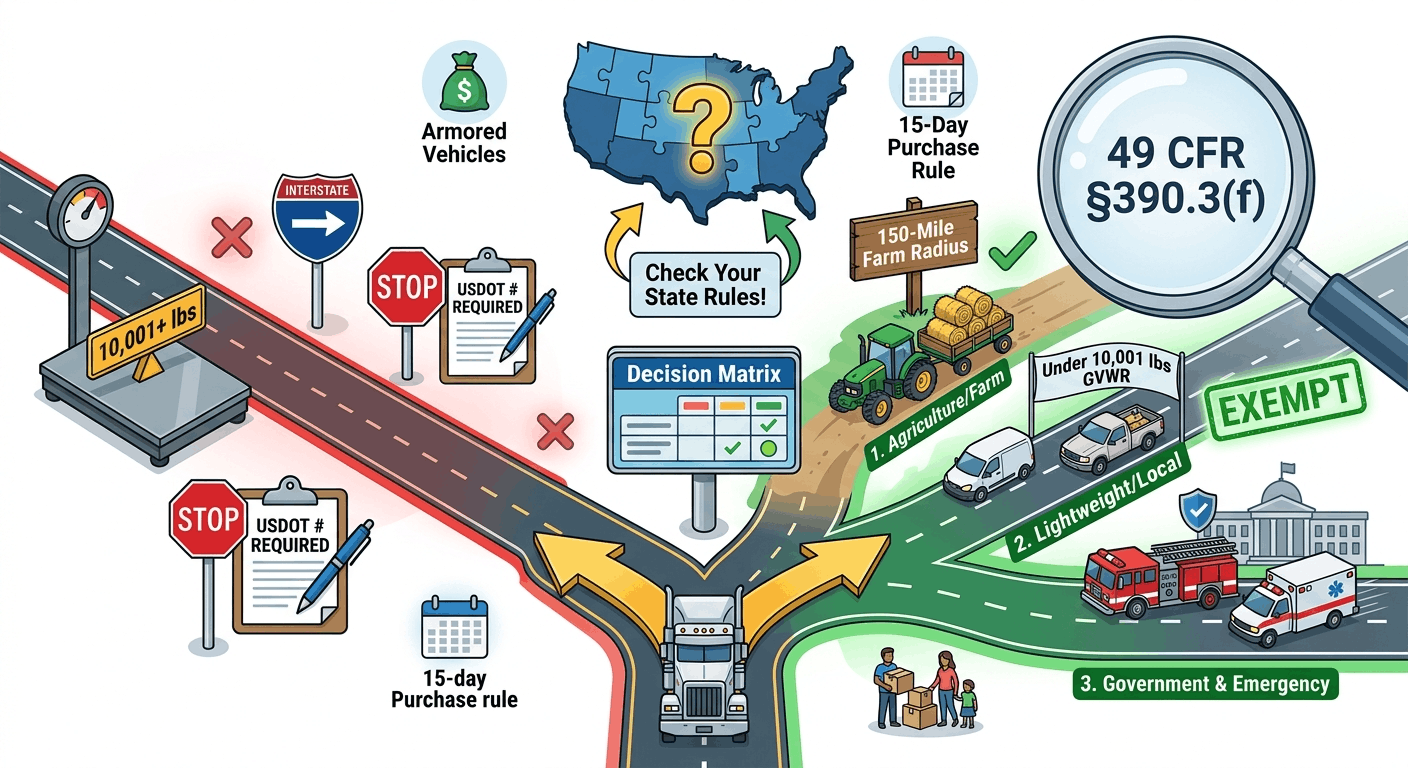
2. Vehicles Under 10,001 Pounds GVWR
One of the most common exemptions involves vehicle weight. If your vehicle has a gross vehicle weight rating (GVWR) or gross combination weight rating (GCWR) of less than 10,001 pounds, you are generally exempt from the USDOT Number requirement, provided you are not transporting hazardous materials.
This threshold applies to many light-duty trucks, vans, and smaller commercial vehicles. However, it is important to note that even if your vehicle falls below this weight threshold, you may still need a DOT Number if your state requires it for intrastate operations or if you transport hazardous materials.
3. Intrastate-Only Operations (With State-Specific Considerations)
If you operate exclusively within a single state and that state does not require DOT registration for intrastate carriers, you may not need a federal USDOT Number. However, this is where things get complicated.
Here is the critical caveat: Many states have their own intrastate regulations that require carriers to obtain a USDOT Number even if they never cross state lines.
Currently, dozens of states require intrastate commercial motor vehicle registrants to obtain a USDOT Number, including Alabama, Alaska, Arizona, California, Colorado, Connecticut, Delaware, Florida, Georgia, Hawaii, Idaho, Indiana, Iowa, Kansas, Kentucky, Maine, Maryland, Massachusetts, Michigan, Minnesota, Missouri, Montana, New Jersey, New York, Nebraska, Nevada, North Carolina, Ohio, Oklahoma, Oregon, Pennsylvania, South Carolina, Texas, Utah, Washington, West Virginia, Wisconsin, and Wyoming.
In most states, intrastate non-hazardous-material motor carriers do not require a federal USDOT Number.
However, several states participate in programs such as PRISM, which does require intrastate motor carriers with or without hazardous materials to have a USDOT Number.
Maryland provides an excellent example of state-level requirements. Under Maryland law, every registered truck over 10,000 pounds, truck tractor, and bus operated on public roads must display either a USDOT Number or a state-issued intrastate motor carrier identification number.
However, Maryland exempts specific vehicles if they are only operated intrastate, including farm trucks, farm truck tractors, farm-area motor vehicles, emergency vehicles, vehicles primarily transporting money or commercial paper, vehicles owned or operated by the State or local government, and vehicles within 15 days of their purchase.
4. Farm Vehicles and Agricultural Operations
Farmers and agricultural operators enjoy significant exemptions from DOT number requirements under specific conditions. Common exemptions include farmers who operate locally within a certain radius from their farm.
The “covered farm vehicle” exemption applies to vehicles that:
- Are designated as farm vehicles by the state in which they are registered
- Operate within 150 air-miles of the farm
- Transport agricultural commodities, including livestock, from the source to a location within 150 air miles
Important distinction: Many farmers qualify for exemptions depending on vehicle type, use, and operating area. Exemptions typically cover vehicles used solely for agricultural purposes within defined geographic limits.
However, farmers may still need a DOT Number for commercial transport across state lines.
The regulations found in 49 C.F.R. §390.3(f) provide exemptions for certain agricultural operations, but these largely do not apply to vehicles with a GVWR over 10,001 pounds that are involved in interstate commerce.
5. Government Vehicles
Vehicles owned or operated by federal, state, or local governments are generally exempt from DOT number requirements.
According to 49 CFR §390.3T(f)(2), certain government entities and their drivers are exempt from compliance with federal regulations.
This exemption covers:
- Federal government vehicles
- State government vehicles
- Political subdivisions of a state
- County government vehicles
6. Emergency Vehicles
Fire trucks, rescue vehicles, and other emergency vehicles are exempt from DOT number requirements while being used in emergency and related operations.
This exemption recognizes the unique nature of emergency response and the need for these vehicles to operate without regulatory delays.
7. Private Carriers Transporting Their Own Cargo
Private carriers that transport their own cargo meaning they are not hauling goods for hire may be exempt from certain registration requirements. The FMCSA exempts private carriers (carriers that transport their own cargo) from operating authority requirements.
However, this exemption primarily applies to operating authority (MC Number) rather than the USDOT Number itself. Private carriers may still need a USDOT Number if their vehicles meet the weight or passenger thresholds and operate in interstate commerce.
8. For-Hire Carriers Hauling Exempt Commodities
“For-hire” carriers that exclusively haul exempt commodities cargo that is not federally regulated may be exempt from obtaining operating authority. If you are transporting exempt commodities and have a USDOT Number, you may operate as an exempt for-hire interstate motor carrier without an MC Number.
9. Vehicles Transporting Between 9 and 15 Passengers Not for Compensation
The operation of commercial motor vehicles designed or used to transport between 9 and 15 passengers (including the driver), not for direct compensation, is exempt from certain regulations.
This exemption applies to vehicles used for non-commercial passenger transport, such as church vans, shuttle services, or volunteer transport.
10. Household Goods Carriers for Personal Relocation
Carriers moving personal possessions in a residential relocation may qualify for exemptions. The occasional transportation of personal property by individuals not for compensation is also exempt.
11. Recreational Activity Providers
FMCSA has amended its regulations to implement a statutory exemption from operating authority registration requirements for providers of recreational activities.
This exemption applies to motor carriers operating a motor vehicle designed or used to transport between 9 and 15 passengers (including the driver).
12. Rig Welders and Specialized Trades
Under certain exemptions, covered rig welders are not required to obtain or display a U.S. DOT Number in accordance with 49 CFR 390.21. However, it is recommended that rig welders be prepared to advise DOT officers of their exempt status if pulled over.
13. Vehicles Within 15 Days of Purchase
Some states exempt vehicles within 15 days of their purchase from DOT number requirements. This temporary exemption allows new vehicle owners time to complete registration without immediate compliance burdens.
14. Vehicles Primarily Transporting Money or Commercial Paper
Vehicles primarily transporting money or commercial paper may be exempt from DOT number requirements in certain states. This exemption recognizes the unique nature of armored car and currency transport operations.
Understanding the Interstate Commerce Requirement
A critical distinction in DOT number requirements is whether your operation involves interstate commerce.
The FMCSA’s jurisdiction primarily applies to vehicles operating in interstate commerce meaning across state lines or involving trade that crosses state boundaries.
If your vehicles operate exclusively within one state and do not engage in interstate commerce, you may not need a federal USDOT Number.
However, as noted above, many states have their own requirements for intrastate operators.
For example, vehicles in excess of 26,000 pounds, even when operating in intrastate commerce, must obtain or display a USDOT Number from the FMCSA in some states.
This demonstrates why checking both federal and state requirements is absolutely essential.
State-by-State Variations: Why You Must Check Local Rules
One of the most confusing aspects of DOT number compliance is the variation between states. As highlighted earlier, 39 states require carriers to obtain a DOT Number regardless of whether they participate in interstate or intrastate commerce.
Here is what you need to know about state-level requirements:
States That Require USDOT Numbers for Intrastate Operations:
A growing number of states require intrastate carriers to obtain USDOT Numbers.
The FMCSA maintains an updated list, which includes Alabama, Alaska, Arizona, California, Colorado, Connecticut, Delaware, Florida, Georgia, Hawaii, Idaho, Indiana, Iowa, Kansas, Kentucky, Maine, Maryland, Massachusetts, Michigan, Minnesota, Missouri, Montana, New Jersey, New York, Nebraska, Nevada, North Carolina, Ohio, Oklahoma, Oregon, Pennsylvania, South Carolina, Texas, Utah, Washington, West Virginia, Wisconsin, and Wyoming.
States With More Limited Requirements:
In states not on this list, intrastate carriers may not need a federal USDOT Number.
However, they may still need a state-issued identification number. Maryland, for instance, requires intrastate carriers to obtain a Maryland identification number (MD DOT Number) if they do not need a federal USDOT Number.
The Bottom Line: Always check with your state’s Department of Transportation or responsible state agency for intrastate motor carrier registration requirements.
The rules can change, and failing to comply with state regulations can result in significant penalties.
DOT Number vs. MC Number: Understanding the Difference
Many people confuse DOT Numbers with MC Numbers (Motor Carrier Numbers), but they serve different purposes.
USDOT Number:
- Required for safety monitoring and compliance tracking
- Applies to vehicles meeting weight, passenger, or hazardous materials thresholds in interstate commerce
- Required by many states for intrastate operations
MC Number (Operating Authority):
- Required for for-hire carriers transporting regulated commodities or passengers across state lines
- Grants the legal authority to operate as a for-hire carrier
- Not required for private carriers or those hauling exempt commodities
You may need a DOT Number without needing an MC Number, and vice versa. Understanding which applies to your operation is crucial for compliance.
Penalties for Non-Compliance: What Happens If You Need a DOT Number and Don’t Get One?
Failing to obtain a required DOT Number can result in serious consequences. Motor carriers that are not in compliance are subject to fines and penalties.
Potential penalties include:
- Civil penalties for operating without proper registration
- Out-of-service orders
- Fines ranging from hundreds to thousands of dollars
- Increased scrutiny during roadside inspections
- Negative impact on your safety rating
The FMCSA takes registration requirements seriously, and ignorance of the law is not a valid defense. It is the responsibility of motor carrier operators and drivers to know and comply with all applicable Federal Motor Carrier Safety Regulations.
How to Determine If You Are Exempt: A Step-by-Step Checklist
To help you determine whether you are exempt from needing a DOT Number, work through this checklist:
Step 1: Identify Your Vehicle Type and Use
- Is the vehicle used exclusively for personal, non-commercial purposes? → Likely Exempt
- Is the vehicle used for commercial purposes? → Continue to Step 2
Step 2: Check Vehicle Weight
- Is the GVWR or GCWR less than 10,001 pounds? → May be Exempt (unless transporting hazardous materials or required by state law)
- Is the GVWR or GCWR 10,001 pounds or more? → Continue to Step 3
Step 3: Determine Your Commerce Type
- Do you operate in interstate commerce (across state lines)? → Likely Required
- Do you operate exclusively intrastate (within one state)? → Continue to Step 4
Step 4: Check Your State’s Requirements
- Does your state require USDOT Numbers for intrastate carriers? → Required (if yes)
- Does your state not require USDOT Numbers for intrastate carriers? → May be Exempt (unless transporting hazardous materials or passengers)
Step 5: Consider Special Exemptions
- Are you a farmer operating within 150 air-miles of your farm? → May be Exempt
- Are you operating a government or emergency vehicle? → Exempt
- Are you transporting fewer than 9 passengers not for compensation? → May be Exempt
- Are you a private carrier hauling only your own cargo? → May be Exempt from MC Number, but check DOT Number requirements
Common Misconceptions About DOT Number Exemptions
Let us clear up some frequent misunderstandings:
Misconception 1: “I only drive intrastate, so I don’t need a DOT Number.”
Reality: Many states require USDOT Numbers for intrastate carriers. Always check your state’s requirements.
Misconception 2: “Rental trucks are automatically exempt.”
Reality: Rental trucks are not DOT exempt simply because they are rentals. When used in interstate commerce, rental trucks must comply with DOT requirements.
Misconception 3: “Farmers are always exempt.”
Reality: Farmers may be exempt under specific conditions (within 150 air-miles, operating covered farm vehicles), but they may still need DOT Numbers for interstate commercial transport.
Misconception 4: “If I don’t have a DOT Number, I don’t need to follow any regulations.”
Reality: Even if you are exempt from the DOT Number requirement, you may still need to comply with other FMCSA regulations, including driver qualification files, hours of service, and vehicle maintenance requirements.
How to Apply for a USDOT Number If You Need One
If you determine that you do need a USDOT Number, the application process is straightforward:
- Register through the FMCSA’s Unified Registration System – First-time applicants who have never registered with FMCSA or received a USDOT Number must register via this system.
- File the required forms – In most cases, applicants must file an MCS-150A form in conjunction with either an MCS-150 Motor Carrier Identification Report or an MCS-150B Combined form.
- Verify your number – Once issued, verify your DOT Number is correct and active.
- Secure insurance – Ensure you have the required insurance coverage for your operation.
- Prepare for inspections – Display your DOT Number on your vehicles in compliance with Federal Motor Carrier Safety Regulations (FMCSR) part §391.21.
Conclusion: Know Your Status, Stay Compliant
Understanding who is exempt from a DOT number is not just about avoiding paperwork it is about ensuring your operation remains legal, safe, and protected from costly penalties.
The FMCSA’s regulations exist to promote highway safety, and compliance benefits everyone on the road.
Key takeaways to remember:
- Personal use vehicles and vehicles under 10,001 pounds are generally exempt
- Intrastate-only operations may be exempt, but check your state’s requirements
- Farmers operating within 150 air-miles may qualify for exemptions
- Government and emergency vehicles are exempt
- When in doubt, check with the FMCSA or your state’s Department of Transportation
The rules surrounding DOT number exemptions can be complex, but taking the time to understand them will save you from headaches down the road.
Whether you are a farmer, a small business owner, or an independent operator, knowing your exemption status is the first step toward successful and compliant operations.
Remember: Safety compliance and safe operations translate into saved lives and protected property. When you follow the rules, everyone wins.
Ready to stop dreaming and start driving?
Fill out the form and a Remms recruiter will reach out within one business day. No spam, no pressure — just real results.
Submit Driver Profile