
Professional truck drivers keep America moving delivering goods, equipment, and materials that fuel businesses and support communities nationwide. While most freight can be handled with a standard Commercial Driver‘s License (CDL), certain types of loads and vehicles require specialized training and certification. That’s where commercial drivers license endorsements come into play.
A CDL endorsement is an added qualification on your license that authorizes you to operate specific vehicles or transport unique types of cargo. These endorsements are not automatically included with a CDL; instead, you must complete extra training and pass specific tests to qualify. Getting one or more endorsements isn‘t merely an enhancement to your driving skills it’s a competitive advantage that often leads to higher pay and better career opportunities.
Whether you‘re just starting your trucking career or looking to expand your expertise, understanding commercial drivers license endorsements is essential for long-term success. In this comprehensive guide, we’ll explore every type of endorsement available, the requirements for each, how to obtain them, costs involved, and how they can transform your earning potential.
What Are CDL Endorsements?
A CDL endorsement is an additional certification added to your Commercial Driver‘s License that authorizes you to operate specialized types of commercial motor vehicles (CMVs) or transport certain kinds of freight. Endorsements are regulated by the Federal Motor Carrier Safety Administration (FMCSA) and individual state DMVs, ensuring that anyone operating a commercial motor vehicle is properly trained and certified.
Each endorsement is represented by a code printed on your commercial driver’s license. On the license, these codes appear on the front side, under the “Expiration Date” field following the letter “E”. For a full description of each endorsement you hold, you can refer to the back of your license, which provides details about the additional driving privileges associated with each code.
Endorsements are not the same as restrictions. While endorsements add capabilities to your license, restrictions limit what you can do. We‘ll explore this important distinction in detail later in this guide.
According to FMCSA regulation 49 CFR 383.93, all commercial drivers who drive certain types of vehicles or haul certain types of cargo must have the appropriate endorsements on their CDL to show that they have the additional specialized knowledge required for these operations.
Understanding CDL Classes
Before diving into endorsements, it’s essential to understand the three classes of CDLs, as certain endorsements can only be added to specific classes.
Class A CDL
The Class A CDL is the most versatile option for commercial drivers. It permits you to operate a combination of vehicles with a gross combination weight rating (GCWR) of 26,001 pounds or more, provided the towed unit has a GVWR of 10,001 pounds or more. Examples include tractor-trailers and truck-and-trailer combinations. With the correct endorsements, you can also use this license to operate Class B or Class C vehicles.
Class B CDL
A Class B CDL allows you to drive a single vehicle with a GVWR of 26,001 pounds or more. You can also tow a trailer as long as it has a GVWR of 10,000 pounds or less. Examples include large buses (city or tour buses), straight trucks, and dump trucks with small trailers. With the right endorsements, a Class B CDL also permits you to drive Class C vehicles.
Class C CDL
You‘ll need a Class C CDL to operate vehicles that don’t fit into Class A or Class B. This includes any commercial vehicle with a GVWR of less than 26,001 pounds, vehicles designed to carry 16 or more people, and vehicles used to carry hazardous materials. Examples include smaller passenger vans with 16+ seats and vehicles transporting hazardous materials that must show warning placards.
The Six Primary CDL Endorsements
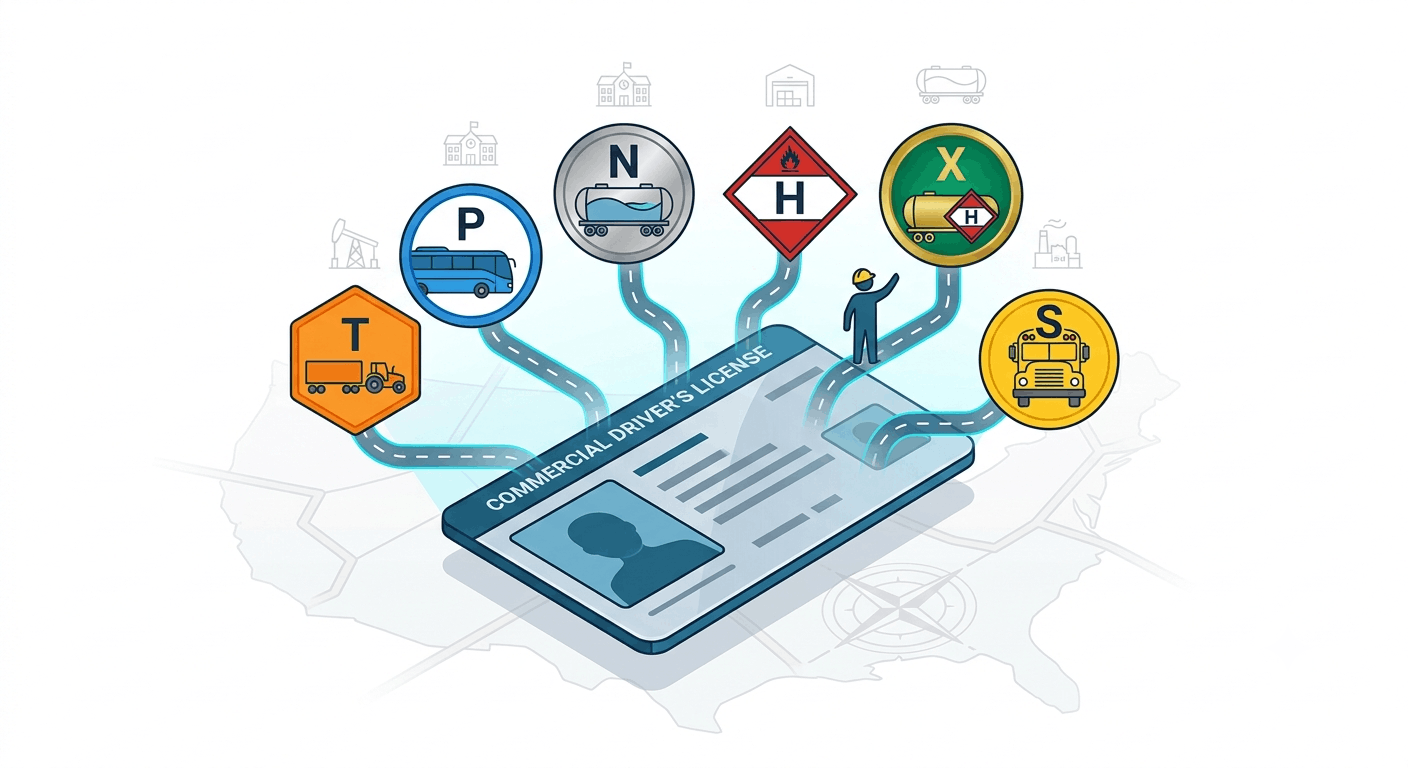
The FMCSA recognizes six primary commercial drivers license endorsements. Each serves a distinct purpose and has its own set of requirements. The table below provides a comprehensive overview:
| Endorsement | Code | Description | Testing Requirements | ELDT Required? | Available On |
|---|---|---|---|---|---|
| Double/Triple Trailers | T | Allows driver to tow two or three trailers of 10,001+ pounds GCWR | Written knowledge test only | No | Class A only |
| Passenger Vehicles | P | Required for vehicles seating 16+ passengers (including driver) | Written + skills test in passenger vehicle | Yes (Theory + BTW) | Class A, B, or C |
| Tank Vehicles | N | Permits operation of tank vehicles transporting liquids or gases in bulk (1,000+ gallons) | Written knowledge test only | No | Class A, B, or C |
| Hazardous Materials | H | Required for vehicles carrying hazardous materials requiring placards | Written test + TSA background check | Yes (Theory) | Any class |
| Combination (Tank + HazMat) | X | Combines N and H endorsements; appears as “X” on license | Qualify for both N and H + TSA check | Yes (Theory) | Any class |
| School Bus | S | For driving school buses; requires P endorsement as prerequisite | Written + skills test in school bus | Yes (Theory + BTW) | Class A (with M restriction), B, or C (with N restriction) |
Detailed Breakdown of Each Endorsement
T – Double/Triple Trailers
This endorsement authorizes you to pull two or three trailers at once behind a single power unit. It is commonly needed for certain long-haul freight operations, particularly in less-than-truckload (LTL) and linehaul jobs. The T endorsement can only be added to a Class A CDL because Class B doesn‘t allow combination vehicles.
Requirements:
- Hold a valid Class A CDL
- Pass the doubles/triples written exam
- The test typically consists of about 20 questions with an 80% passing rate
What you‘ll study: The written test covers operating doubles and triples, focusing on safety, coupling/uncoupling procedures, and vehicle handling in various traffic conditions and driving environments.
P – Passenger Vehicles
If you plan to drive buses, passenger vans, or any commercial vehicle designed to transport 16 or more passengers (including the driver), this endorsement is mandatory.
Requirements:
- Pass the passenger written exam
- Complete Entry-Level Driver Training (ELDT) both theory training and behind-the-wheel training with a registered provider
- Pass a full drive skills test in an actual passenger vehicle
Important notes:
- If you take your skills test in a Class B passenger vehicle and are issued a Class B CDL with the P endorsement, you are qualified to drive other vehicles in the Class B category. However, a driver who completes a skills test in a non-passenger Class B vehicle cannot drive a passenger vehicle or bus.
- If you already possess a CDL and want to add the P endorsement, you must pass the passenger written exam and purchase an instruction permit with the endorsement prior to skills testing.
- This endorsement can be added to Class A, B, or C CDLs.
N – Tank Vehicles
The Tanker endorsement authorizes you to operate any tank vehicle a commercial motor vehicle designed to transport liquids or gaseous materials in bulk. Specifically, this applies to tanks having an individual rated capacity of more than 119 gallons and an aggregate rated capacity of 1,000 gallons or more that is permanently or temporarily attached to the vehicle.
Requirements:
- Pass the tanker written knowledge test
- No skills test required
- No ELDT required
What you‘ll study: Transporting liquids in bulk presents unique challenges liquid movement (surge) can affect vehicle stability, especially during braking or turning. The endorsement ensures drivers understand the physics of liquid surge and proper loading procedures.
Important note: Cement mixers do not require the tanker endorsement.
H – Hazardous Materials (HazMat)
The HazMat endorsement is one of the most sought-after commercial drivers license endorsements because hazardous materials transport commands higher pay across the board. It is also the most involved endorsement to obtain, largely because of the federal security requirements attached to it.
Requirements:
- Be at least 21 years old
- Be a U.S. citizen or lawful permanent resident
- Pass the HazMat written knowledge exam
- Complete a TSA Security Threat Assessment (STA) with fingerprinting
- Complete Entry-Level Driver Training (ELDT) theory training required
The TSA Background Check Process:
The TSA threat assessment includes a federal background check and fingerprinting. TSA recommends that all applicants enroll for the HME Security Threat Assessment (including renewals) a minimum of 60 days before they require an eligibility determination, as processing times for some applicants may exceed 45 days.
Documents you‘ll need:
- Current U.S. passport OR a driver’s license and birth certificate
- Other acceptable documents as listed by TSA
Disqualifications: Approximately 3–5% of applicants are denied a Hazmat endorsement each year due to security-related issues uncovered during the background check.
Expiration: The threat assessment approval is valid for five years. The “H” endorsement will expire no more than five years after the date the security assessment was completed.
X – Combination Tank and HazMat
If you need to transport hazardous materials in a tank vehicle, you can obtain the X endorsement instead of holding both N and H separately. This is a combined designation that appears as “X” on your license. The X endorsement is required for hauling hazardous liquids or gases in tank vehicles the most common example being fuel hauling.
Requirements:
- Pass the Tanker endorsement knowledge test
- Pass the HazMat written knowledge exam
- Pass a TSA background check
- Complete ELDT (theory training)
Career impact: The X endorsement is commonly required for drivers who want to work in the oil, agriculture, waste management, and construction industries.
S – School Bus
This endorsement is specifically for operating a school bus used to transport students to and from home or school, or to and from school-sponsored events.
Requirements:
- Hold a CDL with a P endorsement – the S endorsement will not stand alone
- Pass the school bus written exam
- Complete Entry-Level Driver Training (ELDT) – both theory and behind-the-wheel
- Pass a full drive skills test in an actual school bus
- Pass background checks (Criminal Offender Record Information and Sex Offender Registry Information checks in many states)
What you‘ll study: The written test covers student loading and unloading procedures, school bus-specific equipment (including the eight-lamp warning system), and emergency evacuation procedures for children.
The Air Brakes “Endorsement” (L Restriction Removal)
Many sources reference a seventh item: the air brakes qualification. Technically, this is a restriction removal rather than a standard endorsement, but it functions similarly on your license.
The “L” appears on your license if you do not have air brake certification meaning you cannot drive CMVs with full air brake systems. Conversely, if you pass the air brakes knowledge and skills tests, the L restriction is removed, qualifying you to operate vehicles with air brake systems. For this reason, it is often listed alongside the six primary commercial drivers license endorsements.
CDL Endorsements vs. Restrictions: Understanding the Difference
It is essential to distinguish between endorsements and restrictions. While endorsements add capabilities to your license, restrictions limit what you can do.
| Endorsements (Add Capabilities) | Restrictions (Limit Capabilities) |
|---|---|
| Qualify you for specialized vehicles or cargo | Prohibit you from operating certain vehicles |
| Example: P endorsement allows passenger transport | Example: L restriction prohibits air brake vehicles |
| Example: H endorsement allows HazMat transport | Example: E restriction prohibits manual transmission vehicles |
Common CDL restrictions include:
| Restriction Code | What It Means |
|---|---|
| L | You didn‘t pass the air brakes test or didn’t take the skills test in a vehicle with full air brakes. You can‘t drive CMVs with full air brake systems. |
| Z | You tested in a vehicle with an air-over-hydraulic brake system. You’re not authorized to drive CMVs with full air brakes. |
| E | You tested in a vehicle with an automatic transmission. You‘re restricted from driving CMVs with a manual transmission. |
| O | You tested in a Class A vehicle with a pintle hook or non-fifth wheel connection. You can’t operate Class A vehicles with a fifth wheel connection. |
| M | You have a Class A CDL but earned your Passenger or School Bus endorsement in a Class B vehicle. You’re restricted to operating Class B and C passenger vehicles or school buses. |
| N | You have a Class B CDL but earned your Passenger or School Bus endorsement in a Class C vehicle. |
The good news? Most restrictions can be removed by retaking the proper written or skills test in the appropriate vehicle.
How to Obtain Commercial Drivers License Endorsements
The process for adding endorsements varies slightly depending on the specific endorsement, but generally follows these steps:
Step 1: Get Your State‘s CDL Manual
The first step is to get a copy of your state’s Commercial Driver‘s Licensing (CDL) Manual. Each endorsement requires specialized knowledge, and the manual provides dedicated sections for each one.
Step 2: Study the Relevant Material
- HazMat (H): Study Section 9
- Passenger (P): Study Section 4
- Doubles/Triples (T): Study Section 7
- School Bus (S): Study Sections 4 and 10
- Tank Vehicle (N): Study Section 8
- Air Brakes: Study Section 5
Step 3: Obtain a Commercial Learner‘s Permit (CLP)
You’ll need to get a CLP before you can take skills tests. Important: Commercial learner‘s permits may only carry “P”, “S”, and “N” endorsements. Hazardous materials (H or X) endorsements are not allowed on a CLP because they require a full CDL and federal security clearance.
Step 4: Complete Entry-Level Driver Training (ELDT) If Required
Since February 7, 2022, the FMCSA has required Entry-Level Driver Training for certain endorsements. The ELDT regulations are not retroactive individuals who were issued a CDL or an S, P, or H endorsement prior to February 7, 2022, are not required to complete training for the respective CDL or endorsement.
ELDT is required for:
- Passenger (P) endorsement – both theory and behind-the-wheel training
- School Bus (S) endorsement – both theory and behind-the-wheel training
- HazMat (H) endorsement theory training only
- Combination (X) endorsement -theory training only
You can find approved training providers using the FMCSA Training Provider Registry.
Step 5: Take the Written Knowledge Test
For most endorsements (T, N, H, and X), passing the written knowledge test is the primary requirement. You can take these tests at your local licensing office.
Step 6: Complete Additional Requirements for P and S Endorsements
If you‘re applying for a Passenger (P) or School Bus (S) endorsement, additional steps are required:
- After passing the written test, you’ll be issued a CLP with the endorsement
- You must hold the CLP for at least 14 full days
- Complete ELDT training
- Schedule and pass the CDL road skills test in the appropriate vehicle
Step 7: Complete TSA Background Check for HazMat
For the H and X endorsements, you must complete a TSA threat assessment. You can pre-enroll online through the TSA website and schedule an appointment at an application center.
Step 8: Receive Your Updated CDL
After successfully completing all requirements, your updated CDL with the new endorsement will be issued.
Costs of CDL Endorsements
The cost of obtaining commercial drivers license endorsements varies significantly by state and by the type of endorsement.
| Cost Component | Estimated Amount |
|---|---|
| State endorsement test fee | $15 – $30 per endorsement |
| HazMat TSA background check (effective Jan 1, 2025) | $85.25 |
| HazMat TSA background check (reduced rate with TWIC) | $41.00 |
| CLP fee | $10 – $50 |
| Road/skills test | $50 – $200 |
| DOT physical | $75 – $150 |
Note: Fees are subject to change and are non-refundable. Retaking a written knowledge test may incur additional fees.
Which CDL Endorsements Are Most In Demand in 2026?
The following endorsements are especially valuable in the current job market:
- X (Tanker + HazMat): High-paying freight and fuel hauling the most lucrative combination
- T (Doubles/Triples): Needed for LTL and dedicated regional routes
- N (Tanker): Growing demand due to bulk liquid freight increases
- P & S (Passenger & School Bus): Popular for those looking for non-freight driving roles
- H (HazMat): Critical for chemical transport, waste disposal, and specialized freight
Carriers often pay premium wages for drivers holding multiple endorsements, particularly the HazMat and Tanker combination.
Do CDL Endorsements Increase Your Pay?
Yes commercial drivers license endorsements make you more versatile and valuable to employers. While no credential guarantees a higher paycheck by itself, drivers with key endorsements often see 10–30% higher pay opportunities and have access to roles that pay more due to added responsibility and regulatory requirements.
| Endorsement | Career Opportunities | Earning Potential Impact |
|---|---|---|
| T | Long-haul freight, LTL, over-the-road trucking | Moderate increase |
| P | Bus driver, tour operator, transit authority | Moderate increase |
| N | Fuel hauler, liquid transport, tanker operations | Significant increase |
| H | Chemical transport, waste disposal, specialized freight | Significant increase |
| X | Combination tanker and HazMat operations | Highest increase $75,000–$110,000+ annually |
| S | School bus driver, student transport | Moderate increase |
Many carriers offer tuition reimbursement or training assistance for drivers who obtain additional endorsements, making them a worthwhile investment in your professional future.
State-Specific Endorsements
While the six primary endorsements are federally recognized, some states offer additional commercial drivers license endorsements for unique local operations. For example, Indiana offers a “For Hire” endorsement (Code 2) that requires passing a for-hire written test.
It is always advisable to check with your state‘s Department of Motor Vehicles (or equivalent licensing authority) for any state-specific requirements.
Expiration and Renewal of CDL Endorsements
CDL endorsements expire with your Commercial Driver’s License. In many cases, you will need to retake the corresponding test upon renewal. The “H” or “X” endorsements will expire no more than five years after the date the security assessment was completed. The HazMat endorsement requires the TSA background check to be completed again at each renewal.
Frequently Asked Questions
How many commercial drivers license endorsements are there in the USA?
Which endorsement is the hardest to get?
Can I get multiple endorsements?
Do I need a road test for all endorsements?
How long does it take to get an endorsement?
Do endorsements expire?
Can I add endorsements to my CDL later?
What documents do I need for the HazMat test?
Conclusion
Understanding and obtaining commercial drivers license endorsements is essential for any professional driver looking to advance their career. The six primary endorsements – T, P, N, H, X, and S – each require specific knowledge tests, and some demand additional skills testing, background checks, or ELDT training.
Whether your goal is to transport passengers, haul hazardous materials, or pull double trailers, the right endorsements will set you apart in a competitive job market. Start by studying your state‘s CDL Driver Manual, contact your local licensing authority for specific requirements, and take the first step toward expanding your professional driving capabilities today.
Remember: your CDL is your ticket to the road, but your commercial drivers license endorsements are what truly unlock your earning potential and career opportunities.
Ready to stop dreaming and start driving?
Fill out the form and a Remms recruiter will reach out within one business day. No spam, no pressure — just real results.
Submit Driver Profile