
Quick Answer:
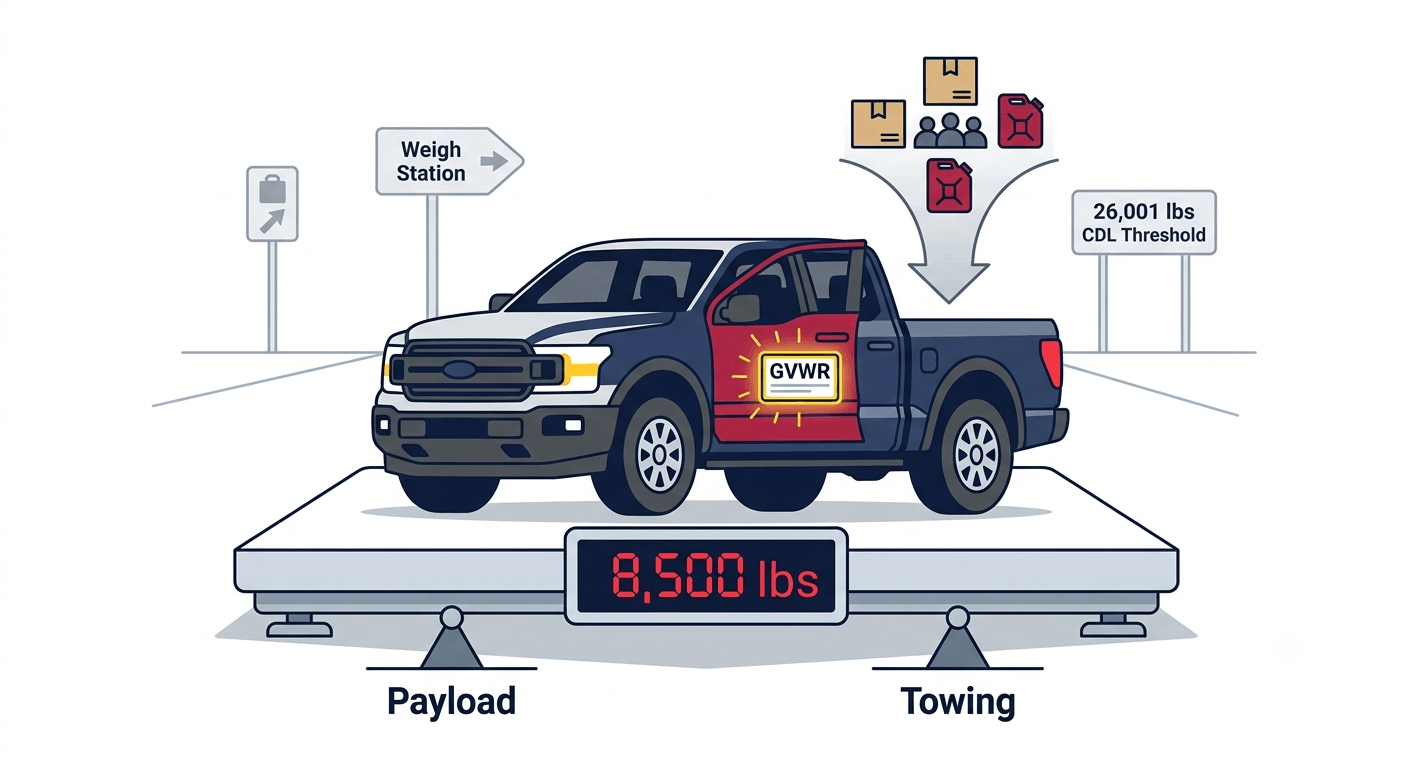
In the United States, pickup truck weight limits are defined by a system of federal vehicle classes based on Gross Vehicle Weight Rating (GVWR). A truck’s GVWR is the maximum allowable total weight of the vehicle, including its own weight, passengers, cargo, and fuel .
The federal classification system for trucks is the official standard used by the government and the automotive industry to categorize trucks by their GVWR .
Federal Truck Weight Classifications
| Class | GVWR (Pounds) | Typical Pickup Truck Examples |
|---|---|---|
| Class 1 | 0 – 6,000 lbs | Compact and some light-duty full-size pickups (e.g., Ford Maverick, some F-150s) . |
| Class 2 | 6,001 – 10,000 lbs | Most full-size “half-ton” and “3/4-ton” pickups (e.g., Ford F-150, F-250, Ram 2500) . Often split into Class 2a (6,001-8,500 lbs) and Class 2b (8,501-10,000 lbs) . |
| Class 3 | 10,001 – 14,000 lbs | Heavy-duty “1-ton” pickups (e.g., Ford F-350, Ram 3500) . |
| Class 4 – 8 | 14,001 lbs and up | Chassis-cab trucks and commercial vehicles (e.g., Ford F-450 and larger) . |
Important Note: These official weight limits are set by the manufacturer for safety and engineering reasons. Exceeding your truck’s GVWR is unsafe and can lead to serious liability issues . The exact GVWR for your specific vehicle can be found on a sticker inside the driver’s side doorjamb .
“Half-Ton, ” “Three-Quarter-Ton, ” and “One-Ton” vs. Federal Classes
The terms “half-ton,” “3/4-ton,” and “1-ton” are historical marketing terms that are now used as general descriptors for different classes of pickup trucks . They are not exact or official weight limits. Today, a modern “half-ton” truck can often carry much more than 1,000 pounds .
Here is how these common terms generally align with the federal GVWR classes:
- Half-Ton (150/1500 Series): Generally falls into Class 1 or 2a (up to 8,500 lbs GVWR) .
- 3/4-Ton (250/2500 Series): Generally falls into Class 2b (8,501 – 10,000 lbs GVWR) .
- 1-Ton (350/3500 Series): Generally falls into Class 3 (10,001 – 14,000 lbs GVWR) .
Introduction:
Understanding pickup truck weight limits is essential for every truck owner, whether you use your vehicle for work, towing, or daily driving.
Exceeding these limits isn’t just unsafe it can lead to expensive fines, voided insurance claims, and serious mechanical damage.
This comprehensive guide breaks down everything you need to know about pickup truck weight limits, from federal classifications to state-specific regulations and CDL requirements.
What Is GVWR and Why Does It Matter?
At the heart of every pickup truck weight limit discussion is the Gross Vehicle Weight Rating, or GVWR.
The GVWR is the maximum safe operating weight established by the manufacturer, based on the vehicle’s structural capacity, axle strength, braking systems, and suspension design. This rating includes everything: the truck itself, fuel, fluids, passengers, and all cargo.
It’s important to distinguish GVWR from GVW (Gross Vehicle Weight). Think of GVWR as the ceiling you should never hit, while GVW is your current weight at any given moment.
If your truck has a GVWR of 26,000 pounds and you load it to 28,000 pounds, your GVW has exceeded your GVWR creating a dangerous and illegal situation.
Where to find your truck’s GVWR: Look for the certification label on the driver’s side door pillar, check your owner’s manual, or refer to the Tire and Loading Information placard.
Federal Vehicle Weight Classifications for Pickup Trucks
The Federal Highway Administration (FHWA) categorizes all trucks into eight classes based on GVWR. For pickup trucks, the relevant classes are Classes 1 through 3, with some heavy-duty models extending into higher classes.
| Class | GVWR Range | Typical Pickup Trucks | Duty Classification |
|---|---|---|---|
| Class 1 | 0 – 6,000 lbs | Compact pickups and some light-duty full-size trucks (e.g., Ford Maverick, Ford Ranger) | Light Duty |
| Class 2a | 6,001 – 8,500 lbs | Traditional “half-ton” pickups (e.g., Ford F-150, Ram 1500, Chevrolet Silverado 1500) | Light Duty |
| Class 2b | 8,501 – 10,000 lbs | “Three-quarter-ton” pickups (e.g., Ford F-250, Ram 2500, Chevrolet Silverado 2500HD) | Light Duty |
| Class 3 | 10,001 – 14,000 lbs | “One-ton” pickups (e.g., Ford F-350, Ram 3500) | Medium Duty |
The FHWA groups Classes 1-2 as light duty, Classes 3-6 as medium duty, and Classes 7-8 as heavy duty. The Environmental Protection Agency (EPA) uses a slightly different threshold, classifying vehicles with a GVWR under 8,500 pounds as Light Duty and those over 8,501 pounds as Heavy Duty.
Understanding “Half-Ton,” “Three-Quarter-Ton,” and “One-Ton” Terminology
The terms “half-ton,” “3/4-ton,” and “1-ton” are historical marketing terms that can be confusing. They date back decades and no longer represent actual payload capacities. For example, a modern 3/4-ton pickup can typically haul between 3,000 and 4,000 pounds more like two tons.
Here’s how these common terms align with federal classifications:
- Half-ton (150/1500 Series): Generally falls into Class 2a (6,001–8,500 lbs GVWR)
- Three-quarter-ton (250/2500 Series): Falls into Class 2b (8,501–10,000 lbs GVWR)
- One-ton (350/3500 Series): Falls into Class 3 (10,001–14,000 lbs GVWR)
GVWR vs. Payload Capacity vs. Towing Capacity
Understanding pickup truck weight limits requires knowing the difference between several related terms:
Payload Capacity is the maximum weight you can add to the cab and bed. It’s calculated by subtracting the truck’s curb weight from its GVWR. For instance, a 2021 Ford F-150 SuperCrew with a GVWR of 7,850 pounds and a curb weight of 4,912 pounds has a payload capacity of 2,900 pounds.
Towing Capacity is the maximum weight your vehicle can safely pull. This is determined by the Gross Combined Weight Rating (GCWR), which is the maximum total weight of your vehicle plus any attached trailer.
Gross Axle Weight Rating (GAWR) is the maximum weight that can safely rest on any single axle. Even if your total weight is within GVWR, exceeding an individual axle rating can compromise handling and lead to mechanical failure.
When Do Pickup Truck Weight Limits Trigger CDL Requirements?
One of the most critical thresholds in pickup truck weight limits is 26,001 pounds. Crossing this number can trigger mandatory Commercial Driver’s License (CDL) requirements.
Here are the CDL thresholds to know:
- Class A CDL: Required for any combination of vehicles with a GCWR of 26,001 pounds or more, provided the towed unit has a GVWR over 10,000 pounds
- Class B CDL: Required for a single vehicle with a GVWR of 26,001 pounds or more
What’s surprising is that a single pound can make the difference. A truck rated at 26,000 pounds can typically be driven without a CDL, but increase that rating to 26,001 pounds, and a CDL becomes required.
The distinction often comes down to axle ratings, suspension components, or intended hauling capacity not how the truck looks.
State-by-State Variations in Pickup Truck Weight Limits
While federal classifications provide a national framework, individual states can and do impose their own regulations regarding pickup truck weight limits. This is particularly important when it comes to weigh station requirements.
As a general rule, pickup trucks are not required to pull into weigh stations if they don’t surpass 10,000 pounds in GVWR. However, some states have different thresholds:
| State | GVWR Threshold for Weigh Station Stop |
|---|---|
| Massachusetts | 5,000 lbs |
| Virginia | 7,500 lbs |
| South Dakota | 8,000 lbs |
| California & Connecticut | All commercial vehicles must stop regardless of size |
| Illinois & Missouri | 16,000 lbs and higher |
Additionally, many states including Mississippi, Kansas, Delaware, Iowa, and Florida permit law enforcement to direct any vehicle to a weigh station if they have reason to believe it exceeds weight capacity. This makes it crucial to know your truck’s specifications before hitting the road, especially when traveling across state lines.
What Happens If You Exceed Pickup Truck Weight Limits?
Exceeding your truck’s GVWR isn’t just a paperwork issue it has real consequences:
Safety Risks: Overloading compromises braking performance, increases stopping distance, causes suspension fatigue, overheats transmissions, and accelerates tire wear.
Legal Penalties: Overweight vehicles are subject to fines and criminal penalties. Commercial operators caught running heavy face fines starting around $10,000.
Insurance Implications: Exceeding GVWR can void insurance claims if an accident occurs. Insurance companies may deny coverage if they determine the vehicle was overloaded at the time of an incident.
Mechanical Damage: Operating even 5–10% above rated capacity increases brake temperatures, tire load stress, suspension fatigue, and long-term drivetrain wear.
Federal Bridge Formula and Gross Weight Limits
For larger trucks, federal law caps the gross weight of vehicles at 80,000 pounds, with single-axle trucks limited to 20,000 pounds and tandem-axle trucks to 34,000 pounds. However, states often have different limits. These federal limits primarily apply to commercial vehicles like 18-wheelers, not standard pickup trucks but they’re important context for understanding the broader regulatory landscape.
Practical Tips for Staying Within Pickup Truck Weight Limits
- Know your GVWR: Always check the certification label on your driver’s side door pillar.
- Weigh your truck: Visit a public scale to determine your actual GVW, especially before long trips or heavy hauling.
- Calculate your payload: Subtract your truck’s curb weight from its GVWR to find your maximum payload capacity.
- Account for everything: Remember that GVWR includes passengers, fuel, cargo, and any aftermarket additions like toolboxes or racks.
- Check state regulations: Before traveling across state lines, research the weight limit rules in each state you’ll pass through.
- Don’t rely on “ton” ratings: The terms half-ton, 3/4-ton, and 1-ton are marketing terms, not accurate weight limits.
Frequently Asked Questions
Do I need a CDL to drive a pickup truck?
Do pickup trucks have to stop at weigh stations?
What’s the difference between GVWR and payload?
Where can I find my truck’s weight limits?
Conclusion
Understanding pickup truck weight limits is essential for safe, legal, and responsible vehicle operation. From the federal classification system that defines vehicle classes by GVWR to state-specific weigh station requirements and CDL thresholds, these regulations exist to protect everyone on the road.
By knowing your truck’s GVWR, calculating your payload correctly, and staying informed about the regulations in the states you travel through, you can avoid costly fines, prevent mechanical damage, and ensure your truck performs safely under any load.
Ready to stop dreaming and start driving?
Fill out the form and a Remms recruiter will reach out within one business day. No spam, no pressure — just real results.
Submit Driver Profile