
Disclaimer: This article is for informational purposes only and does not constitute legal advice. Weight regulations are subject to change. Always consult official state Department of Transportation resources and verify current limits before operating any vehicle.
Quick Answer:
There is no single weight limit for a tri-axle truck in the USA. The legal limit depends on the type of road (Interstate vs. non-Interstate), the specific spacing of the axles, and the state you are driving in.
Here is a breakdown of the regulations:
1. Federal Baseline: Interstate Highway Standards
On the Interstate Highway System, federal law sets the absolute maximums that all states must follow (states can be stricter, but cannot exceed these):
- Single Axle: 20,000 lbs
- Tandem Axles (2 axles): 34,000 lbs
- Gross Vehicle Weight (GVW): 80,000 lbs
Crucial Note: Beyond these axle limits, all vehicles must comply with the Federal Bridge Formula (Formula B). This formula calculates the maximum allowed weight based on the number of axles and the distance between them. In some configurations, the Bridge Formula may restrict the total GVW to less than 80,000 lbs, even if your axles are under their individual limits.
2. State-by-State Variations (Non-Interstate & Special Rules)
Once you leave the Interstate system, states are free to set their own limits. Furthermore, the limit for a “tridem” (tri-axle) group (three axles spaced closely together) is not federally defined, so it varies widely.
Here are examples to illustrate the differences:
| State | Road Type | Tridem (3-Axle Group) Limit | GVW Limit | Notes |
|---|---|---|---|---|
| Louisiana | Interstate | 42,000 lbs | 83,400 lbs | Higher GVW allowed for vehicles with tridem or quad-axle groups. |
| Louisiana | Non-Interstate | 45,000 lbs | 88,000 lbs | Allows increased weights on state roads. |
| Kansas | Interstate (Statutory) | Not explicitly defined; must adhere to Single (20k) & Tandem (34k) limits. | Follows federal 80,000 lbs. | Standard legal limits apply. |
| Kansas | Special Permit (Annual/Std) | 60,000 lbs | 120,000 – 150,000 lbs | This is for special hauling permits on designated routes, not for general freight. |
3. Important Additional Regulations
- Definition of a “Tridem”: States define what counts as a tridem group by the distance between axles. For example, Kansas law defines a tridem as three consecutive axles spaced more than 96 inches apart but not more than 132 inches apart. If the spacing is different, the axles may be calculated as singles or tandems instead.
- Special Permits: For oversized or indivisible loads (e.g., heavy machinery), you can apply for a special permit that allows weights far exceeding these statutory limits.
- Tire Weight Limits: Many states also impose a limit based on tire width. A common regulation limits the weight to 500 lbs or 650 lbs per inch of tire width to prevent pavement damage, which can sometimes be the deciding factor even if your axle weight is under the limit.
For a standard 3-axle group on an Interstate highway, you are generally looking at around 42,000 to 45,000 lbs depending on the state, but the overall truck is hard-capped at 80,000 lbs GVW under federal law.
Always check the specific state’s Department of Transportation (DOT) regulations for the exact route you plan to travel, as enforcement and allowances differ significantly across state lines.
Introduction
Understanding the tri axle weight limit is one of the most critical compliance challenges facing trucking professionals operating in the United States.Whether you’re a fleet manager, an independent owner-operator, or a logistics coordinator, navigating the complex web of federal regulations and state-by-state variations can feel overwhelming.
This comprehensive guide breaks down everything you need to know about the tri axle weight limit, from the Federal Bridge Formula to state-specific allowances, ensuring you stay legal and profitable on every mile of your journey.
What Is a Tri Axle Configuration?
Before diving into weight limits, it’s essential to understand what constitutes a tri axle (also called a tridem) configuration. A tri axle group consists of three consecutive axles arranged in tandem. However, the legal definition varies by jurisdiction.
In Kansas, for example, “triple axles” are defined as three or more consecutive axles spaced more than 96 inches and not more than 132 inches apart. In Louisiana, a tridum axle group must be properly distributed so that no individual axle carries more than 16,000 pounds on interstate highways or 17,000 pounds on noninterstate highways.
The spacing between axles is just as important as the weight itself, because it directly affects how the load is distributed across road surfaces and bridge structures.
Federal Baseline: The Interstate Highway Standards
On the Interstate Highway System, federal law establishes the absolute maximums that all states must follow. These are the floor limits states can be stricter, but they cannot exceed these federal caps.
| Component | Federal Limit |
|---|---|
| Single Axle | 20,000 lbs |
| Tandem Axles (2 axles) | 34,000 lbs |
| Gross Vehicle Weight (GVW) | 80,000 lbs |
Crucially, there is no explicit federal tri axle weight limit for a three-axle group. Instead, the Federal Highway Administration (FHWA) applies the Bridge Formula to determine what a tri axle configuration can legally carry.
For example, three axles with an extreme spacing of 97 inches (just over 8 feet) can carry a load of 42,000 pounds. At 96 inches apart, three axles may carry 42,000 pounds as well. In practical terms, a tri axle group is often limited to approximately 42,500 pounds, or about 14,000 pounds per axle.
The Federal Bridge Formula: The Hidden Constraint
Perhaps the most misunderstood aspect of the tri axle weight limit is the Federal Bridge Formula. Congress enacted this formula in 1975 to limit the weight-to-length ratio of vehicles crossing bridges. The logic is simple but critical: axle spacing is as important as axle weight in designing and protecting bridges.
The formula is expressed as:
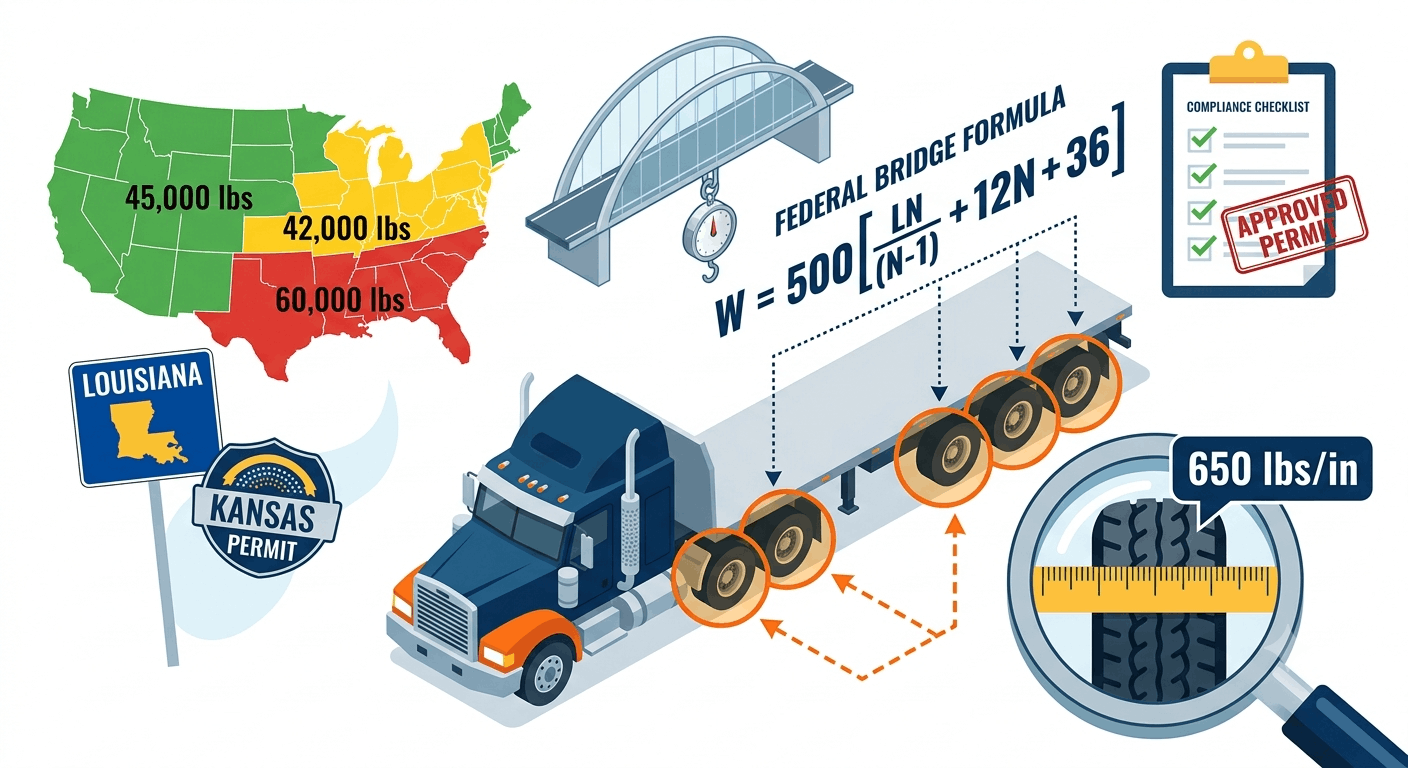
W = 500 [ LN/(N-1) + 12N + 36 ]
Where:
- W = the overall gross weight on any group of two or more consecutive axles (rounded to the nearest 500 pounds)
- L = the distance in feet between the outer axles of the group
- N = the number of axles in the group
Why does this matter for your tri axle weight limit? Even if your individual axles and total gross weight are within legal limits, the Bridge Formula may dictate a lower allowable weight based on your axle spacing. A short vehicle with the same total weight as a longer one concentrates stress on a smaller area of the bridge, causing more damage.
The formula is designed to prevent exactly this scenario ensuring that heavier trucks spread their weight over enough distance to protect the nation’s bridge infrastructure.
State-by-State Variations: Where Things Get Complicated
Once you leave the Interstate System, states are free to set their own weight limits. Moreover, many states have higher allowances on non-interstate highways and through special permit programs. This is where the tri axle weight limit becomes highly variable.
Louisiana: A Case Study in Higher Allowances
Louisiana provides an excellent example of how states can diverge from federal standards:
| Road Type | Tridem Axle Limit | GVW Limit |
|---|---|---|
| Interstate | 42,000 lbs | 83,400 lbs |
| Non-Interstate | 45,000 lbs | 88,000 lbs |
On interstate highways, Louisiana allows tridem axles at 42,000 pounds. On noninterstate highways, axle variances of 3,000 pounds are permitted for tridum axles, raising the limit to 45,000 pounds. Furthermore, any combination vehicle with a tridum axle can carry up to 83,400 pounds on interstates and 88,000 pounds on non-interstates well above the federal 80,000-pound GVW cap.
Louisiana also imposes a tire weight limit of 650 pounds per inch width of tire, which can sometimes be the deciding factor even when axle weights are compliant.
Kansas: Higher Limits for Special Permits
Kansas draws a clear distinction between statutory limits and permit allowances:
- Statutory limits on interstate highways: 20,000 lbs per single axle, 34,000 lbs for tandem axles
- Oilfield Certification Program (annual permit): 60,000 pounds for tridem axles and up to 120,000 pounds for seven or more axles
- Special permits allow 60,000 pounds for triple axles
This illustrates a crucial point: the tri axle weight limit you must follow depends not only on your location but also on whether you hold special permits for your specific cargo or route.
Selected State Tridem Limits (2026)
Here is a snapshot of tridem axle limits across various states:
| State | Tridem Axle Limit |
|---|---|
| Alabama | 42,000 lbs |
| Alaska | 42,000 lbs |
| Arkansas | 50,000 lbs |
| Delaware | 60,000 lbs |
| Hawaii | 42,500 lbs |
| Illinois | 42,500 lbs |
| Indiana | 50,000 lbs |
| Kansas | 43,500 lbs |
| Kentucky | 48,000 lbs |
| Louisiana | 42,000 lbs |
| Maine | 45,000 lbs |
Note: States marked “Per FBF” (Federal Bridge Formula) do not have a fixed tridem limit; the allowable weight is calculated on a case-by-case basis using the Bridge Formula. California lists tridem limits as “Undefined,” meaning the Bridge Formula applies.
The Tire Width Factor: An Often-Overlooked Constraint
Beyond axle weight limits, many states impose restrictions based on tire width. Louisiana, for example, limits weight to 650 pounds per inch of tire width. This means a tire that is 10 inches wide can carry no more than 6,500 pounds, regardless of what the axle limit might allow.
This regulation is designed to prevent pavement damage from high-pressure tires. For operators pushing the upper bounds of the tri axle weight limit, tire specifications can become the binding constraint.
Special Permits: Exceeding the Standard Limits
For oversized or indivisible loads (such as heavy machinery, construction equipment, or oilfield materials), special permits can authorize weights far exceeding standard limits.
In Kansas, the Oilfield Certification Program allows:
- 60,000 pounds for tridem axles
- 89,000 pounds for four-axle vehicles
- 95,000 pounds for five-axle vehicles
- Up to 120,000 pounds for seven or more axles
These permits are route-specific and require careful planning. They are not a blanket authorization to exceed the tri axle weight limit everywhere they apply only to designated roads and under specific conditions.
Legislative Updates: What’s Changing in 2025-2026
Truck weight regulations are not static. Several states are currently considering legislation that could affect the tri axle weight limit:
- Tennessee has introduced legislation to raise the maximum GVW for vehicles with a three-axle group to 85,000 pounds, to the extent permitted under federal law.
- South Carolina has proposed changes affecting single-unit vehicles with four axles, with limits of 63,500 pounds on interstate highways subject to axle spacing requirements.
These developments underscore the importance of staying current with regulations in every state where you operate.
Practical Compliance Checklist
To ensure you remain compliant with the tri axle weight limit on every trip, follow these steps:
- Know your route: Determine whether you’ll be on interstate or non-interstate highways.
- Check the state laws: Every state you enter may have different limits.
- Measure your axle spacing: The distance between axles directly affects your allowable weight under the Bridge Formula.
- Verify tire specifications: Tire width limits can override axle weight limits.
- Secure necessary permits: If your load exceeds standard limits, obtain the proper permits before hitting the road.
- Weigh your vehicle: Use certified scales to verify compliance before crossing state lines.
- Stay updated: Monitor legislative changes that may affect weight limits in your operating areas.
Conclusion
The tri axle weight limit in the United States is not a single number but a complex interplay of federal regulations, state laws, axle spacing, tire specifications, and permit status. On interstate highways, the practical limit for a tri axle group typically falls around 42,000 to 42,500 pounds, with an overall GVW cap of 80,000 pounds. However, states like Louisiana allow higher limits on non-interstate roads, and special permit programs in states like Kansas can authorize tridem weights up to 60,000 pounds.
For trucking professionals, the key to compliance lies in route planning, state-by-state research, and meticulous weight management. The consequences of exceeding the tri axle weight limit can be severe including hefty fines, roadside impoundment, and damage to your safety rating.
By understanding the Federal Bridge Formula, staying current with state regulations, and securing the proper permits when needed, you can operate confidently and legally across all 50 states. The tri axle weight limit may be complex, but with the right knowledge, it’s entirely manageable.
Frequently Asked Questions
What is the federal tri axle weight limit?
Can I carry more than 80,000 pounds with a tri axle?
How does axle spacing affect my tri axle weight limit?
Does on-duty (not driving) time count toward HOS limits?
Do all states recognize the same tri axle weight limit?
Ready to stop dreaming and start driving?
Fill out the form and a Remms recruiter will reach out within one business day. No spam, no pressure — just real results.
Submit Driver Profile