
Quick Answer:
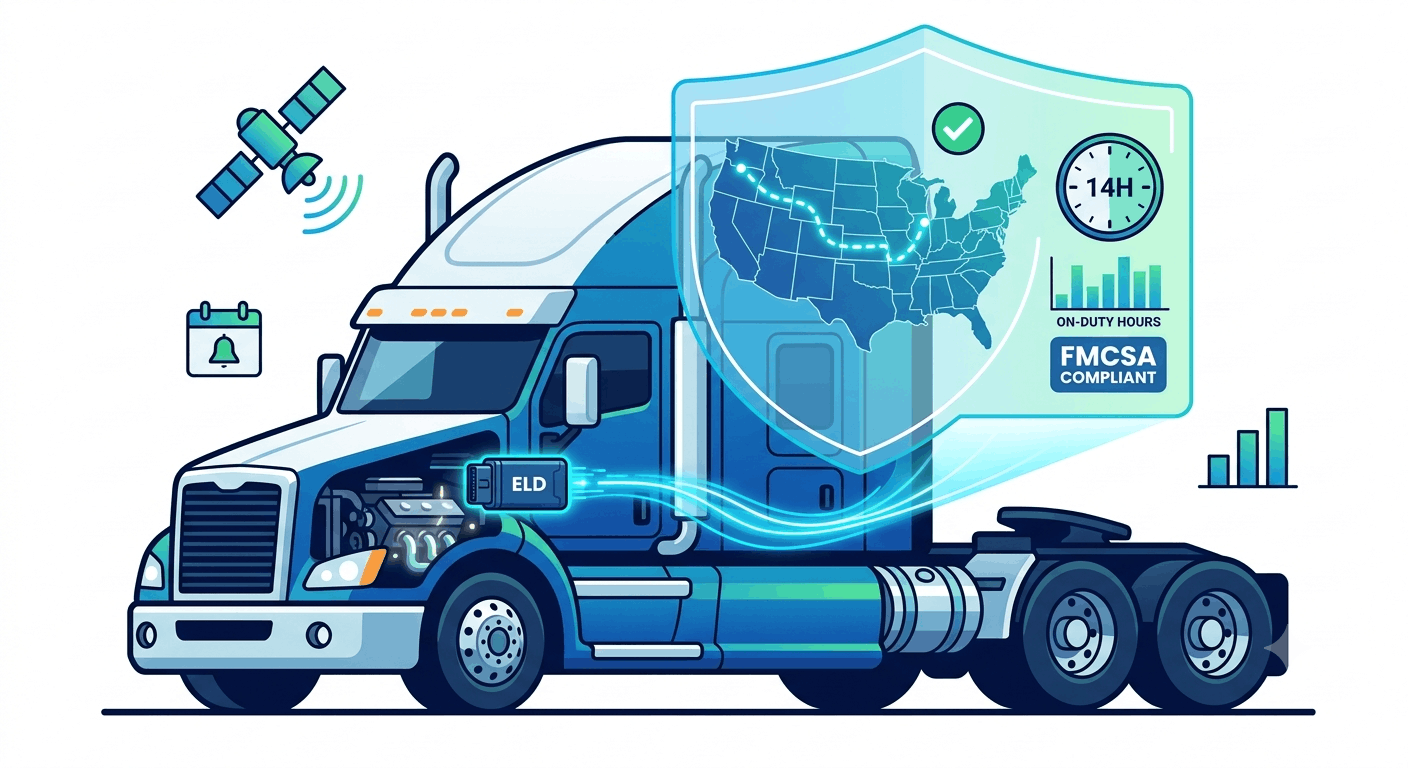
ELD stands for Electronic Logging Device. A federally mandated system for most commercial trucks in the USA that automatically records a driver’s Hours of Service (HOS).
Here’s a comprehensive overview of ELD systems for trucks in the USA.
1. What is an ELD and How Does It Work?
An ELD is a hardware device that connects directly to a truck’s engine via the On-Board Diagnostics (OBD) port. It automatically captures data such as:
- Engine running status and vehicle motion
- Miles driven and engine hours
- GPS location at key intervals
- Driver duty status changes
This creates a tamper-resistant digital record of a driver’s duty status, replacing older paper logs.
2. The FMCSA Mandate: Who Needs an ELD?
The Federal Motor Carrier Safety Administration (FMCSA) requires ELDs for most commercial motor vehicles (CMVs) in interstate commerce.
A truck typically must use an ELD if it meets all of these conditions:
- Weight: GVWR or GCWR of 10,001 pounds or more
- Commercial Use: The operation is commercial in nature
- RODS Requirement: The driver is required to maintain Records of Duty Status (RODS)
- Interstate Commerce: The vehicle operates across state lines
Examples of trucks that usually need ELDs:
- Sleeper cabs and day cabs (long-haul tractor-trailers)
- Reefer, flatbed, dry van, tanker, and intermodal trucks
- Box trucks, straight trucks, and hotshot trucks (when operating as CMVs in interstate commerce)
3. Exemptions: Who Does NOT Need an ELD?
Not every truck driver needs an ELD. Common exemptions include:
- Short-Haul Exception: Drivers operating within a 150 air-mile radius, returning to their work reporting location daily, and not exceeding a 14-hour duty period
- Pre-2000 Engine Model Year vehicles
- Driveaway-Towaway operations
- Drivers who log fewer than 8 days in any 30-day period
4. Key Benefits of Using an ELD
Beyond compliance, ELDs offer operational advantages:
| Benefit | Description |
|---|---|
| FMCSA Compliance | Accurate HOS tracking reduces violations for log falsification and missing entries. |
| Reduced Paperwork | Logs are available instantly and digitally, ready for audits. |
| Driver Accountability | Clear records reduce disputes and improve trust. |
| Real-Time Visibility | GPS tracking and trip progress updates for dispatchers. |
5. Popular ELD Providers in the USA
Here are some of the top-rated ELD systems as of 2025–2026:
| Provider | Best For | Approx. Price (per vehicle/month) |
|---|---|---|
| Samsara ELD | Best overall; powerful telematics and AI dashcams | $30–$40 |
| Motive (KeepTruckin) | Best all-in-one; clean interface, AI dashcams | $25–$35 |
| Verizon Connect Reveal | Full fleet management with advanced analytics | Varies |
| Matrack ELD | Most affordable; no long-term contract | $19.95 |
| EzLogz ELD | Small & mid-sized fleets; multilingual support | $25–$30 |
| Geotab / Lytx | Advanced telematics and IoT integration | Varies |
Note: Always check the FMCSA Registered ELD List before purchasing, as devices are regularly added and removed.
6. Compliance & Enforcement: What’s New in 2026?
FMCSA actively enforces ELD compliance and regularly removes non-compliant devices from the registered list.
- December 2025: FMCSA overhauled the ELD vetting process to block non-compliant devices earlier.
- February 7, 2026: Motor carriers using revoked ELDs are considered as operating without an ELD and face citations and out-of-service orders.
- May 2026: FMCSA removed 12 ELDs (including 888 ELD, DRAGON ELD, ACTION ELD, etc.) from the registered list.
If your ELD is revoked, you must:
- Discontinue using it and revert to paper logs temporarily.
- Replace it with a compliant ELD from the FMCSA Registered List within 60 days.
7. How to Choose an ELD System
When selecting an ELD for your fleet, consider:
- FMCSA Registration: Verify the device is on the official FMCSA Registered ELD List.
- Ease of Installation: Look for plug-and-play devices that connect via the OBD port.
- Fleet Size & Needs: Smaller fleets may prefer budget-friendly options like Matrack, while larger fleets benefit from Samsara’s scalability.
- Additional Features: GPS tracking, AI dashcams, maintenance reminders, and fuel optimization can add significant value.
- Contract Flexibility: Month-to-month options (e.g., Matrack, GPS Trackit) offer flexibility for seasonal operations.
Summary
ELD systems are a critical requirement for most commercial trucks operating in the USA. They ensure compliance with federal Hours of Service regulations, improve road safety, and offer operational benefits like real-time tracking and reduced paperwork. Always verify that your chosen ELD is on the FMCSA’s registered list to avoid fines and out-of-service violations.
Introduction: What Are ELD Systems for Trucks?
Electronic Logging Devices (ELDs) have fundamentally transformed how the American trucking industry tracks driver hours and maintains compliance with federal regulations.
Simply put, ELD systems for trucks are hardware and software solutions that automatically record a commercial driver’s driving time, engine status, and hours of service (HOS) directly from the vehicle’s engine. These devices replace the old paper logbooks that drivers once used to manually track their duty status.
The transition to ELD systems for trucks was driven by the Federal Motor Carrier Safety Administration’s (FMCSA) mandate to improve road safety and ensure drivers get the rest they need.
Today, ELD systems for trucks have evolved far beyond simple logbook replacements they now serve as comprehensive fleet intelligence platforms incorporating real-time GPS tracking, engine diagnostics, driver behavior monitoring, and cloud-based reporting.
Since the mandate’s full enforcement, ELD systems for trucks have become an essential compliance tool for carriers of all sizes, from single-truck owner-operators to massive national fleets.
This comprehensive guide covers everything you need to know about ELD systems for trucks in 2026 from regulatory requirements and exemptions to provider comparisons and cost breakdowns.
Understanding the FMCSA ELD Mandate
What the Law Requires
The FMCSA’s ELD mandate falls under Part 395 of the Federal Motor Carrier Safety Regulations, which establishes the federal standards for hours-of-service recordkeeping. Under these regulations, most commercial motor vehicles operating in interstate commerce must use a registered ELD to track driver hours.
The technical requirements are stringent. ELD systems for trucks must be self-certified and registered on FMCSA’s official list of approved devices. Manufacturers must demonstrate that their devices meet the technical standards outlined in Title 49 CFR Appendix A to Subpart B of Part 395.
This ensures that all ELD systems for trucks provide tamper-resistant, accurate records that can be easily transferred to enforcement officials during roadside inspections.
Who Must Use ELD Systems for Trucks?
A truck typically must use an ELD if it meets all of the following conditions:
- Weight Threshold: The vehicle has a Gross Vehicle Weight Rating (GVWR) or Gross Combination Weight Rating (GCWR) of 10,001 pounds or more
- Commercial Use: The operation is commercial in nature
- Interstate Commerce: The vehicle operates across state lines
- RODS Requirement: The driver is required to maintain Records of Duty Status
This means that ELD systems for trucks are required for a wide range of commercial vehicles, including tractor-trailers, box trucks, straight trucks, flatbeds, reefers, tankers, hotshot trucks, and even certain service or vocational trucks when they operate as CMVs in interstate commerce.
Key Exemptions
Not every commercial driver needs ELD systems for trucks. The FMCSA recognizes several important exemptions:
Short-Haul Exemption
The most common exemption applies to drivers operating within a 150 air-mile radius of their work reporting location who return to that location within 14 consecutive hours. For CDL drivers, the radius is 100 air-miles. This covers most local and regional delivery operations.
Other Exemptions include:
- Vehicles with pre-2000 engine model years
- Drivers who use paper RODS for no more than 8 days in any 30-day period
- Certain agricultural operations, especially during planting and harvest seasons
- Driveaway-towaway operations
It’s important to note that if a short-haul driver breaks the 150 air-mile radius or exceeds the 14-hour duty window, they must immediately reconstruct their day using a standard paper Record of Duty Status.
2026 Regulatory Updates: What’s New This Year
The regulatory landscape for ELD systems for trucks continues to evolve in 2026. Here are the most significant recent developments:
FMCSA’s Aggressive Enforcement Against Non-Compliant Devices
FMCSA has dramatically stepped up enforcement in 2026, repeatedly removing devices from the Registered ELD List when providers fail to meet minimum requirements.
As FMCSA Administrator Derek D. Barrs stated: “Meeting federal requirements isn’t optional. If a device falls short, it will be removed. We enforce the standard fairly and firmly because safety depends on it” .
Key removal events in 2026 include:
- March 4, 2026: FMCSA removed fourteen devices from the registered list
- April 2, 2026: HERO ELD was removed
- May 20, 2026: FMCSA removed twelve additional ELDs, including 888 ELD, DRAGON ELD, ACTION ELD, Mondo ELD HOS, FIRST ELD, MTL ELD, USPower ELD, Sam Freight ELD, DSGELOGS, COBRA ELD, and GT USA ELOGS
When an ELD is revoked, motor carriers have a 60-day window to replace the device with a compliant alternative. During this grace period, inspectors are encouraged to request paper logs rather than cite drivers.
However, after the deadline passes, drivers using revoked devices are considered to be operating without an ELD and face out-of-service orders.
Rescission of the Operator’s Manual Requirement
In a significant regulatory change, FMCSA issued a final rule effective July 22, 2026, rescinding the requirement for a copy of the ELD operator’s manual to be kept in commercial motor vehicles.
The agency determined there was “no readily apparent benefit to continuing to require that the user’s manual be in the CMV” given that ELDs have been in use since December 2019.
Most ELDs already have an electronic version of the manual built into the device. This rule eliminates a regulatory burden on motor carriers without compromising safety.
Increased Inspection Scrutiny
The Commercial Vehicle Safety Alliance’s (CVSA) Roadcheck 2026 placed special emphasis on ELD tampering and cargo securement.
Inspectors are not just looking to see if a truck has an ELD they are examining how the ELD is being used. This means proper training and consistent usage of ELD systems for trucks have never been more critical.
How ELD Systems for Trucks Work
Understanding the technology behind ELD systems for trucks helps fleet managers make informed purchasing decisions.
Core Components
ELD systems for trucks typically consist of three main components:
- Hardware Device: A small unit that plugs into the truck’s diagnostic port (OBD-II, 9-pin, or 6-pin connector)
- Fleet Management Software: A cloud-based platform that stores logs, generates reports, and handles compliance
- Mobile Application: A smartphone or tablet app that drivers use to view logs, change duty status, and submit reports
Data Captured
ELD systems for trucks automatically record:
- Engine running status and vehicle motion
- Miles driven and engine hours
- GPS location at key intervals
- Driver duty status changes (On-Duty, Driving, Off-Duty, Sleeper Berth)
- Time-stamped entries with tamper-resistant audit trails
FMCSA Technical Requirements
To be registered, ELD systems for trucks must meet specific technical standards including:
- Driver authentication connecting each duty status record to a verified driver profile
- Log integrity with tamper-resistant time-stamped entries
- Supporting records accommodating shipment documentation and compliance notes
- Enforcement access allowing authorized officials to retrieve records during inspections
Costs of ELD Systems for Trucks in 2026
Typical Pricing Structure
The cost of ELD systems for trucks varies significantly based on hardware choices, service plans, and fleet size. Here’s what to expect in 2026:
| Cost Component | Typical Range |
|---|---|
| Hardware | $0 – $500 per truck (most common: $100–$300) |
| Monthly Service | $15 – $60 per truck |
| First-Year Total | $300 – $1,200 per truck |
Scenario Breakdown
Different deployment approaches yield different costs:
- BYOD (Bring Your Own Device) app with dongle only: $0–$150 hardware, $15–$30/month
- Dedicated plug-in or hard-wired ELD: $100–$300 hardware, $20–$40/month (most popular for fleet standardization)
- One-time purchase/no-subscription device: $250–$500 hardware, $0–$10/month (limited features)
Real-World Examples
To put this in perspective:
- Example 1: $150 ELD device + $25/month plan = $450 in year one per truck
- Example 2: “Free” OBD dongle with 3-year contract at $40/month = $1,440 over 3 years
- Example 3: One-time $399 no-subscription device = $399 over 3 years (excluding phone/data costs)
When fleet managers ask “how much is an ELD,” the real question is usually “how much per truck per month once everything is included.” The hardware cost is just the starting point. Fleets in 2026 typically evaluate total cost over a 3–5 year period.
Cost-Saving Opportunities
Some manufacturers are now offering free ELD services. For example, Daimler Truck North America partnered with Class8 to provide a free ELD service with maintenance visibility for eligible Freightliner Cascadia trucks, available starting February 2026. This trend may continue as competition in the ELD market intensifies.
Top ELD Systems for Trucks in 2026
Based on expert reviews, real-world testing, and user feedback, here are the leading ELD systems for trucks available in 2026.
1. Matrack ELD – Best Overall
Matrack ELD consistently ranks as the best overall ELD system for trucks in 2026.
Key Features:
- Free hardware eliminates upfront barriers
- $19.95/month with month-to-month contracts
- Plug-and-play OBD2 installation
- 24/7 customer support with 10-minute response time
- Real-time GPS tracking integrated with compliance
Best For: Owner-operators, small fleets, and cost-conscious carriers who want flexibility without long-term contracts
2. Samsara ELD – Best for Enterprise Fleets
Samsara offers a comprehensive telematics ecosystem built for data-driven fleet management.
Key Features:
- $30–$40/month
- AI-powered dual-facing dashcams
- Real-time GPS tracking with route history and maintenance data
- Advanced integrations and AI-supported insights
- Unified interface for managers
Best For: Large enterprises and fleets managing complex, multi-location operations
3. Motive ELD – Best for Owner-Operators
Motive (formerly KeepTruckin) blends electronic logging with driver safety technology.
Key Features:
- Around $30/month
- Month-to-month contracts on base ELD plans
- Integrated dashcam options for incident documentation
- Driver scorecards and fuel monitoring tools
- Mobile-first design
Best For: Owner-operators and mid-sized fleets expanding their safety programs
4. Garmin eLog – Best for Simplicity
Garmin eLog focuses on straightforward electronic logging for drivers who prioritize simplicity.
Key Features:
- Automatic driving time capture
- Bluetooth pairing with smartphones or Garmin displays
- Simple interface design
Best For: Drivers who want a no-frills, reliable logging solution
5. Other Notable Providers
- Verizon Connect Reveal: Full fleet management with advanced analytics
- Geotab: Advanced telematics and IoT integration
- BigRoad DashLink: Popular for its user-friendly app
- Trimble ELD: Robust compliance support with GPS tracking and vehicle diagnostics
Quick Comparison Table
| Provider | Monthly Cost | Best For | Contract Flexibility |
|---|---|---|---|
| Matrack | $19.95 | Best Overall | Month-to-month |
| Samsara | $30–$40 | Enterprise Fleets | Typically annual |
| Motive | ~$30 | Owner-Operators | Month-to-month available |
| Garmin eLog | ~$20 | Simplicity | Varies |
| BigRoad | ~$25 | Small Fleets | Month-to-month |
Choosing the Right ELD System for Your Fleet
Selecting the right ELD system for trucks requires careful evaluation of several factors:
1. Verify FMCSA Registration
This is non-negotiable. Always verify that the device is on the official FMCSA Registered ELD List. FMCSA regularly removes non-compliant devices, and using a revoked device can result in out-of-service orders and citations.
2. Evaluate Your Fleet Size and Needs
- Owner-operators and small fleets (1-10 trucks): Look for affordable options with month-to-month contracts like Matrack
- Mid-sized fleets: Consider Motive for trucking-native workflows
- Large enterprises: Samsara offers comprehensive AI safety and turnkey deployment
3. Consider Additional Features
Modern ELD systems for trucks offer far more than basic logging:
- GPS Tracking: Real-time vehicle location and route history
- Dashcams: AI-powered driver monitoring and incident documentation
- Maintenance Alerts: Engine diagnostics and preventative maintenance reminders
- Fuel Analytics: Idling reports and fuel efficiency tracking
- IFTA Reporting: Automated fuel tax reporting
4. Assess Installation and Ease of Use
Most ELD systems for trucks offer plug-and-play installation via the OBD-II port. However, some vehicles may require 9-pin or 6-pin connectors. Consider:
- How quickly can drivers get up and running?
- Is the mobile app intuitive?
- What kind of training and support is provided?
5. Review Contract Terms
Contract structure matters significantly:
- Month-to-month contracts offer flexibility for seasonal operations or fleets testing a new provider
- Annual contracts may offer lower monthly rates but lock you in
- Watch for hidden fees like activation charges, early termination penalties, or overage fees
ELD Systems for Trucks: Benefits Beyond Compliance
While compliance is the primary driver for adopting ELD systems for trucks, the benefits extend far beyond avoiding fines:
Operational Efficiency
ELD systems for trucks automate recordkeeping, eliminating the administrative burden of paper logs. Dispatchers can view driver status in real time, enabling better load planning and reduced empty miles.
Reduced Violations and Downtime
Accurate HOS tracking reduces the risk of log violations, which can lead to costly fines and out-of-service orders. During CVSA Roadcheck 2026, inspectors specifically focused on ELD compliance, making proper ELD usage more important than ever.
Improved Safety
ELD systems for trucks help ensure drivers get the breaks they need, reducing fatigue-related accidents. Advanced features like dashcams and driver scorecards further enhance safety.
Real-Time Visibility
Integrated GPS tracking provides fleet managers with real-time visibility into vehicle locations, enabling better customer communication and more efficient dispatching.
Cost Savings
Fuel monitoring, idle reduction, and maintenance alerts help fleets reduce operating costs. Some fleets report significant savings through improved fuel efficiency and reduced wear and tear.
Common Mistakes to Avoid with ELD Systems for Trucks
1. Choosing an Unregistered Device: Always verify FMCSA registration. In 2026 alone, FMCSA removed dozens of devices from the registered list. Using a revoked device is equivalent to operating without an ELD.
2. Ignoring the 60-Day Grace Period: When an ELD is revoked, carriers have 60 days to replace it. Failing to act within this window results in out-of-service orders.
3. Underestimating Training Needs: ELD systems for trucks are only effective if drivers know how to use them properly. Inspectors in 2026 are examining not just whether a truck has an ELD, but how it’s being used.
4. Focusing Only on Price: The cheapest option isn’t always the best. Consider total cost of ownership, support quality, and features that matter for your operation.
5. Overlooking Data Plans: For BYOD solutions, don’t forget to factor in the cost of smartphone or tablet data plans.
Frequently Asked Questions About ELD Systems for Trucks
Do all trucks need ELD systems?
What happens if I use a revoked ELD
Can a revoked ELD be reinstated?
What’s the cheapest ELD system for trucks?
Do I need an ELD for intrastate operation?
Conclusion: The Future of ELD Systems for Trucks
The ELD mandate has fundamentally reshaped the American trucking industry, and the evolution of ELD systems for trucks shows no signs of slowing down. As we move through 2026, several trends are emerging:
Stricter Enforcement: FMCSA’s aggressive removal of non-compliant devices demonstrates a commitment to maintaining high standards for ELD systems for trucks. Carriers must stay vigilant about their chosen provider’s registration status.
Integration with AI: Advanced ELD systems for trucks are increasingly incorporating artificial intelligence for load optimization, route planning, and safety monitoring.
Free and Low-Cost Options: Competition is driving prices down, with some manufacturers offering free ELD services.
Electronic Inspections: There is a shift toward electronic inspections, which could streamline roadside checks.
For fleet managers and owner-operators alike, choosing the right ELD system for trucks is one of the most important decisions you can make. It’s not just about compliance it’s about operational efficiency, driver safety, and long-term profitability.
Take the time to research your options, verify FMCSA registration, and select a provider that offers the features, support, and pricing that align with your specific needs. With the right ELD system for trucks, you’ll stay compliant, reduce costs, and keep your fleet moving safely and efficiently.
Disclaimer: Regulations and pricing are subject to change. Always verify current FMCSA requirements and ELD registration status at eld.fmcsa.dot.gov before making a purchase decision.
Ready to stop dreaming and start driving?
Fill out the form and a Remms recruiter will reach out within one business day. No spam, no pressure — just real results.
Submit Driver Profile