
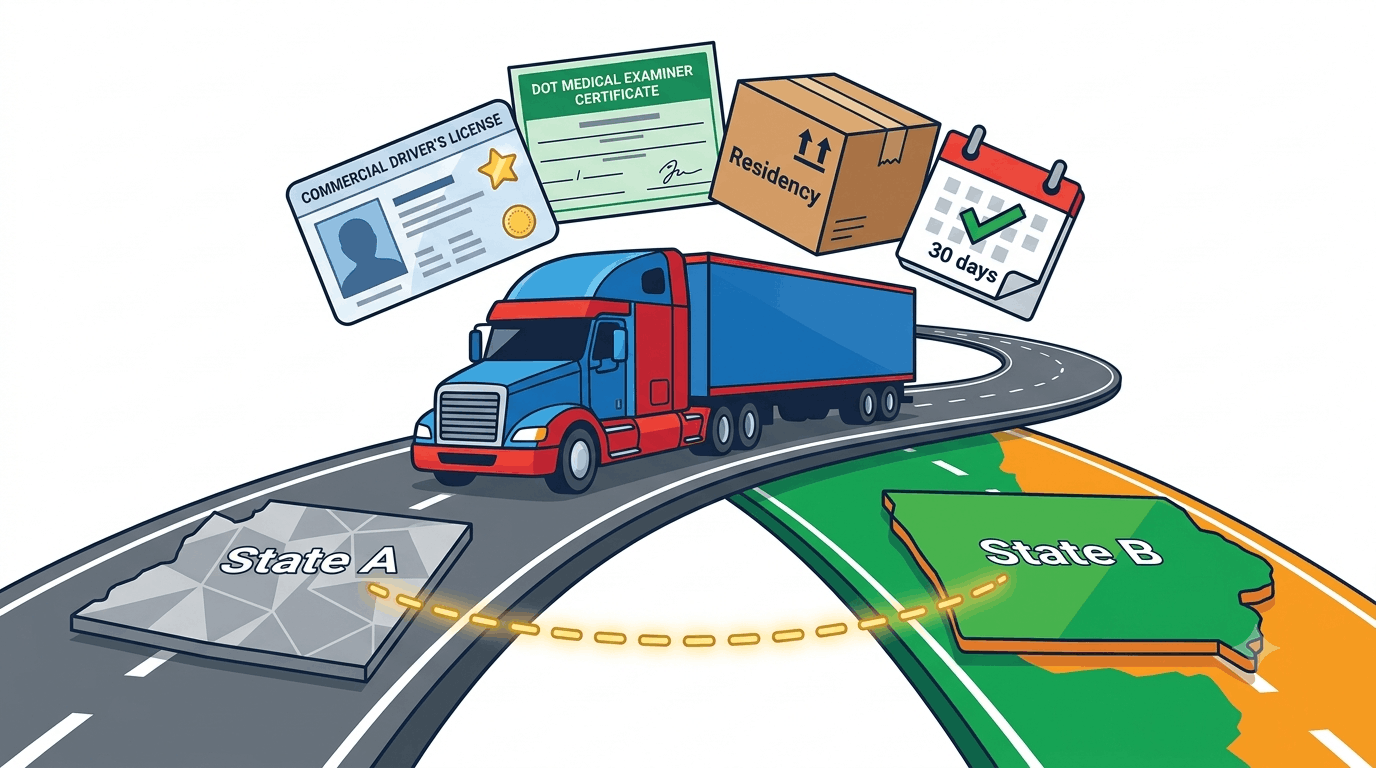
Moving to a new state brings excitement, new opportunities, and let’s be honest a mountain of paperwork. For commercial truck drivers, one task rises above all others: how to transfer CDL to another state correctly and on time. Miss a deadline or skip a step, and you could face fines, license suspension, or even lose your ability to work.
Quick Answer:
To transfer your CDL to another state, establish residency, gather proof of identity and address, visit your new state’s DMV, surrender your old CDL, pass any required vision or knowledge tests, submit a valid DOT medical certificate, and pay the transfer fee. Most drivers do not need to retake the CDL skills test if their license is valid. Federal law gives you 30 days to complete the transfer after establishing residency.
This guide walks you through everything you need to know about how to transfer CDL to another state, from federal requirements and document checklists to state-specific variations and insider tips that save you time and frustration. Whether you are relocating for a better job, family reasons, or simply a change of scenery, follow these steps to stay legal, protect your driving record, and get back behind the wheel as quickly as possible.
How to Transfer a CDL to Another State: Step-by-Step
Here is the exact sequence to follow when transferring your CDL to another state.
- Establish residency in your new state
- Gather all required documents (see Section 4)
- Visit your new state’s DMV (schedule an appointment if possible)
- Surrender your out-of-state CDL (you cannot hold CDLs from two states)
- Pass required tests (vision test is almost always required)
- Submit your DOT medical certificate (must be in the National Registry)
- Pay transfer fees
- Receive your new CDL (temporary license issued same day; permanent card mailed within 7-21 days)
1. Can You Transfer a CDL to Another State?
The short answer is yes. You can transfer a valid Commercial Driver’s License to another state when you establish residency there. However, your CDL does not transfer automatically you must actively apply through your new state’s DMV or licensing agency and meet that state’s specific requirements.
A CDL is issued by the state where you reside, not by the federal government. This means that when you move, your new state becomes your “state of record” and takes over responsibility for maintaining your commercial driving record.
Federal regulations explicitly prohibit holding a CDL from more than one state at the same time. When you receive your new CDL, you must surrender your old one.
Key requirement: You must be at least 21 years old to transfer a CDL, as this is the federal minimum age for operating a commercial vehicle across state lines.
2. The 30-Day Rule: Why Timing Matters
Federal law requires you to apply for a transfer CDL within 30 days of establishing domicile (residency) in your new state. This is not a suggestion – it is a federal regulation codified in 49 CFR § 384.212(b) and 49 CFR § 383.71(c).
Establishing residency typically means:
- Getting a new driver’s license
- Registering to vote
- Changing your address on official documents
- Signing a lease or purchasing a home
What happens if you miss the deadline? Driving on an out-of-state CDL past the 30-day window can lead to:
- Citations and fines
- Insurance problems
- Potential license invalidation
- Job loss, as most carriers require drivers to hold a CDL from their state of residence
Do not gamble with this deadline. Check your new state’s requirements immediately after moving.
3. Step-by-Step Guide: How to Transfer CDL to Another State
Step 1: Establish Residency in Your New State
Before you can transfer your CDL, you must prove you actually live in your new state. Most DMVs require two or three documents showing your new address. Acceptable proofs include:
- Signed lease or mortgage statement
- Utility bills (electric, water, cable, gas)
- Bank statements showing your new address
- Updated vehicle registration
- Voter registration card
- Government correspondence
Pro tip: Gather these documents before you visit the DMV. Without clear proof of residency, your application will be rejected.
Step 2: Gather All Required Documents
Missing documents are the number one reason CDL transfers get delayed. Collect everything before you step foot in a DMV office. See the full document list in Section 4 below.
Step 3: Visit Your New State’s Licensing Agency
Most states require CDL transfers to be completed in person. During your visit:
- DMV staff will review your documents
- They will check your driving record through the Commercial Driver’s License Information System (CDLIS)
- You will surrender your out-of-state CDL
- You will pay the applicable transfer fee
Pro tip: Schedule an appointment online if possible. Many states require appointments for CDL transfers.
Step 4: Complete Required Tests
Many states waive the CDL skills test for drivers with a valid, unexpired CDL. However, you may still need to:
- Take a vision test
- Pass a knowledge (written) test
- Complete endorsement-specific exams
- Retake tests if your CDL has been expired for more than one year
Step 5: Self-Certify Your Driving Type
You must self-certify to a single type of commercial operation on your application form. This tells the state whether you will be driving interstate or intrastate commerce.
Step 6: Submit Medical Certification
Your Medical Examiner’s Certificate (Form MCSA-5876) must be current and on file. Beginning June 16, 2025, medical examiners are required to upload your certificate into the National Registry of Certified Medical Examiners Portal.
States will check the National Registry to verify your medical certification. Missing or expired medical information can delay issuance of your new CDL.
Step 7: Receive Your New CDL
Once all requirements are met, your new state will issue your CDL. Processing times vary, but you typically receive your license immediately or within a few weeks by mail.
4. Documents You Need for CDL Transfer
Here is the comprehensive document checklist for how to transfer CDL to another state. Requirements vary slightly by state, but you will generally need:
Identity and Legal Presence Documents
- Current out-of-state CDL (must be active and not expired)
- Proof of U.S. citizenship or lawful permanent residency:
- Valid unexpired U.S. passport
- Certified birth certificate issued by a state vital statistics office
- Certificate of Naturalization or Citizenship
- Permanent Resident Card (Green Card)
- Social Security number (physical card may not be required in all states)
Residency Documents (Two proofs required in most states)
- Utility bill in your name
- Lease or mortgage agreement
- Bank statement with new address
- Vehicle registration in the new state
- Government correspondence
Medical Documentation
- Valid Medical Examiner’s Certificate (MCSA-5876)
- Must be from a medical examiner listed on the FMCSA National Registry
- The examiner must electronically submit your certificate to the National Registry
Additional Documents
- Completed CDL transfer application
- Payment for applicable fees
- For Hazmat endorsement: TSA Security Threat Assessment documentation
Critical note: Most states require original documents only – no copies. Hospital birth certificates and photocopies are generally not accepted.
5. Will You Have to Retake CDL Tests?
This is one of the most common questions drivers ask when learning how to transfer CDL to another state. The good news is that most drivers with a valid, unexpired CDL do not need to retake the skills test.
However, you may need to retake tests in these situations:
| Situation | Tests Required |
|---|---|
| CDL valid and unexpired | Vision test only (in most states) |
| CDL expired by less than 1 year | May transfer without retesting |
| CDL expired by more than 1 year | Written + Skills tests |
| Adding or removing endorsements | Endorsement-specific exams |
| Upgrading from Class B to Class A | Written + Skills tests |
| State-specific requirements | Knowledge test may be required |
| Hazmat endorsement transfer | Hazmat knowledge exam + new background check |
Most states also require a vision test as part of the transfer process.
Pro tip: Even if your new state does not require retesting, it is wise to review the CDL manual for your new state. Some states have unique traffic laws or regulations that could appear on a knowledge test.
6. What Happens to Your Endorsements?
Most endorsements transfer with your CDL when you remain qualified and the destination state recognizes them. Common endorsements that typically transfer include:
- Tank vehicle
- Passenger
- School bus
- Doubles and triples
Hazmat Endorsement: Special Rules Apply
The Hazardous Materials (H) endorsement requires special attention when transferring your CDL to another state:
- You generally cannot transfer the remaining validity period of an HME issued by another state
- You must pass a new Hazmat knowledge exam
- You must complete a new TSA background check and security threat assessment
- However, if you completed a TSA assessment within the previous five years, the new state may verify your approval date with TSA rather than requiring a new assessment
- Some states will not place the Hazmat endorsement on your new CDL until authorized by TSA
Critical note: Some states explicitly state that Hazmat endorsements and associated background check results from other states are not transferable. Always check with your new state’s DMV before assuming your Hazmat endorsement will carry over.
7. CDL Transfer Costs and Fees
Transfer fees vary significantly by state. Two states with identical federal requirements can charge $40 or $400 for the same license. Here are specific fees from several states:
| State | Transfer Fee | Notes |
|---|---|---|
| Texas | $60–$97 | Class A CDL upgrade costs $97 |
| Florida | $48–$75 | CDL renewal/transfer varies by license type |
| California | $66–$85 | $73 application fee + additional fees |
| Georgia | $32–$35 | $35 application fee, $32 for 8-year CDL |
| Illinois | $60 | Transfer in from another state |
| Oklahoma | $61.50–$138 | 4-year or 8-year credential options |
| Rhode Island | $59.50 | Out-of-state transfer |
| Ohio | $42–$50 | Knowledge test fee bundled with permit fee |
Typical DMV fee range: $25-$85 for DMV fees alone (not counting training school costs). Total costs can range from $40 to $400 depending on the state.
Pro tip: Contact your new state’s DMV website or call their office to confirm exact fees before your appointment. Having the correct payment method (check, money order, or card) ready will speed up the process.
8. CDL Transfer Timeline
Here is what you can expect in terms of timing:
| Step | Time Required |
|---|---|
| Establish residency | 1 day |
| Gather documents | 1-3 days |
| DMV appointment | Same day (with appointment) |
| Testing (if required) | Same day |
| Receive temporary CDL | Same day |
| Receive permanent CDL | 7-21 days |
Pro tip: The 30-day federal deadline counts from when you establish residency, not from when you visit the DMV. Start the process immediately after moving.
9. State-by-State Transfer Requirements
While the federal framework is consistent, each state has its own procedures. Here are specific requirements for major states:
Texas
- Transfer within 30 days of establishing residency
- Must hold a valid Texas Class C driver license
- Prove lawful presence in the U.S.
- Be medically certified through a DOT physical from an FMCSA-listed Medical Examiner
- Pass a vision screening at 20/40 in each eye
- Texas has a Special Requirements test
- Transfer fee: $60-$97
Florida
- Transfer within 30 days of establishing residency
- Two proofs of Florida residency required (effective July 1, 2026)
- Current out-of-state CDL required
- Transfer fee: $48-$75
- Florida allows retesting without a waiting period
California
- Transfer within 30 days of establishing residency
- Requires a CHP vehicle inspection
- Visit a CDL-issuing DMV office, complete form DL 44C
- Transfer fee: $66-$85
- Must pass vision screening
- Can transfer if CDL is current or expired less than two years ago
Georgia
- Transfer within 30 days of establishing residency
- Must take the required CDL Knowledge Test (written exam)
- Hold the permit for 14 days before taking the road test
- Vision testing is required
- All CDL holders must complete and submit a self-certification form
- Transfer fee: $32-$35
Ohio
- Transfer within 30 days of establishing residency
- Knowledge test required (80% passing score)
- Transfer fee: $42-$50
Illinois
- Transfer within 30 days of establishing residency
- Transfer fee: $60 ($50 for age 69 and older)
Oklahoma
- Must have a valid CDL from previous state
- If CDL expired less than six months, non-commercial driving privilege can transfer
- Hazmat endorsements do not transfer automatically
- Transfer fee: $61.50-$138 depending on class and credential length
Always check your specific state’s DMV website for the most current requirements. State procedures can change, and your specific situation (endorsements, driving history, etc.) may affect the process.
10. Can You Transfer a CDL Permit?
No. A Commercial Learner’s Permit (CLP) cannot be transferred from one state to another. If you move while holding a CLP, you must:
- Apply for a new learner’s permit in your new state
- Meet that state’s permit requirements
- Retake any required knowledge exams
- Complete any state-specific training requirements
CLPs are issued under state-specific rules, and most states do not recognize permits from other states. If you move before getting your full CDL, you may need to restart part or all of the licensing process.
Pro tip: If you are planning to move, try to complete your CDL training and obtain your full CDL before relocating. This will save you significant time and effort.
11. What If Your CDL Is Expired?
An expired CDL complicates the transfer process. Depending on the state and the length of expiration:
| Expiration Length | Requirements |
|---|---|
| Less than 1 year | May transfer without retesting |
| Less than 6 months | Non-commercial driving privilege may transfer |
| More than 1 year | Written test required |
| Significantly expired | Written + Skills tests + additional documentation |
If your CDL is lost or you cannot obtain a duplicate from your original state, you may need to retest in your new state and apply for a commercial learner’s permit.
12. Common Mistakes to Avoid
When transferring your CDL to another state, avoid these common pitfalls:
- Waiting beyond 30 days – This is the #1 mistake. Federal law requires transfer within 30 days of establishing residency.
- Bringing photocopies instead of originals – Most states require original documents only.
- Forgetting proof of residency – You typically need two proofs of residency.
- Missing DOT medical certificate – Your medical certification must be current and in the National Registry.
- Assuming Hazmat transfers automatically – Hazmat endorsements often require a new TSA background check and knowledge test.
- Not scheduling a DMV appointment – Many states require appointments for CDL transfers.
- Not informing your employer – Your employer needs to update driver-qualification files to comply with FMCSA rules.
13. Real Example: Transferring Your CDL
Example:
Mike moved from Georgia to Texas for a new job. Within two weeks of arriving, he:
- Established residency by signing a lease and setting up utilities
- Gathered his Georgia CDL, birth certificate, Social Security card, and two proofs of residency
- Updated his DOT medical certificate and confirmed it was in the National Registry
- Scheduled an appointment at the Texas DMV
- Visited the DMV, surrendered his Georgia CDL, passed the vision test, and paid the $97 transfer fee
- Received a temporary Texas CDL the same day
- His permanent Texas CDL arrived in the mail 10 days later
Total time from move to new CDL: 3 weeks – well within the 30-day federal deadline.
14. Statistics Every Driver Should Know
- Over 3.5 million CDL holders are licensed in the U.S.
- The FMCSA regulates commercial licensing across all states
- Most states process CDL transfers within 7-21 days after approval
- States must query the FMCSA Clearinghouse before any CDL transfer or renewal
- Typical DMV fees range from $25 to $85 for DMV fees alone
- Two states with identical federal requirements can charge $40 or $400 for the same license
16. Final Checklist Before You Go
Before you start the process of transferring your CDL to another state, run through this final checklist:
- Confirm your move date and new address
- Gather two proofs of residency (utility bill, lease, bank statement)
- Locate your current CDL (must be unexpired)
- Find your birth certificate or passport
- Locate your Social Security card or number
- Verify your Medical Examiner’s Certificate is current and in the National Registry
- Check your new state’s DMV website for specific requirements
- Schedule an appointment (if required)
- Prepare payment for transfer fees
- If transferring Hazmat, initiate TSA background check process
- Plan to complete the transfer within 30 days of moving
- Inform your employer of the change
Final Thoughts
Learning how to transfer CDL to another state does not have to be overwhelming. The process follows a predictable pattern: establish residency, gather documents, visit the DMV, complete required tests, and receive your new license. The key is preparation and timing.
Remember these three critical points:
- The 30-day deadline is federal law – do not ignore it.
- Gather all documents before visiting the DMV – missing paperwork is the #1 cause of delays.
- Hazmat endorsements require special handling – start the TSA process early.
Moving to a new state is an exciting chapter in your life and career. By following this guide, you can complete your CDL transfer smoothly, stay compliant with federal and state regulations, and get back on the road with minimal downtime.
15. Frequently Asked Questions
Can I transfer my CDL without taking the road test?
How long does it take to transfer a CDL?
Which states require CDL knowledge tests?
Can I transfer my CDL if I have violations?
Can I transfer a suspended CDL?
Can I transfer my CDL before I move?
Does a CDL transfer affect my endorsements?
Can I drive while waiting for my new CDL?
Can I transfer my CDL online?
What if I have a CDL and a regular driver’s license?
Ready to stop dreaming and start driving?
Fill out the form and a Remms recruiter will reach out within one business day. No spam, no pressure — just real results.
Submit Driver ProfileDisclaimer: This guide provides general information about transferring a CDL between states. Requirements vary by state and may change over time. Always verify current requirements with your new state’s DMV or licensing agency before beginning the transfer process. Last Updated: July 2026.