
Quick Answer:
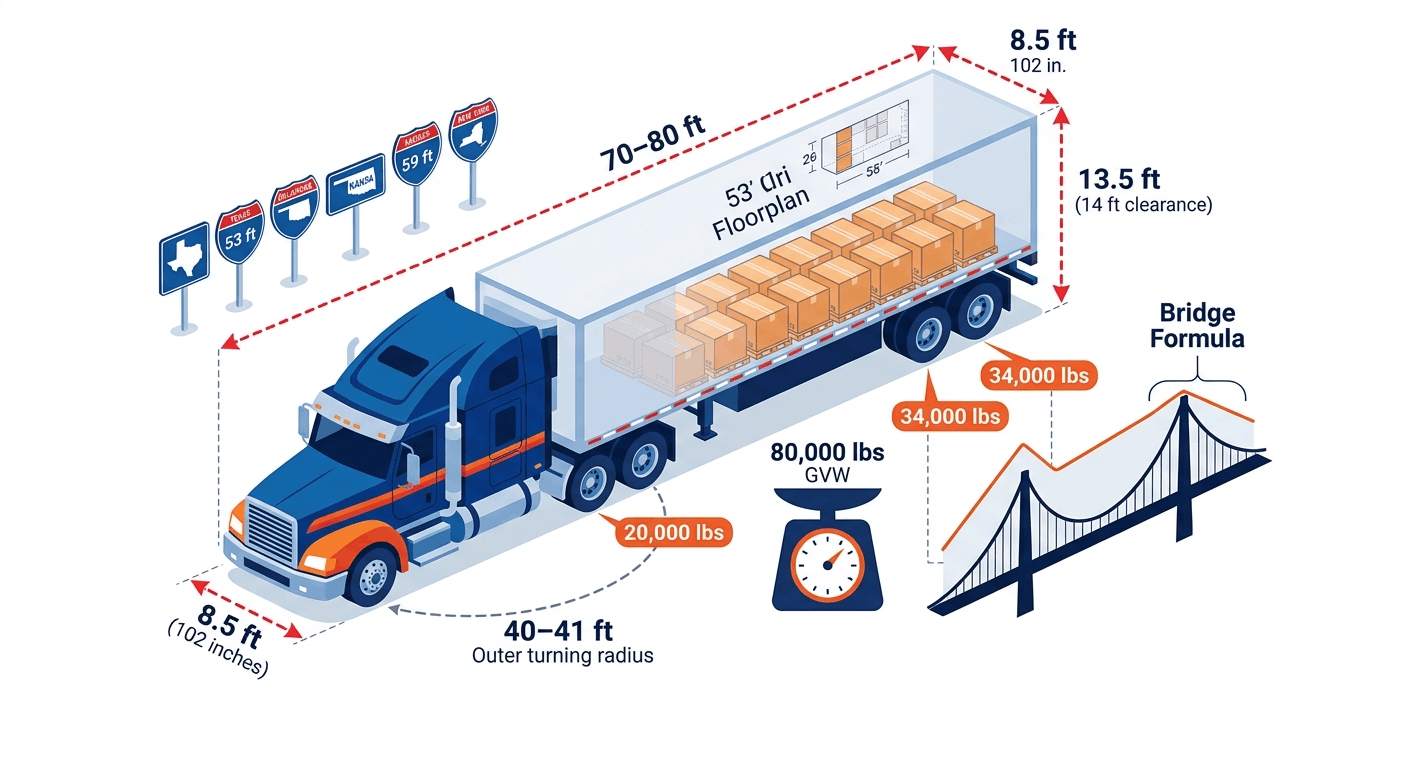
A standard semi-truck (tractor and 53-foot trailer) averages 70 to 80 feet in total length, 8.5 feet in width, and 13.5 feet in height. These dimensions define maximum interstate allowances and require specialized route planning to clear low bridges and tight turning radiuses.
Standard Semi-Truck Dimensions
A typical 5-axle semi-truck (tractor and trailer) in the U.S. has the following standard dimensions:
- Overall Length: 70 to 80 feet. This varies based on the tractor and trailer type. A common combination is a 20-foot tractor with a 53-foot trailer.
- Overall Width: 8 feet 6 inches (102 inches). This is the federal maximum width for commercial vehicles on the Interstate System.
- Overall Height: 13 feet 6 inches (13.5 feet). This is the standard height to safely clear most bridges and overpasses, though some states may allow taller vehicles.
Weight Limits
The weight of a semi-truck is strictly regulated:
- Maximum Gross Vehicle Weight (GVWR): The federal limit for a fully loaded 5-axle semi-truck on the Interstate System is 80,000 pounds.
- Single Axle (Steer Axle): Maximum 20,000 pounds.
- Tandem Axle (two axles close together): Maximum 34,000 pounds.
Trailer Dimensions
The most common trailer type is the 53-foot dry van. Here are dimensions for several common trailer types:
| Trailer Type | Length | Width | Max Weight Capacity | Notes |
|---|---|---|---|---|
| Dry Van | 48 – 53 ft | 8.5 ft | 42,000 – 45,000 lbs | Enclosed, for general freight. |
| Flatbed | 48 – 53 ft | 8.5 ft | ~50,000 lbs | Open deck for heavy or oversized cargo. |
| Step Deck | 48 – 53 ft | 8.5 ft | ~48,000 lbs | Lower deck for taller cargo. |
| Lowboy | 40 – 53 ft | 8.5 – 10 ft | 45,000 – 85,000 lbs | Very low deck for extremely tall/heavy loads. |
Cab Dimensions
- Day Cab: Approximately 20 feet long.
- Sleeper Cab: Approximately 20 feet long, though the final measurement varies.
- Cab Height: The cab itself ranges from 6 to 10 feet tall, depending on the model.
Legal Considerations
It’s important to note that while these are federal standards, state regulations can vary:
- State Variations: Some states may have different length or weight limits. For instance, Texas and Oklahoma allow trailers up to 59 feet long on some roadways.
- Permits: Loads that exceed standard legal dimensions (height, width, length, or weight) require special oversize/overweight permits.
- Bridge Formula: The Federal Bridge Formula is a more complex weight calculation that may impose a lower limit than 80,000 pounds to protect highway bridges, based on the number and spacing of axles.
Having reviewed the competitor article from Truckopedia, I can see it provides a solid basic overview of semi-truck dimensions. However, it lacks depth in several critical areas: precise regulatory citations, detailed axle and weight calculations, comprehensive trailer type specifications, and practical operational guidance.
My analysis below builds upon that foundation by adding verified regulatory data, expanded technical specifications, and actionable insights for drivers and fleet managers.
Where the competitor article offers general statements, I provide specific numbers, legal frameworks, and real-world applications.
The Definitive Guide to Length, Height, Width, Weight, and Regulations in the USA
Semi-trucks are the undisputed workhorses of the American economy. From fresh produce moving from California’s Central Valley to manufacturing supplies heading to factories in the Midwest, these massive vehicles transport approximately 72.7% of long-haul freight in North America. Despite their constant presence on our highways, few people truly understand just how large and how carefully regulated these vehicles really are.
Understanding semi truck dimensions is far more than a matter of curiosity. For fleet managers, owner-operators, logistics coordinators, and warehouse managers, knowing the exact length, width, height, and weight of a semi-truck is essential for route planning, regulatory compliance, cargo capacity optimization, and safe operation. A truck that exceeds legal limits can face costly fines, routing delays, and even infrastructure damage.
This comprehensive guide builds upon existing resources by providing verified regulatory data, detailed axle weight calculations, comprehensive trailer specifications, and actionable operational guidance for everyone involved in the trucking industry.
What Exactly Is a Semi-Truck?
Before diving into the numbers, it is helpful to understand what a semi-truck actually is. A semi-truck commonly called an 18-wheeler, big rig, or tractor-trailer is a combination vehicle made up of two main components: the tractor and the trailer.
The tractor is the powered front section that contains the engine, cab, and front axle. It is where the driver sits and controls the vehicle. The trailer is the unpowered rear section that carries the cargo. The term “semi” comes from the trailer’s design: unlike a full trailer that supports itself with front wheels, a semi-trailer supports only its rear half. The front half rests on the tractor via a coupling mechanism called a fifth wheel.
When we refer to semi truck dimensions, we are considering the combined size of both the tractor and the trailer working together as a single unit. This distinction is important because the total length is not simply the tractor length plus the trailer length part of the trailer actually sits over the tractor at the fifth wheel connection.
Standard Semi Truck Dimensions at a Glance
For those who need quick reference, here are the standard semi truck dimensions for a typical 5-axle tractor-trailer combination operating on U.S. highways:
| Measurement | Standard Dimension |
|---|---|
| Overall Length | 70–80 feet |
| Width | 8 feet 6 inches (102 inches) |
| Height | 13 feet 6 inches (13.5 feet) |
| Maximum Gross Weight | 80,000 pounds |
These baseline measurements apply to most highway applications. However, exact semi truck dimensions can vary depending on the specific equipment configuration, trailer type, and state regulations.
Semi Truck Length: How Long Is a Semi-Truck?
Length is perhaps the most variable of all semi truck dimensions. The total length of a semi-truck depends on several factors, including the type of tractor, the type of trailer, and state-specific regulations.
Tractor Length
The tractor alone typically measures between 20 and 25 feet in length. This range depends primarily on whether the truck uses a day cab or a sleeper cab:
- Day cabs are designed for regional and local routes where drivers return home each night. They are more compact, typically measuring around 20 feet long.
- Sleeper cabs include a sleeping berth behind the seats for long-haul drivers. They typically measure around 20–30 feet long depending on cab design and specifications.
Trailer Length
The most common trailer length in the United States is 53 feet. This length has become the industry standard because it offers optimal cargo space specifically, it can accommodate 26 standard pallet positions across its floor space while still complying with most state regulations.
Other common trailer lengths include:
| Trailer Type | Typical Length |
|---|---|
| Dry Van | 48–53 feet |
| Flatbed | 48–53 feet |
| Refrigerated (Reefer) | 48–53 feet |
| Step Deck | 48–53 feet |
| Lowboy | 40–53 feet |
| Pup Trailer | ~28 feet |
| Intermodal Container | 20, 40, or 53 feet |
Total Combined Length
When the tractor and trailer are coupled together, the total length of a standard semi-truck typically ranges from 70 to 80 feet. A common configuration a 20-foot tractor with a 53-foot trailer results in a total length of approximately 72 to 75 feet.
It is worth noting that specialty trailers, such as extendable double-drop trailers (RGNs), can reach up to 80 feet when fully extended.
Federal and State Length Regulations
The regulatory landscape for semi-truck length is somewhat complex. At the federal level, the minimum trailer length on the Interstate System is 53 feet, while trucks “grandfathered” in under FMCSA rules from December 1, 1982, may operate at a minimum trailer length of 48 feet.
Instead of federal maximum length limits, individual states regulate trailer length on their roads. Most states limit trailers to 53 feet, but some allow longer trailers under specific circumstances:
| State | Trailer Length Allowance |
|---|---|
| Texas | Up to 59 feet for certain freight |
| Oklahoma | Up to 59 feet for certain freight |
| Kansas | Up to 59.5 feet for semitrailers |
| New York | 53 feet on state highways; 48 feet in NYC |
| North Carolina | 53 feet maximum |
For twin trailer configurations (double trailers), each trailer is typically limited to 28 feet.
For truck drivers and fleet managers, understanding these state-by-state variations in semi truck dimensions is critical for route planning and avoiding compliance issues.
Semi Truck Width: How Wide Is a Semi-Truck?
Width is the most uniformly regulated of all semi truck dimensions. The legal maximum width for most semi-trucks in the United States is 8 feet 6 inches (102 inches).
Why This Width?
This standard width aligns with standard U.S. highway lane widths, which are typically around 12 feet. The 8.5-foot width ensures that semi-trucks can safely share the road with other vehicles while leaving adequate clearance on both sides.
Width Exceptions and Considerations
There are several important nuances to understand about semi-truck width:
- Mirror Allowance: While the truck body itself must stay within 8.5 feet, mirrors and other safety equipment are exempt from width restrictions. Trucks are allowed an extra 10 inches per side for mirrors, making the total mirror-to-mirror width up to 10 feet.
- State Variations: All 49 continental states follow the 8.5-foot width rule. However, Hawaii is an exception, allowing a 9-foot maximum width.
- Oversized Loads: Any load that exceeds the standard 8.5-foot width is considered oversized and requires special permits.
Semi Truck Height: How Tall Is a Semi-Truck?
Height is another critical semi truck dimension that drivers must constantly monitor. The standard height for a semi-truck is 13 feet 6 inches (13.5 feet). However, some trucks may reach up to 14 feet depending on the configuration.
Why 13 Feet 6 Inches?
This standard height exists for a critical reason: bridge and overpass clearance. The Federal Highway Administration requires bridge clearances to be no lower than 14 feet. By keeping trucks at 13 feet 6 inches, there is a safety margin of 6 inches to prevent collisions with bridges, overpasses, and tunnels.
Even though most highways are designed with higher clearances, not all routes are. Drivers must always verify height restrictions before entering a route, especially in areas with older infrastructure or in urban environments.
Height Variations by Trailer Type
Different trailer types have different heights, which affects the overall semi truck dimensions:
| Trailer Type | Height |
|---|---|
| Dry Van | 13.5 feet total |
| Flatbed | ~5 feet (plus up to 8.5 feet for cargo) |
| Step Deck | Lower than standard flatbed |
| Lowboy | 3.5 feet to as low as 1.5 feet |
| Intermodal | ~9.5 feet |
Step deck and lowboy trailers are designed specifically to sit lower to the ground, allowing taller freight to stay within legal height limits.
Semi Truck Weight: How Much Does a Semi-Truck Weigh?
Weight is perhaps the most critical and most heavily regulated aspect of semi truck dimensions. Exceeding weight limits can cause severe damage to road surfaces and bridges, posing a significant risk to public safety.
Maximum Gross Vehicle Weight (GVW)
The federal maximum gross vehicle weight for a standard 5-axle tractor-trailer combination on the Interstate System is 80,000 pounds. This includes the weight of the truck itself, the trailer, fuel, driver, and cargo.
Axle Weight Limits
In addition to the overall weight limit, there are strict limits on how much weight can be placed on each axle:
- Single Axle (Steer Axle): Maximum 20,000 pounds
- Tandem Axle (two axles close together): Maximum 34,000 pounds
The Federal Bridge Formula
The 80,000-pound gross weight limit is not the only constraint. The Federal Bridge Formula is a more complex calculation that may impose a lower weight limit depending on the number and spacing of axles.
This formula is designed to protect highway bridges by ensuring that weight is distributed properly across the vehicle’s axles.
The Federal-Aid Highway Act Amendments of 1974 established the bridge formula as law, along with the gross weight limit of 80,000 pounds.
The formula applies when the gross weight on two or more consecutive axles exceeds the limitations of the formula.
State Weight Variations
While the federal limits apply on the Interstate System, some states allow trucks to exceed the 80,000-pound cap on non-Interstate roads, as long as they still meet the Bridge Formula requirements. For example:
| State | Weight Allowance |
|---|---|
| Maine | 80,000 lbs on interstates; 100,000 lbs on other highways |
| New Mexico | 86,400 lbs |
Many states also allow higher weight limits for certain agricultural, logging, or construction vehicles, provided they stay on approved routes.
Trailer Types and Their Dimensions
Understanding the different types of trailers is essential because each has unique semi truck dimensions that affect cargo capacity, route planning, and regulatory compliance.
Dry Van Trailers
Dry vans are the most common trailers on American roads. They are enclosed, weatherproof boxes used for general freight.
- Length: 48–53 feet
- Width: 8.5 feet
- Height: 13.5 feet
- Weight Capacity: 42,000–45,000 pounds
- Cargo Volume: Approximately 3,800 cubic feet
Flatbed Trailers
Flatbeds have no sidewalls or roof, making them ideal for large equipment, construction materials, and other weatherproof cargo.
- Length: 48–53 feet
- Width: 8.5 feet
- Weight Capacity: ~50,000 pounds
Step Deck Trailers
Step deck trailers feature a step-down area between the cab and cargo area, making them more suitable than standard flatbeds for transporting taller cargo.
- Length: 48–53 feet
- Width: 8.5 feet
- Height: 10 feet 6 inches
- Weight Capacity: 48,000 pounds (up to 65 tons depending on axles)
Lowboy Trailers
Lowboys have an extremely low deck height (18–24 inches), making them ideal for extra-tall cargo such as heavy machinery and construction equipment.
- Length: 40–53 feet
- Width: 8.5–10 feet
- Deck Height: 18–24 inches
- Weight Capacity: 40,000–80,000+ pounds (varies by axle configuration)
Pup Trailers and Doubles
Pup trailers are shorter trailers, typically around 28 feet, that are sometimes pulled in pairs (double trailers) depending on the route and regulations.
Refrigerated Trailers (Reefers)
Refrigerated trailers are insulated and equipped with refrigeration units for temperature-sensitive cargo.
- Length: 48–53 feet
- Width: 8.5 feet
- Height: 13.5 feet
Regulatory Framework: Federal and State Oversight
The semi truck dimensions discussed throughout this guide are not arbitrary they are the result of decades of regulation designed to balance economic efficiency with public safety and infrastructure protection.
Federal Regulations
At the federal level, regulations are primarily governed by the Federal Highway Administration (FHWA) and the Federal Motor Carrier Safety Administration (FMCSA). Key federal regulations include:
| Dimension | Federal Limit |
|---|---|
| Width | Maximum 102 inches (8 feet 6 inches) |
| Height | Typically 13 feet 6 inches (standard, not federally mandated) |
| Weight | Maximum 80,000 pounds gross vehicle weight |
| Axle Weight | 20,000 lbs (single) / 34,000 lbs (tandem) |
| Length | No federal maximum for tractor-semitrailer combinations; minimum 53 ft trailer |
State Regulations
Individual states can impose additional, sometimes stricter, requirements depending on local infrastructure and conditions. States control routing, parking, bridge access, and local road restrictions, which determine where long combination vehicles can legally operate.
For example, while most states limit trailers to 53 feet:
- Texas and Oklahoma allow trailers up to 59 feet
- Kansas allows up to 59.5 feet
- New York City restricts trailers to 48 feet on city truck routes
Oversize and Overweight Permits
Loads that exceed standard semi truck dimensions whether in length, width, height, or weight require special oversize/overweight permits. These permits are typically issued by state departments of transportation and may restrict the routes the vehicle can travel.
Common scenarios requiring permits include:
- Loads exceeding 8.5 feet in width
- Loads exceeding 13.5 feet in height
- Loads exceeding 53 feet in trailer length (in most states)
- Loads exceeding 80,000 pounds gross weight
Practical Considerations for Drivers and Fleet Managers
Understanding semi truck dimensions is not just about compliance it has practical, day-to-day implications for everyone involved in the trucking industry.
Route Planning
Knowing your truck’s exact height is essential for avoiding low-clearance obstacles such as bridges, tunnels, and overpasses. A truck that is too tall for a route can cause catastrophic accidents and infrastructure damage.
Similarly, knowing your truck’s length and width helps with navigating tight urban streets, parking at truck stops, and positioning at loading docks.
Load Planning
The dimensions of your trailer directly determine how much cargo you can haul and how it should be distributed. Proper weight distribution is just as important as total weight for safe handling and braking performance.
Safety and Maneuverability
Larger vehicles require more space to maneuver. A typical semi-truck has a minimum inner turning radius of about 19 feet 4 inches and an outer turning radius between 40 and 41 feet. Drivers must account for this when making turns, especially in urban environments.
Compliance and Fines
Failing to comply with size and weight regulations can result in significant fines, penalties, and operational setbacks. For fleet managers, ensuring that all vehicles stay within legal semi truck dimensions is essential for protecting the bottom line.
Visualizing Semi-Truck Dimensions
To better visualize the size of a semi-truck:
- Height: Roughly the same as a one-story building or a giraffe
- Length: Comparable to a basketball court; a full semi-truck equals two school buses lined up end-to-end
The Future of Semi Truck Dimensions
As the trucking industry evolves, so too do the dimensions of the vehicles themselves. Electric semi-trucks, such as the Tesla Semi, are beginning to enter the market with their own specifications. The Tesla Semi, for example, has a gross combination weight of 82,000 pounds slightly higher than the traditional 80,000-pound limit. These new vehicles may prompt regulatory updates in the coming years.
Additionally, ongoing infrastructure improvements and changes in freight demand may lead to adjustments in allowable semi truck dimensions. Fleet managers and drivers must stay informed about regulatory changes to remain compliant.
Conclusion
Understanding semi truck dimensions is essential for anyone involved in the trucking industry. From the standard 70-to-80-foot overall length to the 8.5-foot width, 13.5-foot height, and 80,000-pound weight limit, every measurement serves a purpose balancing cargo capacity with safety, infrastructure protection, and regulatory compliance.
Whether you are a fleet manager planning routes, a driver navigating highways and city streets, or a logistics coordinator optimizing load plans, knowing the exact semi truck dimensions of your equipment is critical for safe, efficient, and lawful operation.
As the industry continues to evolve with new technologies and changing regulations, one thing remains constant: the importance of understanding the size and scale of these essential vehicles. The next time you see an 18-wheeler on the highway, you will have a much deeper appreciation for the careful engineering and regulation that goes into every inch of its semi truck dimensions.
Frequently Ask Question
What are the standard semi truck dimensions used in the US?
Standard dimensions for a 53-foot dry van trailer
Where can I find detailed semi truck size specifications?
Legal maximum height for commercial vehicles in the US
Average width of a semi truck cab
What are the length and height restrictions for semi trucks on US highways?
Factors affecting overall semi truck length
How do semi truck dimensions vary between different trailer types?
Weight distribution considerations for different trailer dimensions
What size are most semi trucks?
Ready to stop dreaming and start driving?
Fill out the form and a Remms recruiter will reach out within one business day. No spam, no pressure — just real results.
Submit Driver Profile