
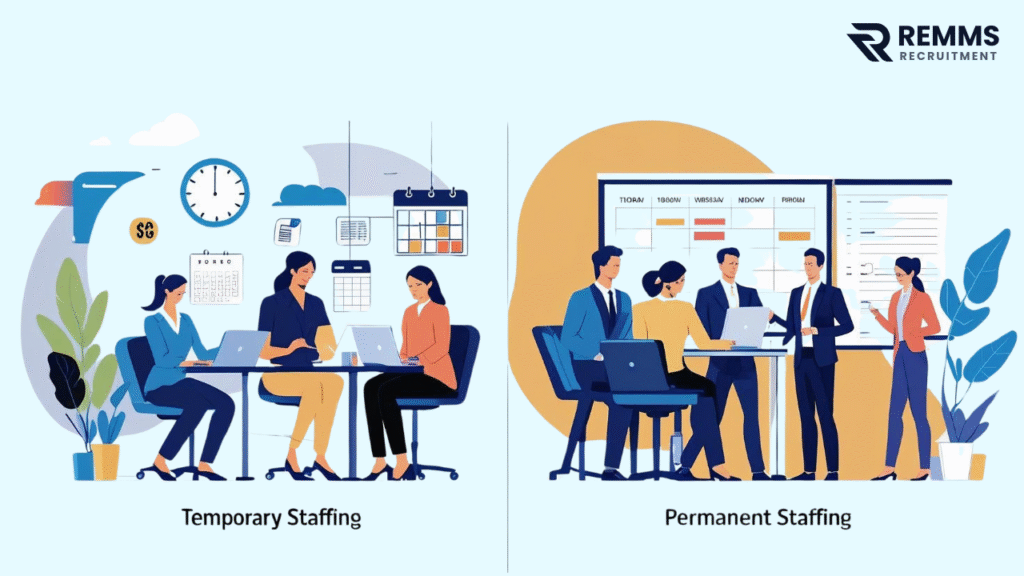
Hiring is one of the most important decisions you’ll make as a business leader or HR professional. But it’s rarely just about finding someone to fill a seat. It’s about finding the right seat-filler. Do you hire someone permanently and invest in them for the long haul? Or do you bring in a temporary worker to manage short-term needs? This is a big strategic call. When done right, understanding the difference between temporary and permanent staffing can give you an edge in agility, cost-efficiency, and long-term growth.
In this guide, I’ll walk you through all the essential components, definitions, benefits, challenges, best practices, legal insight, and real-life strategies. By the end, you’ll be equipped to build a staffing plan that perfectly fits your business needs.
What Is Temporary Staffing?
Temporary staffing (also called “contingent,” “contract,” or simply “temp” work) involves hiring talent for a limited scope or duration like weeks, months, or project timelines. These hires are typically sourced through staffing agencies. That means the agency handles payroll, benefits, compliance, and even taxes while you get to focus purely on the work at hand.
Temporary staffing shines when you:
- Have seasonal demand spikes like retail during the holidays or tax prep firms during tax season.
- Need support for short projects like launching new software or setting up a trade show.
- Want to cover absences when someone goes on maternity leave, sabbatical, or medical leave.
The beauty of temporary hires is their speed and flexibility. Agencies maintain pools of pre-screened professionals all ready to begin work fast. Some stats even show that 72% of companies rely on temporary staffing to handle uneven workloads.
Pros of Temporary Staffing
- Quick mobilization: Most agencies can send a candidate within days .
- Reduced overhead: Agencies handle the hard stuff like healthcare, payroll taxes, unemployment insurance.
- Lower commitment: You never feel locked in if demand drops.
- Try-before-you-buy: Temp-to-perm lets you test the waters before offering a full-time role.
- Access to niche skill sets: Need a cybersecurity specialist or locum nurse for a few weeks? Temp hires can fill in.
Cons of Temporary Staffing
- High turnover: Temps come and go, which can disrupt workflows.
- Integration gap: They may not mesh with your team culture or systems quickly.
- Training costs: Every new temp requires orientation even if it’s just compliance training.
- Possible morale impact: Constant change can frustrate long-term staff.
What Is Permanent Staffing?
Permanent staffing is all about the long game: hiring individuals you intend to keep indefinitely. These employees become integrated members of your company. You manage their benefits, development, training—the full package.
Permanent hires are ideal when you:
- Need long-term strategic leadership—think financial officers, marketing managers.
- Want someone who lives and breathes your culture.
- Require deep institutional knowledge like product owners or process experts.
Yes, permanent staffing takes longer. You might have to post ads, review dozens (or hundreds) of resumes, conduct multiple interviews, and negotiate salary and benefits. But when done well, it lays the foundation for stability, loyalty, and long-term performance.
Pros of Permanent Staffing
- Stability and institutional knowledge: Employees get to know your systems deeply.
- Stronger engagement: They have ownership in your mission, which boosts morale.
- Enhanced training ROI: Courses, certifications—they all pay off over time.
- Cultural cohesion: Permanent staff build and maintain company culture.
Cons of Permanent Staffing
- Higher upfront cost: Benefits, PTO, 401(k), onboarding—all add up.
- Low flexibility: Letting someone go is harder than ending a contract.
- Longer hiring cycle: You might be weeks—or even months—away from filling a role.
- Risk of mis-hires: A bad fit can be costly and toxic.
Temporary vs. Permanent: How to Decide
Choosing between the two isn’t a coin toss, it’s a strategy. Here are the key questions I’ve learned to ask:
- Is the need short-term or long-term?
Temporary works when your need is weeks or months. Permanent is better for strategic roles lasting years. - How urgent is it?
Need someone yesterday? Temporary staffing makes sense. If you can wait weeks, permanent might be worth it. - What’s your budget?
In the short term, temps are often cheaper. Over time, investing in permanent staff usually pays dividends. - Do you need specialized skills?
If the role is niche or technical and short-lived, temp hires offer quick access. Permanent hires take longer but build deep expertise. - How important is culture fit?
Deep alignment matters more for permanent roles. With temps, you can sometimes just overlook quirks to get the job done.
Here’s a quick breakdown:
| Scenario | Go Temp | Go Permanent |
|---|---|---|
| Seasonal peaks | ✔️ | ❌ |
| Project work | ✔️ | ❌ |
| Core operations | ❌ | ✔️ |
| Missing key skill | ✔️ | ✔️ |
| Hiring leader | ❌ | ✔️ |
| Fast fill needed | ✔️ | ❌ |
| Culture-building | ❌ | ✔️ |
The Hybrid Model: Best of Both Worlds
A trend I love? Combining both approaches. Many of my clients adopt a hybrid staffing model. Here’s why:
- Temps cover urgent spikes, special initiatives, or staff absences.
- Permanent staff maintain institutional knowledge, strategic consistency, and company culture.
Allied with smart budgeting, hybrid models are strategic. You maximize agility without compromising long-term stability.
Here’s a case study: A software firm hired temp developers to support a short-term offshore migration. At the same time, they retained a permanent core team to maintain product vision and quality. The result: a successful, low-cost transition with minimal disruption.
In healthcare, hybrid staffing is vital. Hospitals often rely on permanent nurses for continuity and temps (like travel nurses) to handle seasonal influxes.
Legal and Compliance Considerations
Both staffing models come with regulatory obligations:
Temporary Staffing
- Agency contracts: Make sure roles and responsibilities are defined.
- Worker status: Temps might be W-2 employees, 1099 contractors, or agency employees.
- OSHA/Safety compliance: Under U.S. law, both you and the agency share responsibility for temp worker safety .
- Anti-discrimination laws: All hires must comply with EEO, ADA, etc., even if they’re temps.
Permanent Staffing
- Comprehensive benefits: Health insurance, paid leave, retirement plans.
- Employment laws: Minimum wages, overtime, termination rules—all apply.
- Performance issues: You need policies around firing, coaching, and severance.
Working with reputable agencies can simplify this significantly especially around classification, payroll taxes, and legal protections.
What Top Brands Are Doing
A few industry trends stand out from top-tier staffing providers:
- Try-before-you-hire models: Temp-to-perm arrangements are increasingly common—a risk-free way to evaluate talent.
- Flexing with the economy: After mid-2025’s economic uncertainty, many organizations froze full-time hires and leaned on temp workers for critical roles .
- Skill-based temp hires: Need a specialized role like data-science or medical billing? Agencies are pushing niche talent pools to fill those gaps quickly .
- Software-enabled staffing: Agencies now offer platforms that manage temps from scheduling to compliance like a mini HRIS for freelancers .
Best Practices: Make the Most of Both Staffing Types
Here are tips to help you get staffing right:
1. Define clear needs
Before you hire, specify the job, skill sets needed, timeline, budget, and desired outcome.
2. Choose your agency wisely
Go with reputable agencies. Ask for referrals, check reviews, and vet their sourcing and screening processes. Do they specialize in your industry or role type?
3. Standardize onboarding
Create an onboarding template for temps. Include role overview, login credentials, team introductions, and training materials.
4. Track performance
Use weekly check-ins or performance metrics like output, accuracy, and engagement. Especially important for temp-to-perm potential.
5. Keep communication consistent
Temps often feel isolated. A weekly welcome note, team invite, or lunch invite can go a long way in helping them feel valued.
6. Know when to convert
If a temp is accelerating in performance and culture fit, move them to permanent before they’re scooped up elsewhere.
When You Should Absolutely Go Permanent
You’re better off with a permanent hire if:
- You need institutional memory (e.g., CFO, software architect).
- The role is mission-critical—client-facing or revenue-generating.
- You’re investing in leadership or training pipelines.
- Long-term cost leverage is essential—benefits amortize over time.
- You want someone fully invested in your winning strategy and values.
When Temporary Is Perfect
Temporary hiring wins when you:
- Expect seasonal highs or unpredictable volume.
- Need niche expertise—regulatory, creative, technical—but only for a short project.
- Want to cover leave or avoid project slowdowns.
- Want to test-drive a candidate before committing (temp-to-perm).
- Need to accelerate early-phase timelines without long-term hiring cycles.
The Real Cost Comparison
An oft-cited stat: hiring a new full-time employee costs ~1.5–2x their annual salary (onboarding, benefits, recruitment). Temps, on the other hand, typically cost only 1.1–1.3x hourly rate since agencies cover overhead and admin.
But permanent hires can pay off if they stay for 3–5 years and especially if they’re central to your business strategy.
Final Thoughts: Tailor Your Staffing Strategy
There’s no one-size-fits-all approach. The best strategy marries speed, cost, culture, and long-term impact.
- Use temporary staffing for bursts in demand and specialized short-term roles.
- Use permanent staffing to build core teams and invest in your future.
- Build hybrid models that balance the two because flexibility without focus won’t move the needle.
Solid staffing decisions empower you to navigate change better, grow smarter, and stay ahead. The smarter you are with your people strategy, the sharper your competitive edge.